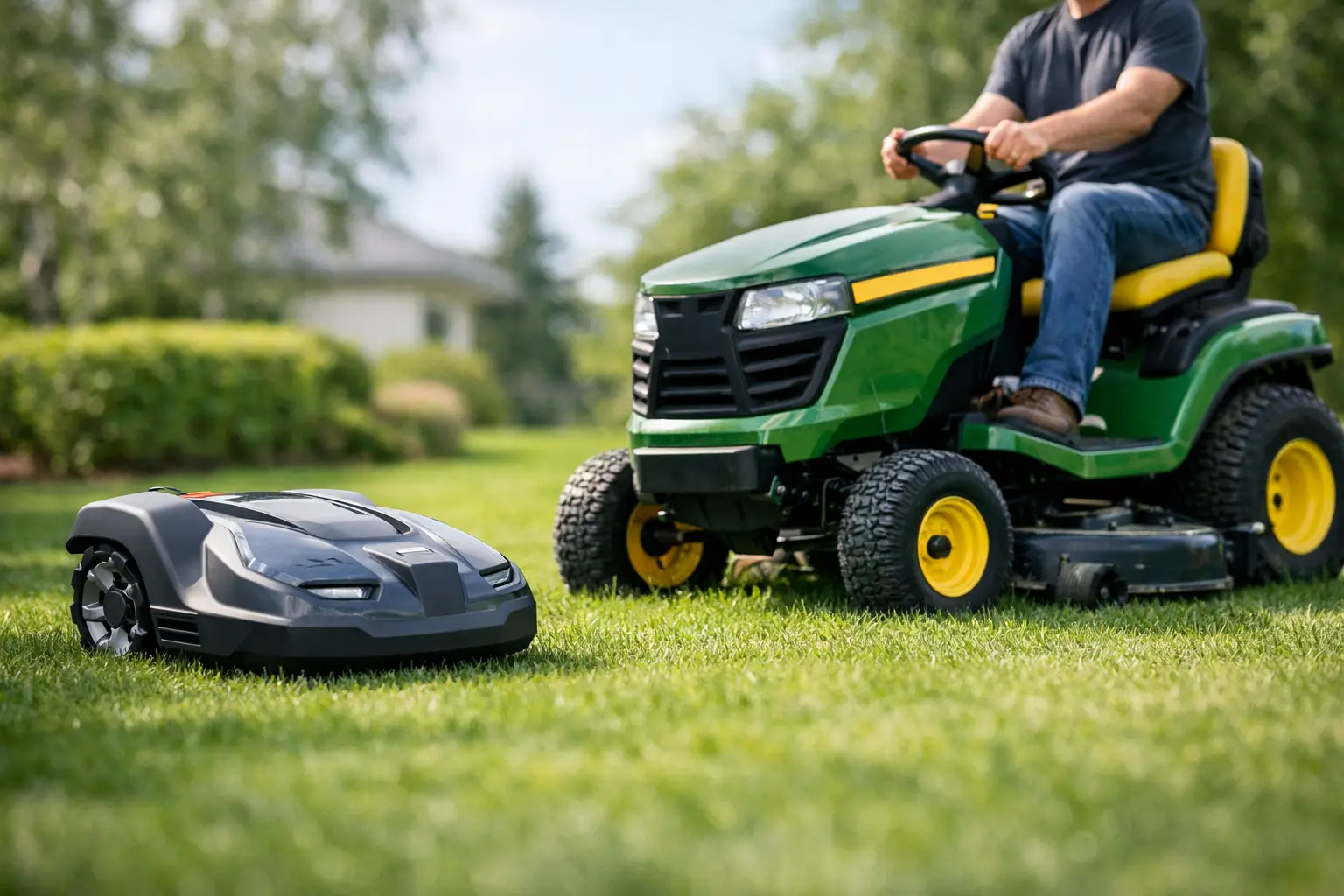
When labour gaps leave a fairway cut running late or a pitch needs presentation standards held through a busy fixture list, the question stops being theoretical. Robotic mower versus ride on becomes a live operational decision, with implications for labour planning, cut consistency, fuel use and the standard of finish your site can deliver every day.
For professional turf teams, this is not a simple old versus new debate. A ride-on mower remains a proven, high-output machine in many settings. But robotic mowing has moved well beyond novelty. On the right site, it changes how work is allocated, how often surfaces are cut and how reliably standards are maintained.
Robotic mower versus ride on for professional turf
The key difference is not just who sits in the seat. It is how the mowing operation is structured.
A ride-on mower concentrates output into staffed working hours. An operator, machine and fuel are assigned to a task, often on a fixed schedule, and the quality of the result depends on machine set-up, operator consistency, traffic patterns and available labour. That model is familiar and still effective, particularly where flexible one-off cutting, collection or heavy growth management is required.
A robotic mower works differently. It is designed to maintain turf through frequent autonomous cutting, following a controlled programme rather than periodic manual passes. That shift matters. Instead of chasing growth with larger cutting events, the site is maintained continuously, which tends to support a more even presentation and a steadier workload.
For golf courses, sports pitches and institutional grounds, the question is less about replacement in absolute terms and more about fit. Some areas are ideal for autonomy. Others still suit conventional machinery. The strongest outcomes usually come when managers assess each surface by labour demand, access, quality target and operational risk.
Where ride-on mowers still make sense
Ride-on mowers remain valuable because they are versatile. If you need to respond quickly to changing ground conditions, tackle heavier growth after weather disruption or move between varied areas without perimeter setup, a ride-on can be the practical choice.
They also suit sites where mowing is part of a broader operator-led routine. A grounds team may combine cutting with inspection, debris clearance, setup work or immediate corrective action. In those scenarios, the machine is only one part of the task, and keeping an experienced operator on the ground has clear value.
There is also the matter of one-pass productivity. Large ride-on units can cover significant acreage in a shift, especially on open ground. Where labour is available, and where the objective is periodic mowing rather than constant maintenance, that can still stack up well.
But ride-ons carry the cost profile most managers already know too well. Labour remains the biggest factor. Add fuel, servicing, wear parts and downtime risk, and the real cost is often higher than the purchase decision first suggests. The issue is not whether ride-ons work. It is whether they are the best use of skilled labour on surfaces that need repetitive, predictable cutting.
Why robotic mowing changes the calculation
Robotic mowing shifts mowing from a labour-intensive activity to a managed autonomous process. That has a direct impact on staffing pressure.
On many professional sites, the real advantage is not just lower manual mowing hours. It is the ability to redeploy skilled staff towards higher-value work – course setup, presentation detailing, renovation support, irrigation checks, line marking, divoting, disease monitoring and stakeholder-facing tasks. In a market where experienced turf staff are difficult to recruit and retain, that matters.
There is also the quality benefit of frequency. Robotic systems are built to mow little and often. On fine turf and intensively managed areas, that can support a more consistent visual finish and a steadier playing surface. Rather than seeing growth peaks between cuts, the surface stays under control.
That consistency is one of the strongest reasons professional operators consider autonomy. A ride-on may deliver excellent results in the hands of a strong operator, but the quality can vary with timing, staffing and route discipline. A properly deployed robotic mower delivers repeatable output according to programme.
For organisations focused on productivity, this is where the argument becomes commercially serious. A machine that works autonomously does not remove the need for management, planning or maintenance. It does reduce the dependence on finding available hours in the day for repetitive mowing tasks.
Labour and availability
This is often the deciding factor. If your team is stretched, robotic mowing offers more than convenience. It provides operational resilience.
A ride-on requires a competent operator every time the machine needs to cut. A robotic system requires site planning, setup and ongoing oversight, but not continuous labour input. That difference compounds over a season. On a golf site, sports venue or large institutional estate, the cumulative labour saving can be significant.
Cut quality and consistency
Ride-ons can produce an excellent finish, especially with the right cutting units and setup. But consistency depends on the operator, the schedule and whether conditions allow the task to be completed at the correct interval.
Robotic mowers are strongest where consistency over time matters most. Frequent cutting helps avoid the step changes in presentation that come from delayed mowing rounds. For premium and highly visible turf, that regularity is often a clear advantage.
Operating costs
Ride-on ownership is familiar, but not cheap. Fuel, servicing, operator time and depreciation all need to be counted properly. Robotic systems bring their own cost structure, including installation, maintenance and site-specific planning, but the savings in labour and daily operating input can change the long-term picture.
This is why procurement should not be based on sticker price alone. For professional operators, the relevant comparison is cost per maintained area over time, with labour fully accounted for.
The trade-offs professionals should assess
Autonomy is not a universal answer. It works best when the site suits it.
A robotic mower depends on a well-considered operating environment. Access routes, boundaries, obstacle density, slope profile, security and the required standard of finish all need evaluation. The more structured and repeatable the mowing task, the stronger the robotic case tends to be.
Ride-ons still hold the advantage in more reactive situations. If weather causes a surge in growth and the site needs aggressive catch-up work, a conventional machine may be better suited. The same applies where collection is essential, or where multiple different tasks must be completed in one pass by a trained operator.
There is also a mindset shift. Moving to autonomous mowing means managing a system rather than dispatching a machine. For progressive turf teams, that is a strength. For sites built around traditional routines, it may require adjustment in planning, staffing and expectations.
Which sites benefit most from robotic mowing?
The strongest fit is usually on sites with repeatable mowing demand, high presentation expectations and pressure on labour availability.
Golf facilities are a clear example. Fairways, surrounds, approaches and other defined areas can benefit from autonomous precision, especially where the objective is consistent daily presentation without adding recurring staff hours. Sports venues also stand out, particularly where pitch presentation, line integrity and dependable scheduling matter across a busy calendar.
Institutional and commercial grounds can see similar gains where large maintained areas need dependable mowing but do not justify constant operator time. In each case, the value comes from using labour where human judgement matters most, while repetitive cutting is handled autonomously.
This is where a specialist supplier such as GrassRobotics has a clear role. Professional buyers do not need consumer messaging. They need a solution that reflects surface type, site layout, performance standard and operational reality.
So, robotic mower versus ride on?
If your priority is flexible, operator-led mowing across varied tasks and changing conditions, a ride-on still has an important place. If your priority is labour reduction, consistent cut frequency and a more productive use of skilled staff, robotic mowing is often the stronger long-term decision.
For many professional sites, the answer is not either-or across the whole estate. It is matching the right mowing method to the right surface. High-frequency, repeatable areas are where robotics can transform productivity. Reactive, heavy-growth or multi-purpose tasks may remain better suited to ride-on equipment.
The most effective buying decisions come from looking beyond machinery categories and focusing on outcomes – better turf consistency, lower labour dependence and a mowing operation that is easier to sustain season after season.
If your team is spending too many skilled hours simply keeping up with the cut, that is usually the point at which autonomy stops looking like a future option and starts looking like the practical next step.