
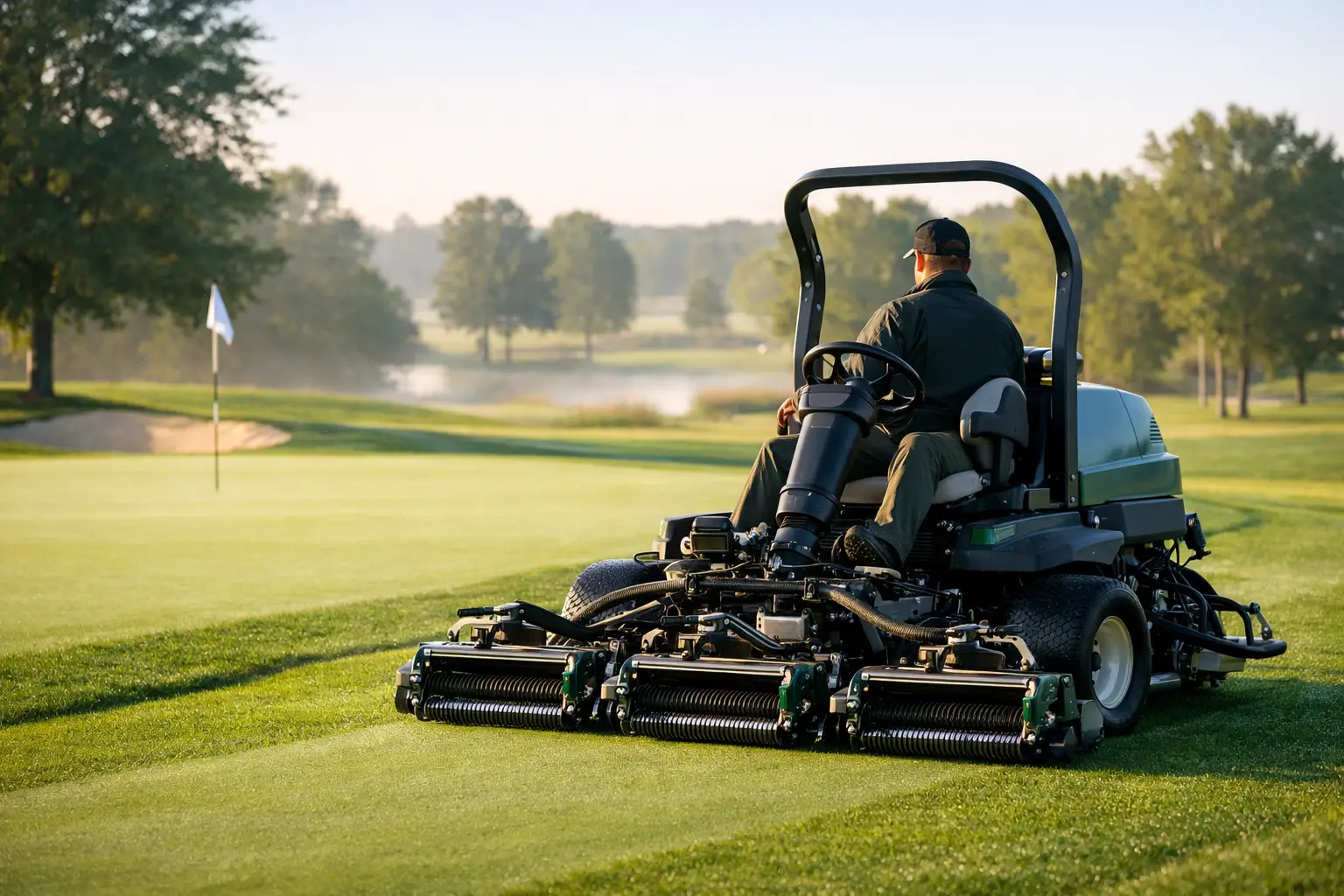
A poor cut on a green shows up immediately. Ball roll changes, presentation drops, and the maintenance team ends up spending time correcting an issue that should never have reached the surface. That is why choosing the right commercial greens mower is less about buying another machine and more about protecting consistency across a high-standard operation.
For golf and fine turf professionals, the question is not simply whether a mower can cut low. Most can. The real question is whether it can deliver repeatable quality of cut, reliable productivity and practical labour savings without creating new weaknesses elsewhere in the maintenance programme. On greens, small variations matter, and equipment decisions are felt quickly.
What a commercial greens mower needs to do
A commercial greens mower works in a narrow margin for error. It has to produce a clean, even cut at very low heights while handling daily use, changing conditions and demanding presentation standards. In practice, that means quality of cut is only the starting point.
The machine also needs to fit the way the site operates. On one facility, the priority may be early morning productivity across multiple greens before play. On another, it may be reducing dependency on experienced labour that is increasingly difficult to recruit and retain. For some venues, noise reduction, repeatable line quality and the ability to maintain cutting frequency without stretching staff are just as important as the clip itself.
This is where buyers often separate into two groups. One group is replacing a familiar pedestrian or ride-on setup and wants a direct performance comparison. The other is looking at automation seriously, not as a novelty, but as a way to stabilise standards and free skilled staff for more valuable work.
Commercial greens mower options: conventional or autonomous?
The traditional route is well understood. Pedestrian cylinder mowers and ride-on greens mowers have set the benchmark for years because they offer established cutting performance and a maintenance model most teams already know. If the site has dependable labour, clear servicing routines and no pressure to change workflow, conventional equipment can still make sense.
The challenge is that many operations no longer have that luxury. Labour is tighter, wages are higher, and experienced operators are not always available when needed. A conventional machine may still cut well, but if it relies on the right person being available every morning, the overall system is less resilient than it used to be.
That is why the autonomous commercial greens mower has become a serious consideration in professional turf care. The value is not only that it cuts without an onboard operator. The larger gain is consistency. Autonomous mowing can reduce variation between operators, maintain scheduled cutting frequency and release staff from repetitive mowing tasks so they can focus on set-up, detail work, presentation and agronomic priorities.
That does not mean autonomy suits every site in the same way. Greens with complex access routes, mixed traffic patterns or highly variable daily use may need a more tailored deployment plan. But for many golf and sports environments, robotic mowing is now a practical operational upgrade rather than a future concept.
The buying criteria that matter most
Quality of cut still sits at the top. On greens, there is no room to compromise. Buyers should look beyond headline specifications and consider how consistently the machine will perform across real working conditions, including moisture variation, turning patterns and day-to-day repeatability.
Productivity comes next, but it should be measured properly. A mower is not productive simply because it has a wide working width or high travel speed. True productivity is about how much high-standard mowing it completes within the available maintenance window, with the least disruption to labour planning. If a machine is quick on paper but requires more supervision, transport time or corrective work afterwards, the gain may be smaller than expected.
Reliability is equally commercial. Downtime on greens is expensive because it creates immediate pressure on staff and standards. Professional buyers should think carefully about supportability, service requirements and whether the mower is designed for routine use in a demanding turf environment rather than occasional fine-turf work.
Then there is labour efficiency. This is often treated as a secondary benefit, but for many sites it is now central. If a commercial greens mower can remove routine hours from the weekly schedule without sacrificing presentation, it has a measurable effect on staffing flexibility and operating cost.
Why automation is changing greens maintenance
The strongest case for automation is not theoretical. It sits in daily operations. Greens teams are being asked to maintain premium presentation with leaner labour and tighter budgets. At the same time, expectations around consistency have not softened. If anything, they have risen.
An autonomous greens mower addresses that pressure directly. It can maintain repeatable cutting patterns, operate to a defined schedule and reduce the reliance on manual operator availability. For head greenkeepers and course managers, that changes the labour conversation. Instead of assigning skilled staff to repetitive cutting every cycle, those hours can move into bunker work, detail presentation, moisture management and event preparation.
There is also a quality control advantage. Human operators vary. Even very good operators produce slightly different outcomes based on fatigue, pace and judgement in changing conditions. Autonomous systems, when correctly deployed, are built around repeatable paths and disciplined performance. On a surface where uniformity matters, that consistency has real value.
Of course, it depends on the site. Automation works best when the mower, the area and the operating plan are aligned. Greens with severe complexity or unusual access restrictions may require more planning than a straightforward setup. But that is a deployment question, not a reason to dismiss the category.
Where a commercial greens mower can underperform
Not every issue is the machine’s fault. Many disappointing mower purchases happen because the buyer focused on one metric and ignored the wider operating environment.
For example, a mower may promise excellent finish quality, but if it is awkward to move between greens or too dependent on operator skill, the practical output may fall short. Equally, a robotic system may offer clear labour benefits, but if the site has not considered charging, routing, supervision protocols or seasonal workflow, the return can be delayed.
Another common problem is buying for peak conditions only. A machine that looks ideal in dry summer presentation may be less effective when surfaces are softer or the maintenance team is stretched. Professional buyers should assess year-round fit, not just best-case performance.
Matching the mower to the facility
A single eighteen-hole course, a multi-course venue and a sports facility with formal fine turf each present different demands. The right commercial greens mower for one may be the wrong choice for another.
On a high-end golf site, precision and presentation may justify a more specialised setup, especially where greens speed and visual finish are under constant scrutiny. On a busy commercial venue, the stronger priority may be dependable output with lower labour input across the whole week. For contractors, transport, setup time and operational simplicity can carry more weight because machine downtime affects multiple client sites.
This is why solution-led selection matters. The mower should be judged against the facility’s actual maintenance model, not against generic product claims. GrassRobotics positions robotic mowing in exactly that way – as a practical fit for professional environments that need autonomous precision and stronger labour efficiency, not as technology for its own sake.
Questions worth asking before you buy
Before committing, it is worth being direct about what problem the machine is supposed to solve. Is the issue cut quality, labour availability, output, operator consistency or a combination of all four? That answer should shape the shortlist.
It is also worth asking how success will be measured after purchase. If the target is fewer labour hours on routine mowing, that should be quantified. If the target is a more consistent finish across all greens, there should be a clear standard to compare against. Equipment decisions are easier to justify when the operational outcome is defined at the start.
Finally, consider how the mower fits the wider direction of the site. If the business is already moving towards smarter, more autonomous turf operations, buying another purely conventional machine may solve today’s issue while delaying tomorrow’s progress.
The best commercial greens mower is the one that keeps standards high when labour is tight, schedules are full and expectations stay uncompromising. If a machine can deliver that with consistency, it earns its place quickly.