
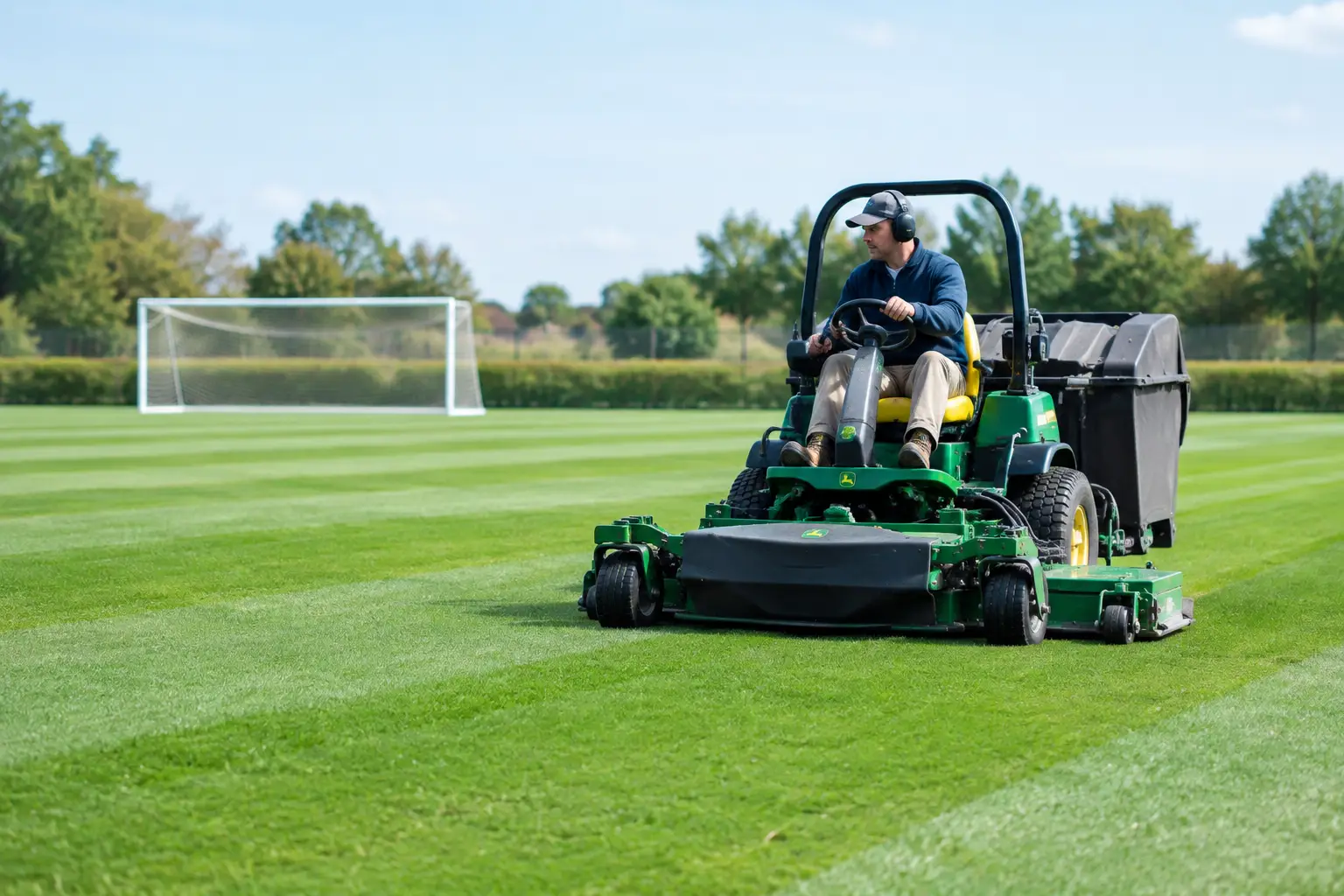
A playing surface can look immaculate at 8am and still perform poorly by the first fixture if the mowing programme is wrong. Knowing how to mow sports surfaces is not simply a matter of cutting to a set height. It is about managing leaf removal, plant recovery, surface firmness and presentation around the demands of each sport.
For professional grounds teams, mowing is one of the most frequent and visible operations on site. Done well, it supports a denser sward, a truer ball roll and a surface that stands up to play. Done aggressively or inconsistently, it weakens the plant, opens the canopy and creates more work elsewhere in the maintenance programme.
Start with the surface, not the mower
There is no universal mowing height for sport. A cricket square, football pitch, rugby field and tennis court have different grass species, construction profiles, wear patterns and performance requirements. The correct target is the lowest sustainable height that delivers the required playing characteristics without putting the turf under unnecessary stress.
Fine turf surfaces often operate at lower heights because ball speed, smoothness and presentation are central to the game. Winter sports pitches need sufficient leaf area to recover from divoting, traffic and wet conditions. On a heavily used community pitch, maintaining plant health may be more valuable than chasing the finish expected at an elite venue.
Set mowing height according to the season as well as the sport. During active growth, a surface can generally tolerate closer and more frequent mowing. In drought, heat, shade, disease pressure or cold weather, raising the height slightly gives the plant more leaf area and resilience. The objective is consistent performance, not adherence to a number that suited conditions six weeks earlier.
How to mow sports surfaces without stressing turf
The one-third rule remains a sound operating principle: avoid removing more than one-third of the leaf blade in a single pass. It is not an absolute law, particularly where presentation work or event preparation calls for a planned change, but it is a reliable safeguard against scalping and growth shock.
Where a pitch has been allowed to grow on, reduce the height progressively over several cuts rather than dropping straight to the match height. This is particularly important after wet weather, staff shortages or a break in the playing calendar. Taking too much leaf at once leaves a pale, open surface that is less able to photosynthesise and recover.
Frequency matters as much as height. Frequent mowing at a modest removal rate encourages tillering and improves uniformity. In peak growth, this may mean mowing several times a week or, for intensively managed surfaces, daily. As growth slows, intervals can be extended, but the decision should be based on actual growth and clipping yield rather than a fixed weekly routine.
A disciplined approach also reduces the temptation to make one heavy corrective cut before a fixture. The best match-day finish is usually the result of consistent work in the preceding weeks.
Match the cutting system to the job
Cylinder mowing is the established choice where close, clean cutting and a refined finish are required. A well-set cylinder mower produces a scissor-like cut, making it particularly suited to fine turf, formal presentation areas and surfaces where ball roll is critical. Its quality depends on correct reel-to-bedknife adjustment, sharpness and stable height of cut.
Rotary mowing has a valuable place on longer grass sports areas, outfields, surrounds and lower-intensity pitches. It is generally more tolerant of variable conditions and can manage heavier growth effectively. However, it is less suited to very low cutting heights or applications where the finest finish is non-negotiable.
The mower should follow the surface requirement, not convenience. A football pitch may use a cylinder mower for regular presentation cuts, while a rotary machine supports rougher peripheral areas. Golf facilities often need several approaches across greens, tees, fairways and semi-rough. Treating every hectare as if it needs the same machine and standard is inefficient.
Keep the cut clean and the height true
Mowing quality is determined as much by maintenance as by machine selection. Dull blades tear leaf tissue instead of cutting it cleanly. The result is frayed leaf tips, a grey or brown cast across the surface and greater vulnerability to moisture loss and disease. On fine turf, poor sharpness becomes visible quickly.
Check cutting units routinely for sharpness, bedknife contact, wear and contamination. Verify actual height of cut on a level surface rather than relying solely on the machine setting. Small inconsistencies become significant when mowing low or when multiple machines are used across one venue.
Rollers, tyres and cutting units must also be clean. Soil, wet clippings and debris can affect cut quality, spread unwanted material between areas and add avoidable weight to the machine. In wet conditions, even the correct mower can cause smearing, wheel marking or compaction if the surface is not carrying adequately.
Clippings require a practical decision. Returning light, dry clippings can recycle nutrients and avoid collection time, provided they disperse properly and do not smother the canopy. Collecting is more appropriate when growth is heavy, presentation is paramount, disease risk is elevated or clippings could interfere with play. The right choice changes with conditions.
Use mowing patterns to protect presentation and turf
Changing direction is not only about appearance. Repeated travel on the same line can create rutting, compaction and visible tracking, especially at turning points and along touchlines. Alternate mowing direction regularly, while keeping patterns appropriate to the sport and the venue’s presentation standards.
Striping is created by laying the grass in opposing directions with rollers, not by cutting alternate colours into the turf. It can deliver a strong visual finish, but it should not dictate the entire mowing programme. If persistent striping concentrates traffic or forces turns in vulnerable areas, vary the approach.
On marked pitches, plan the sequence around line marking, irrigation and fixture preparation. Mowing before marking often gives cleaner lines and a more professional finish. Where robotic units are operating, routes, exclusion zones and scheduling should be set so that markings, goalmouths and high-wear areas receive the right attention without disrupting other maintenance tasks.
Time mowing around weather, use and recovery
Avoid mowing when leaf tissue is excessively wet unless operationally necessary. Wet mowing increases clumping, can reduce cut quality and may spread disease pathogens across the site. It also raises the risk of surface damage from machinery, particularly on fine or saturated profiles.
Equally, avoid close mowing during acute drought stress. A slightly higher height of cut can help shade the crown, retain moisture and preserve root function. This may be a modest adjustment, but across a large sports estate it can make the difference between a surface that holds through a dry spell and one that requires costly recovery.
Fixture schedules need to influence mowing decisions. Before play, the aim is a consistent, clean surface at the required height. After play, assess damage before sending machinery back out. Divoting, debris removal, irrigation and local repairs may take priority. Mowing a damaged, soft surface too soon can flatten loose material and make recovery harder.
Build autonomy into the mowing programme
Autonomous mowing is most effective when it is treated as part of a planned turf-care system, not as a substitute for judgement. Regular, light autonomous mowing can maintain a consistent height, reduce clipping volume and free skilled staff for tasks that cannot be automated, such as pitch repairs, disease assessment, line marking and event preparation.
For large or labour-constrained sites, this changes the operating model. Rather than relying on a limited team to complete long mowing rounds within narrow daylight or weather windows, autonomous machines can undertake scheduled work across suitable areas with repeatable precision. The benefit is not simply fewer hours on a machine. It is a more reliable cadence of mowing.
There are boundaries. Complex surfaces, confined areas, steep banks, intensive renovation periods and wet conditions still require informed oversight. Every site should have clear operating zones, safety procedures, inspection routines and a defined response when ground conditions change. GrassRobotics systems are designed for professional environments where that control and consistency matter.
Measure results, then adjust
A mowing programme should be reviewed through surface outcomes, not just completed hours. Look at turf density, colour, clipping yield, ball response, striping consistency, recovery from wear and the frequency of corrective work. If a surface is thinning, scalping or showing uneven growth, the answer may be mowing frequency, height, machine set-up, nutrition, irrigation or all of these together.
Record heights of cut, mowing frequency, weather conditions and observations around key fixtures. Over time, this provides a practical site-specific reference that is far more useful than a generic mowing calendar. It also helps managers explain operational decisions to clients, committees and budget holders.
The strongest sports surfaces are rarely created by one perfect pre-match cut. They come from a mowing programme that respects the plant, reflects the sport and gives the grounds team enough consistency to focus on the details players notice.