
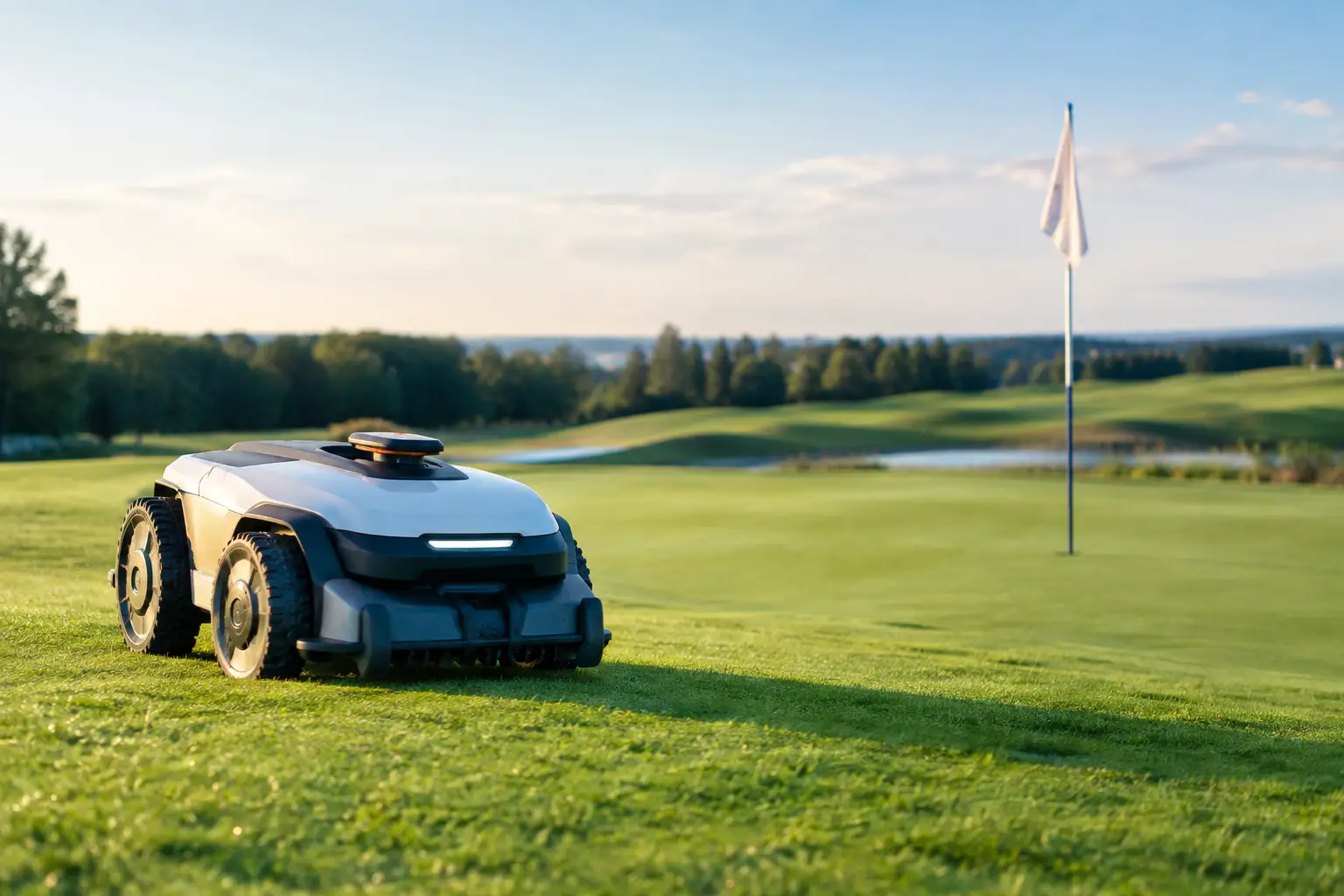
A course can lose valuable presentation time every morning to routine mowing. When skilled staff are needed on greens, bunkers, irrigation, disease pressure and tournament preparation, allocating them to repeat passes across fairways or rough is increasingly difficult to justify. That is why trends in golf course robotics are moving beyond the question of whether autonomous mowing works, towards where it delivers the greatest operational value.
For UK golf operations, the direction is clear: robotics is becoming a planned part of the maintenance programme, not a separate experiment. The strongest results come when machines, surfaces, staff responsibilities and cutting schedules are designed to work together.
Trends in golf course robotics: from single machines to planned fleets
The early adoption model was straightforward: deploy one robotic mower on a contained area and assess the finish. That remains a sensible starting point, but professional sites are now looking at connected fleets covering distinct mowing roles.
A fairway unit may maintain broad areas continuously, while a more precise robotic cylinder mower is assigned to tees, surrounds or formal presentation areas. Smaller machines can work in spaces that are inconvenient for larger equipment, including practice grounds, driving-range margins and selected amenity areas around the clubhouse. The objective is not to automate every square metre with one platform. It is to match the machine, cutting system and duty cycle to the surface.
This approach also creates resilience. If one unit is offline for service, the wider programme does not stop. It can be reallocated while the team retains access to conventional equipment for recovery work, seasonal peaks and specialist tasks. For most courses, a phased fleet is more practical than a wholesale replacement of existing machinery.
Surface-specific cutting quality is becoming the deciding factor
Golf courses do not manage one type of grass at one height. Greens, tees, approaches, fairways, semi-rough and rough each place different demands on cutting quality, frequency and clippings management. As a result, buyers are moving away from general claims about automation and asking more useful questions: What finish is required here? How often should the area be cut? What happens to clippings? Can the machine operate without disrupting play?
Rotary robotic mowers are well suited to high-frequency maintenance across larger areas where a consistent, fine finish is required without committing an operator to hours of repetitive work. Cylinder technology has particular relevance where a clean, presentation-led cut and close control of the playing surface are required. The right specification depends on grass species, season, site expectations and the course’s existing cultural programme.
More frequent light cutting can support a more even appearance and reduce the visible step between mowing days. It does not remove the need for agronomic judgement. Growth rates still change with temperature, moisture, fertility and shade. Robotics provides consistent execution, while the greenkeeping team remains responsible for the standards and decisions behind it.
Labour pressure is driving workflow redesign
Recruiting and retaining experienced greenkeeping staff remains a significant issue across the sector. Robotics is not a substitute for a capable course team, nor should it be positioned that way. Its value is in removing routine, repeatable mowing from the daily workload so skilled people can focus on work that directly protects turf health and playing quality.
That may mean more time for hand mowing and detail work ahead of competitions, irrigation checks, aeration planning, machinery care, bunker presentation or disease monitoring. It may also give a smaller team a more realistic way to maintain a large estate without allowing lower-priority areas to fall behind.
The operational gain is most noticeable when schedules are rebuilt around autonomous work. Simply adding a robot while keeping every existing mowing route and staffing pattern unchanged can limit the return. Course managers should identify the hours spent on repeat passes, the windows in which machines can operate safely, and the jobs that would benefit from recovered labour.
Night and low-traffic operation need careful planning
Autonomous mowers can extend the effective working day, particularly on fairways, out-of-play areas and practice facilities. Yet overnight operation is not automatically the best choice for every site. Noise, wildlife, security, dew conditions, public access and course layout all need consideration.
Many courses gain more from daytime operation in defined low-traffic windows, with machines returning to charge outside those periods. Others will prioritise early-morning or overnight routes to present fairways before play begins. The correct programme depends on tee-time density, staff cover and the areas being maintained.
Autonomy should reduce conflict with golfers, not create it. Clear zoning, sensible operating times and reliable stop or avoidance features are central to successful deployment.
Boundary-free navigation and site mapping are advancing
Navigation technology is one of the most closely watched developments in professional turf robotics. Traditional boundary-wire systems remain effective for many applications, especially where working areas are stable and clearly defined. However, satellite-guided and virtual-boundary systems are expanding the options for larger or more complex sites.
The attraction is obvious: mapped working zones can be adjusted without physically relocating wire, allowing managers to respond to course alterations, temporary exclusions or seasonal priorities. On a golf course, that flexibility can be useful around competition setups, renovation work, winter routes and changing practice-ground layouts.
There are trade-offs. Tree cover, steep banks, narrow corridors, buildings and variable signal conditions can affect the suitability of any navigation method. A site survey should assess the actual operating environment rather than assuming that the newest navigation format is automatically the best fit. Reliable positioning, safe return routes and practical charging locations matter more than a specification sheet.
Data is becoming part of machinery management
A professional robotic mower is increasingly a source of operational information as well as a cutting machine. Run time, charge status, working-area coverage, fault alerts and mowing history can help managers understand whether the planned programme is being delivered.
That visibility is valuable across dispersed sites and for contractors managing several locations. Instead of discovering a problem during a walk-round, the team can respond to an alert, adjust a schedule or investigate an area that has not received its expected cut. Records also help demonstrate that machinery time is being used effectively when budgeting and planning replacements.
Data should support judgement, not add administrative burden. The useful systems are those that make exceptions visible: a machine that has stopped, an area that has been missed, or a route that is taking longer than expected. The purpose is better control of turf operations, not another dashboard to monitor for its own sake.
Electric operation is changing the cost discussion
The move to battery-powered equipment is often discussed in terms of emissions and reduced fuel use. Those factors matter, particularly where clubs are setting environmental targets or need quieter machinery near residential boundaries. But for course managers, the financial case is usually broader.
Electric robotic mowing can reduce routine fuel handling, daily operator time and wear associated with long mowing shifts. It may also provide more predictable cutting availability when labour is limited. The investment case must still account for purchase cost, installation, charging infrastructure, servicing, blade or cylinder maintenance, insurance and any site preparation.
Payback varies sharply between courses. A compact members’ club with modest mowing demand will assess the numbers differently from a high-volume venue with multiple 18-hole courses, extensive practice facilities or a lean maintenance team. The best assessment compares the full operational cost of the current mowing programme, not only the price of fuel against electricity.
The next step is integrated turf-care planning
The most significant trend is not a single sensor, battery or navigation system. It is the shift towards treating autonomous machinery as part of the course’s wider turf-care plan. Mowing height, frequency, irrigation, growth management, play patterns and staff allocation all affect the outcome.
Before investing, a course should define the surfaces it wants to automate first, the finish required on each one and the labour hours it expects to recover. A practical demonstration on the intended area is more valuable than a generic comparison, particularly where slopes, trees, crossing points or irregular boundaries are involved.
GrassRobotics works with professional operators who need that conversation to start with the course rather than the machine. The right autonomous solution should fit the maintenance programme, protect presentation standards and give the team more time where expertise makes the greatest difference.
The courses that benefit most will not be those that automate fastest. They will be the ones that deploy robotics with clear surface objectives, realistic operating rules and a plan for putting recovered labour back into better turf care.