
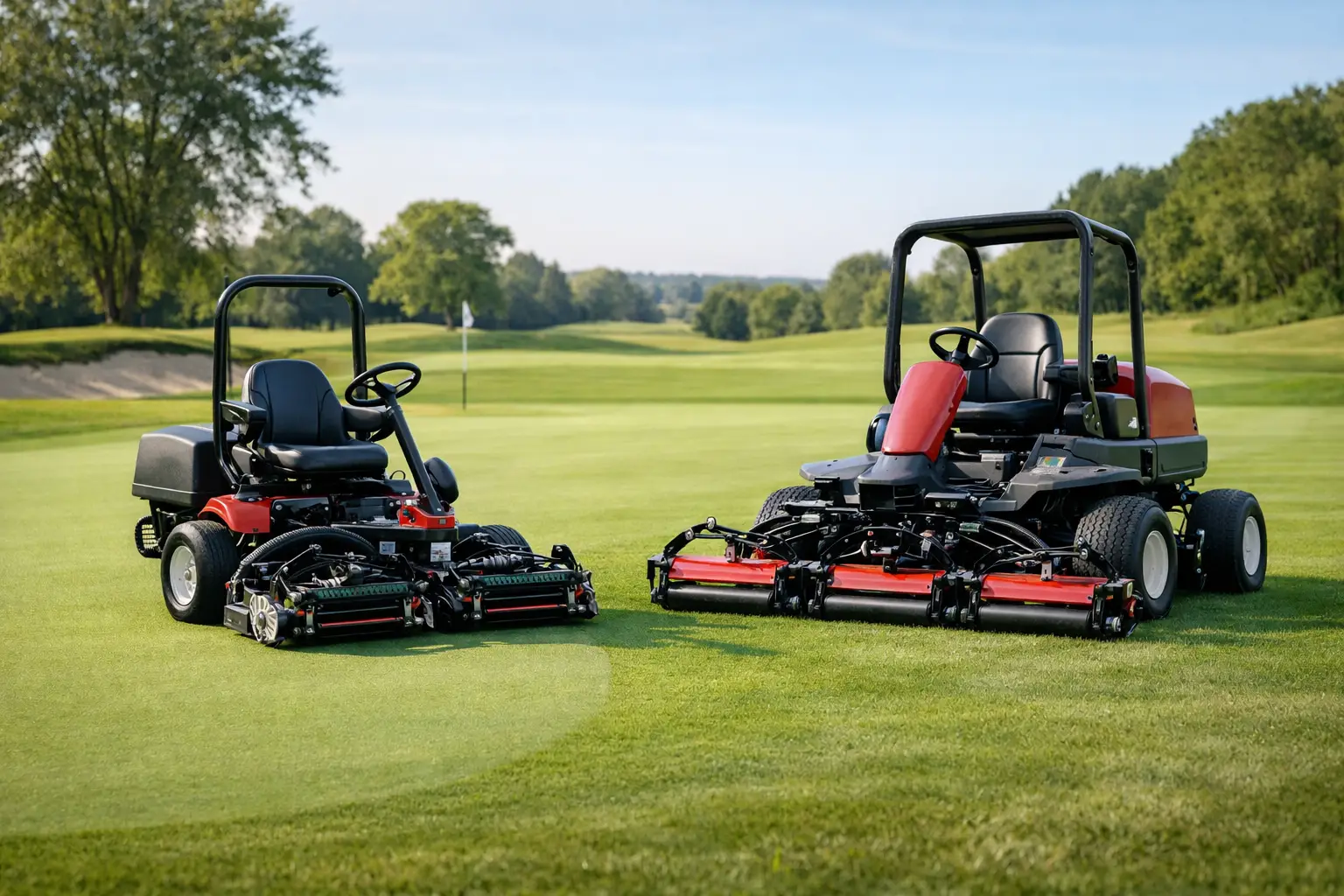
A greens mower vs fairway mower decision is not simply a question of cutting grass shorter or longer. It determines how consistently a surface plays, how efficiently staff time is used and how well the turf tolerates daily traffic. On a golf course, the wrong machine in the wrong area can compromise presentation, plant health and the pace of the morning operation.
Greens and fairways demand different outcomes. A green must be true, uniform and closely controlled at a very low height of cut. A fairway must provide a clean, consistent lie across a much larger area while retaining enough leaf to protect turf health and recover from wear. The equipment should reflect those fundamentally different jobs.
Greens mower vs fairway mower: the practical difference
The primary difference is height of cut. Greens mowers are designed for exceptionally close mowing, commonly in the low millimetre range depending on grass species, season, green speed targets and maintenance programme. They use finely set cutting units to deliver a smooth finish without excessive scalping or bruising.
Fairway mowers operate at a higher height of cut. Their purpose is not to create putting-surface smoothness but to maintain a uniform, playable expanse of turf at pace. They must cover substantial acreage efficiently, follow ground contours and maintain a reliable finish over variable density, moisture and surface firmness.
That distinction affects nearly every aspect of machine selection: cutting-unit configuration, number of reels or decks, ground-following ability, clipping capacity, transport arrangements and daily operating pattern. A fairway machine may be capable of cutting low grass, but it is not a substitute for a dedicated greens unit. Equally, using greens equipment to cover broad fairway areas is neither productive nor commercially sensible.
Cut quality is defined by the surface
On greens, the expectation is exacting. The mower must produce a clean cut across fine turf maintained at close height, with minimal disturbance to the surface. Reel-to-bedknife set-up, sharpness, clip rate and consistent contact all matter. Small variations can show immediately as streaking, uneven colour, torn leaf tips or a change in ball roll.
Greens mowers are therefore built around precision. Walk-behind and ride-on configurations are common, with cutting units engineered to follow subtle undulations. Many greenkeeping teams alternate mowing direction to limit grain and maintain a refined appearance. Collection is also a central part of the operation, as clippings left on a putting surface can affect presentation and play.
Fairways call for a different balance. Operators need an even visual finish and a predictable ball lie, but they also need output. The machine has to cut effectively across large areas without creating pronounced striping, scalping crests or losing consistency through hollows. Independent, contour-following cutting units are valuable where fairways have changing levels, drainage features and traffic-worn approaches.
A higher fairway height of cut also provides a margin of protection. It supports photosynthesis, helps the plant manage stress and reduces the risk of exposing weak turf during dry periods. Cutting too low with unsuitable equipment may look tidy briefly, but it can leave the surface thin, stressed and more vulnerable to weed ingress and disease pressure.
Productivity changes the equipment calculation
A greens mower is a specialist finishing machine. Its work area is relatively small, but the standard required is high and the operation may be repeated daily during the main playing season. Efficiency comes from dependable set-up, clean collection, quick movement between greens and a consistent result with limited rework.
A fairway mower is judged more heavily on hectares covered per hour. Large cutting widths, efficient routing and reduced non-productive travel make a significant difference to labour use. The goal is to complete the fairway programme within the available weather and staffing window without sacrificing the standard players expect.
This is where traditional equipment planning can create pressure. A team may have the correct mower types but still struggle to complete every task before play, particularly when staffing is reduced, weather interrupts the schedule or machinery requires attention. The question is no longer only which mower cuts best. It is also which mowing system delivers that quality reliably, day after day.
Why automation suits fairways and selected greens work
Autonomous mowing is particularly compelling where repeatable coverage and labour reduction are priorities. Fairways are often the strongest starting point because they combine large areas, recurring mowing requirements and a clear need for consistent presentation. A robotic mower can maintain defined working zones on a frequent schedule, reducing the pressure on operators to cover every hectare manually.
The benefit is not merely fewer hours in the seat. More frequent light mowing can improve visual consistency and avoid the heavy clipping loads associated with longer intervals. It also allows skilled staff to focus on tasks where professional judgement is most valuable, including moisture management, disease monitoring, hand finishing, bunker presentation and course set-up.
Greens require a more selective approach. Their low cutting heights, fine turf and high playing expectations mean that precision is non-negotiable. Purpose-built autonomous cylinder technology can support greens and closely managed areas where the equipment is designed specifically for that standard of finish. It should be assessed on cut quality, navigation accuracy, safety systems, collection or clipping management, and its ability to integrate with existing maintenance practices.
At GrassRobotics, the practical case for autonomy centres on matching the machine to the surface. Autonomous precision should extend the capability of the greenkeeping operation, not force a change in standards to suit the technology.
Cutting units and set-up matter as much as machine category
The label on the bonnet is only the first filter. A professional evaluation should consider the cutting system and the working conditions it will face. Cylinder mowing remains the benchmark for the clean, scissor-like cut associated with high-quality greens and closely maintained sports turf. Rotary systems can offer productive coverage in suitable fairway and rough applications, particularly where conditions are less formal or grass growth is more variable.
For greens, inspect reel condition, bedknife set-up, cutting frequency and the quality of after-cut appearance. A mower that appears acceptable from a distance may still be tearing leaf tissue or creating an inconsistent clip. For fairways, assess contour following, effective cutting width, overlap, traction and the quality of finish at the intended ground speed.
Seasonal conditions also change the answer. During strong growth, fairways may need more frequent mowing to prevent clumping and maintain a uniform appearance. In dry weather, a conservative height and careful timing may protect stressed turf. On greens, growth regulation, irrigation, topdressing and rolling all interact with the mowing programme. No mower choice should be made in isolation from the wider agronomy plan.
Selecting the right mowing strategy
Start with the playing standard required for each area, then work back to the machinery and operating model. Greens need precision first, with productivity achieved through reliable routines and equipment designed for close, fine turf. Fairways need productive coverage first, with cutting quality sufficient to support a clean presentation and consistent lie.
For courses considering robotics, map the areas that consume the most repeatable labour. Identify where autonomous mowing can operate safely, frequently and with a clear quality advantage. Fairways, practice grounds, surrounds, tee banks and selected sports surfaces can all offer opportunities, but each zone needs its own specification for cut height, access, slopes, obstacles and finishing expectation.
It also pays to define what remains manual. A robotic programme can reduce routine mowing load, but it does not remove the need for skilled turf inspection or detailed presentation work. The strongest model combines autonomous consistency with experienced staff making informed decisions where conditions demand intervention.
The best choice is rarely a single machine for every hectare. It is a mowing system in which greens equipment protects the standard of the putting surface, fairway equipment delivers efficient scale, and automation gives the maintenance team more control over time, labour and consistency.