
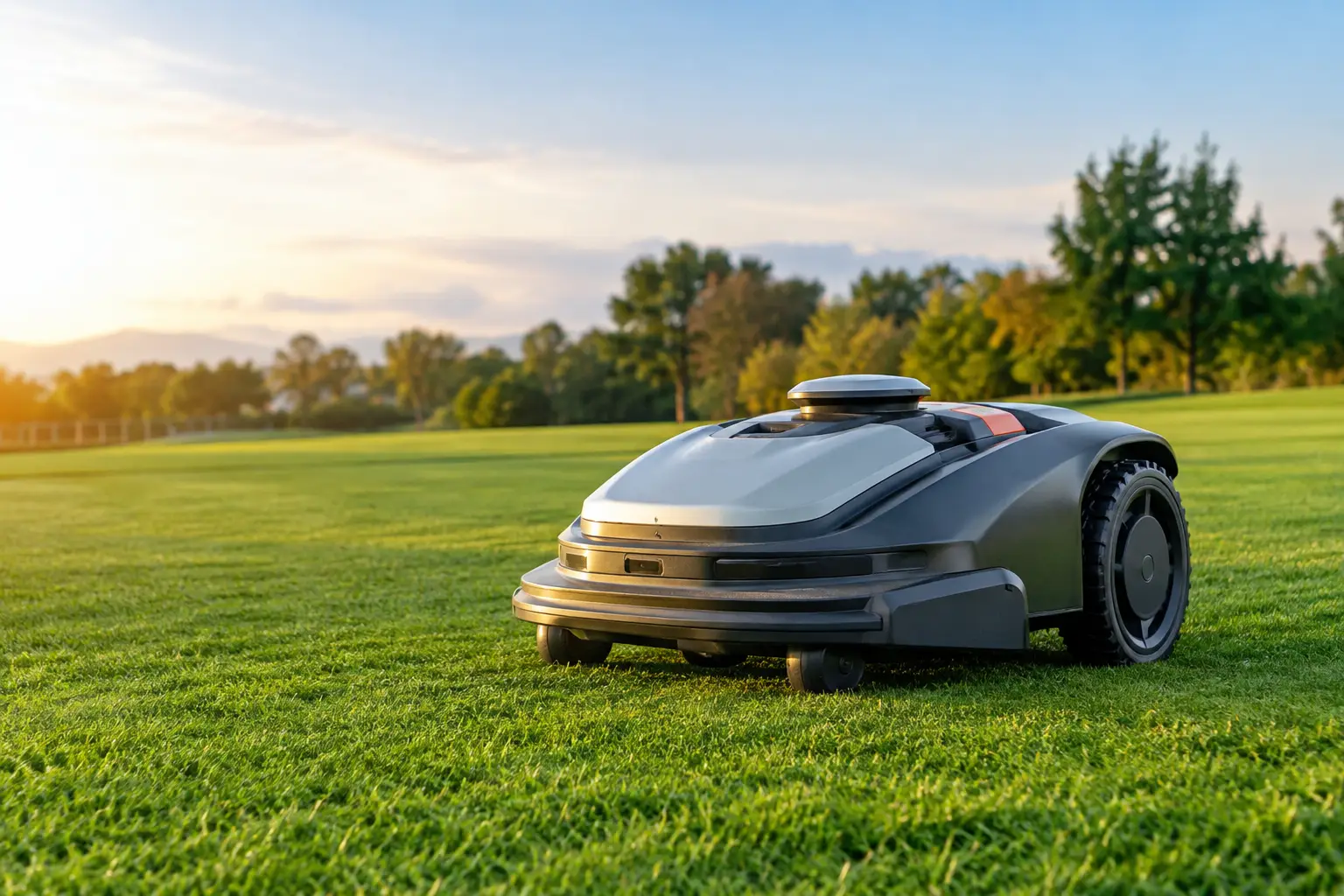
A missed mowing window is rarely caused by a lack of grass-cutting equipment. More often, it is caused by a shortage of available operators, competing tasks or weather narrowing the working day. The best autonomous grounds equipment gives professional teams another dependable route to consistent presentation, keeping routine cutting moving while skilled staff focus on the work that demands their judgement.
For golf courses, sports facilities and large managed estates, autonomy is not a substitute for a turf programme. It is equipment that supports one. The right machine must match the surface, mowing frequency, finish standard, operating conditions and daily workflow of the site.
What makes the best autonomous grounds equipment?
The best autonomous grounds equipment is not necessarily the largest machine or the one with the longest stated run time. It is the equipment that repeatedly delivers the required cut without creating extra intervention, disruption or risk for the grounds team.
That starts with matching the mower to the area. A closely managed green, a striped stadium pitch, a fairway and a perimeter area may all be cut autonomously, but they do not need the same cutting system. Rotary mowing is well suited to many larger turf areas where frequent, efficient maintenance cutting is the priority. Cylinder technology is the natural choice where a finer, more precise presentation is required, particularly on greens and other closely mown surfaces.
Consistency matters as much as cutting capacity. Regular autonomous mowing removes small amounts of leaf little and often, helping maintain an even appearance and reducing the peaks in growth that can strain both the turf and the maintenance schedule. However, this only works when cutting height, route planning and machine capacity are specified for actual seasonal growth rather than ideal summer conditions.
Start with the surface, not the machine
A productive investment begins with a clear area-by-area assessment. Separate the site into zones based on turf type, expected finish and access requirements. This prevents the common mistake of asking one autonomous unit to perform every mowing task at every standard.
Greens, tee boxes and presentation areas
Fine turf requires exceptional cut quality and predictable operation. Here, the priority is a clean, accurate cut at a controlled height, with a machine that can work around the geometry and operational demands of the area. An autonomous cylinder mower can provide the frequency needed to protect presentation standards while reducing repetitive manual passes.
Golf greens also bring practical questions that should be resolved before deployment. How will the mower operate around golfers? When are maintenance windows available? Does the route account for slopes, collars, irrigation heads and changing hole locations? The answer is usually a managed operating plan, not simply allowing a machine to run without supervision.
Fairways and larger golf areas
Fairways reward capacity, efficient coverage and dependable navigation. Autonomous rotary mowers can take on routine cutting across substantial areas, releasing staff for bunker work, course set-up, irrigation checks and detailed presentation tasks. The operational gain is particularly strong where labour is limited and mowing rounds consume a large part of the day.
The best option depends on acreage, terrain, fleet size and desired mowing frequency. A single high-capacity unit may suit a defined area, while several machines can create useful redundancy across a larger course. If one unit is temporarily unavailable, the overall programme does not stop.
Sports pitches and marked playing surfaces
Sports turf managers need more than an even cut. They need accurate boundaries, predictable movement and equipment that works around bookings, training schedules and match preparation. Autonomous machines can maintain regular mowing on pitches and surrounding areas, but line-marking, renovation and final pre-match preparation remain skilled tasks.
For marked surfaces, look closely at positioning accuracy and route repeatability. The ability to define working zones and exclusion areas is fundamental. A mower should operate where it is intended to operate, avoid sensitive areas and fit around the site’s event calendar.
Navigation and safety are operational decisions
Autonomous mowing only delivers labour savings if it does not create a new supervision burden. Navigation should therefore be considered in the context of the whole site: tree cover, changing light, slopes, narrow access points, buildings, public routes and areas with intermittent use.
Satellite-guided and boundary-wire approaches each have a place. Wire-free systems can offer flexibility where layouts change or installation disruption needs to be kept low. Boundary-wire systems can be effective in fixed, clearly defined areas. Neither is automatically better. The right choice is the one that holds its operating area reliably through the conditions present on site.
Safety features also need to be evaluated as part of daily operations, not as a tick-box exercise. Consider obstacle detection, emergency stopping, lift and tilt sensing, access control, alerts and the ability to pause or redirect equipment when the site becomes active. A golf course at dawn, a school field after lessons and a public-facing park have very different operating environments.
Measure productivity beyond hectares per hour
Headline coverage figures are useful, but they do not tell the full story. Productive output is shaped by charging time, travel between zones, slope performance, wet-weather limitations, mowing speed and the number of times a member of staff must intervene.
Ask suppliers to model the proposed equipment around your real programme. That means the areas to be cut, the target frequency, growth peaks, work windows and any no-go periods. It should also include travel routes, docking locations and the time required for routine checks.
The strongest business case often comes from redeploying labour rather than removing it. Autonomous mowing can reduce repetitive cutting hours and help a smaller team maintain standards across more hectares. Those hours can move into agronomy, repairs, tournament preparation, line marking, hand finishing and customer-facing work that cannot be automated effectively.
Choose equipment that fits the maintenance system
Every autonomous mower needs a maintenance plan. Blades or cutting reels wear, decks require cleaning, batteries need monitoring and software or navigation systems need periodic checks. Professional equipment should reduce routine labour, not imply that no care is required.
Before selecting a machine, establish who will carry out daily inspections, cleaning and scheduled service. Confirm how faults are reported, what local technical support is available and whether critical parts can be supplied promptly. Downtime during a peak growth period is more costly than it appears if the mowing programme then has to be recovered manually.
It is also worth considering fleet standardisation. A site may benefit from a combination of machines, but too many unrelated platforms can complicate training, parts holding and daily management. A focused fleet of equipment suited to greens, fairways and larger amenity areas is often easier to operate at scale.
Compare the right machine categories
Professional sites should compare autonomous grounds equipment by application rather than by consumer-style feature lists. The central question is simple: what surface will the machine maintain, and what standard must it achieve?
For fine-cut golf surfaces, a robotic cylinder mower such as the RCM01 or GM22S Greens Mower is designed around presentation-led cutting. For extensive fairways and general managed grass, high-capacity units such as the RM21, Titan Robotic Mower or FRX Robotic Mower may better suit routine coverage and labour reduction.
These categories should not be treated as interchangeable. A machine that is excellent on broad, open fairway will not automatically be the correct choice for a closely managed green. Equally, specifying premium fine-turf cutting technology for low-priority rough can add cost without improving the outcome that matters.
Plan deployment before purchase
Autonomous mowing performs best when introduced through a structured deployment process. Begin with a representative area where the team can validate cut quality, operating hours, navigation and interaction with normal site activity. This allows settings and schedules to be refined before expanding the programme.
Involve the people who will work alongside the equipment from the outset. Head greenkeepers, mechanics, irrigation staff and operators will identify practical issues that may not be visible on a site plan, from a regularly used service gate to a wet corner that holds water after rain.
GrassRobotics approaches autonomous turf care as a professional maintenance solution, with equipment selected around the surfaces and outcomes a facility needs to protect. That is the right standard for any supplier conversation: clear application, measurable productivity and a support plan that keeps the fleet working.
The most effective autonomous mower is the one that becomes an accepted part of the daily routine. When it cuts the right areas at the right standard, staff can spend less time chasing the next mowing round and more time improving the surfaces people come to play on.