
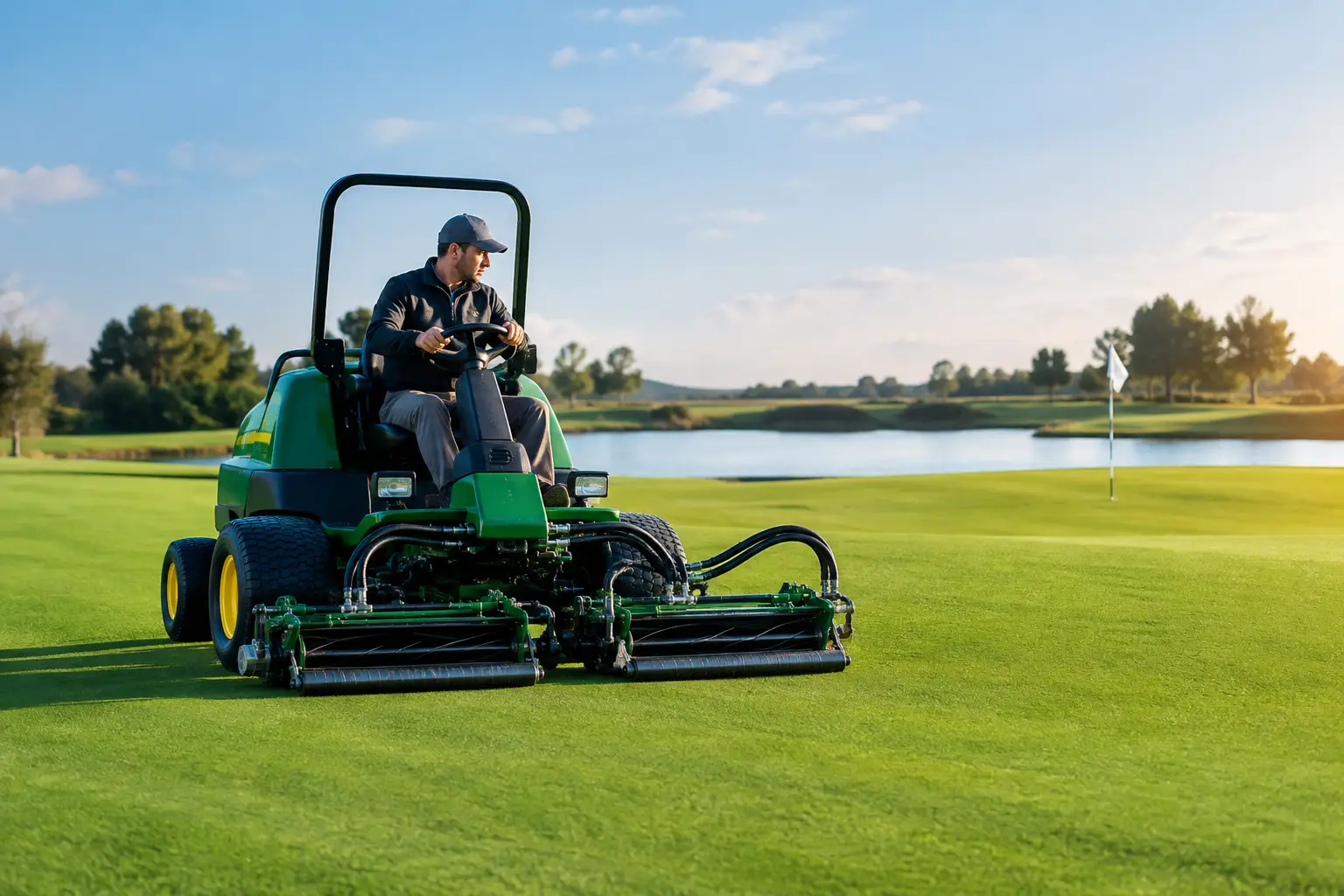
A mower that looks economical on a quotation can become expensive by mid-season if it cannot work the right areas, fit the maintenance routine or reduce the labour pressure it was bought to solve. Effective golf mower procurement starts with the course operation, not the machine specification. The question is not simply what to replace. It is which mowing tasks should be made more consistent, more productive and less dependent on available labour.
For most golf facilities, the strongest business case comes from assigning autonomous equipment to repeatable work across fairways, semi-rough, practice areas, tee surrounds or defined greens tasks. This releases skilled greenkeeping time for presentation, agronomy, setup and the detailed work that directly influences playing quality.
Start golf mower procurement with the mowing plan
Before comparing models, map the current cutting programme. Record the areas cut, their frequency, grass type, target height, slopes, travel routes and the time required from setup to clean-down. Include the labour needed to transport machines, refuel or charge them, inspect cut quality and respond to weather disruption.
This establishes the real workload. A fairway may appear straightforward in hectares, yet contain narrow corridors, mature trees, bunkers, bridges, water hazards and public access points that change the practical mowing requirement. Equally, a small practice ground can be a high-value automation opportunity if it demands frequent cuts and regularly pulls a team member away from priority tasks.
Separate areas by finish and operational risk. Greens, approaches, tees, fairways and rough do not need the same cutting system, frequency or level of supervision. Procurement becomes more precise when each surface is considered on its own merits, then assessed as part of an integrated fleet.
Define the outcome before the specification
A specification should state the result required, not merely repeat familiar machine features. For example, a course may need autonomous mowing that maintains fairway presentation six days a week while removing a set number of manual mowing hours. Another may need precise cylinder cutting for greens where finish and consistency outweigh total area covered.
Set measurable requirements around cut quality, operating window, area capacity, gradient, navigation accuracy, obstacle management and weather tolerance. Consider whether the mower must work during playing hours, in early morning windows or only when the course is quiet. These decisions affect the appropriate navigation system, safety configuration and supervision model.
Autonomous mowing is not a like-for-like replacement for every ride-on or pedestrian mower. It is most effective when the task is suitable for repeatable operation and the team has a clear plan for the hours it creates. If released labour simply shifts to another bottleneck, that can still be valuable, but it should be recognised in the business case.
Assess cutting technology by surface
Rotary and cylinder systems serve different purposes. A rotary robotic mower can provide frequent, low-impact maintenance across larger areas, supporting a consistently tidy appearance without the compaction and fuel use associated with repeated conventional passes. Cylinder mowing remains central where the highest quality finish, a specific height of cut and clean presentation are required.
The correct decision depends on the surface standard and the task. A greens mower must be judged on quality of cut, contour following and repeatability. A fairway machine must be judged on productive coverage, navigation confidence, reliability and its ability to operate without disrupting play. Buying the same technology for every area may simplify the purchase, but it can compromise results.
Build a realistic whole-life cost case
Purchase price matters, but it is only one part of the decision. Compare the total operating cost over the expected service life, including installation, training, scheduled maintenance, replacement consumables, energy, insurance, software or connectivity requirements and support provision.
Labour savings should be calculated carefully. Do not assume every autonomous operating hour becomes an immediate payroll saving. In many golf operations, the more realistic gain is labour redeployment. A head greenkeeper may use the recovered time to improve course setup, complete preventative maintenance, undertake detail work or cover absences without relying on overtime or contractors.
Fuel, transport and machine wear also deserve attention. Autonomous units can reduce routine vehicle movements and repeated passes in appropriate areas. However, charging locations, access routes and seasonal storage must be practical. A cheaper unit that demands frequent intervention, complicated relocation or poor access to its charging point will not deliver its projected value.
Consider productivity across the full week rather than only per hour. An autonomous mower that operates reliably outside the busiest staff periods may add more useful capacity than a faster machine that still requires an operator at the same time each morning.
Test site suitability, not just stated capacity
Manufacturer capacity figures are useful, but they are not a substitute for a site assessment. Real output is influenced by terrain, boundary complexity, grass growth, travel distance, charging cycles and the level of overlap needed to maintain presentation standards.
Walk proposed working areas with the supplier. Identify slopes, ditches, water margins, bunker edges, paths, overhanging branches, narrow entrances and locations where players, members or visitors may interact with the machine. Review mobile signal or other connectivity requirements across the full operating area, not only near the maintenance compound.
Navigation and boundary technology should be selected around the site. Some environments suit virtual boundaries and satellite-based positioning; others need a different approach due to tree cover, layout or the required accuracy. The important point is operational confidence. The machine must know where it can work, where it must not go and how it will respond when conditions change.
A demonstration should reflect normal course conditions wherever possible. Ask to see starts, stops, boundary behaviour, obstacle response, charging and return-to-work routines. A clean, open demonstration area rarely reveals the issues that matter on a mature golf course.
Make support part of the procurement decision
Professional robotic equipment is an operational asset. It needs dependable commissioning, clear staff training and a defined support route when an issue affects the mowing schedule. Evaluate the supplier as closely as the machine.
Ask who will install the system, set up work zones, train the team and provide seasonal adjustments. Establish expected response arrangements for technical faults, the availability of parts and whether remote diagnostics are available. Clarify which daily and weekly checks remain with the course team, as well as the servicing responsibilities required to protect machine performance.
GrassRobotics approaches this as a professional turf-care deployment rather than a consumer mower purchase. That distinction matters where machinery has to perform across demanding golf environments and fit an established maintenance programme.
Use a phased procurement approach
A staged rollout can reduce risk and improve adoption. Begin with an area where the task is repeatable, the access is straightforward and the labour demand is clear. Measure actual operating hours, interventions, cut quality and staff time released over a meaningful period.
The evidence from that first deployment should shape later purchases. It may show that a second unit on a different fairway provides the strongest return, or that precision cylinder automation on a high-profile area should be the next priority. It can also reveal practical changes needed in daily routines, such as where machines are cleaned, charged and inspected.
For larger sites, avoid procuring isolated machines without considering fleet management. Multiple autonomous units need coordinated operating zones, charging capacity, supervision and a simple process for exceptions. The goal is not to create another system for the team to manage. It is to build a more predictable mowing operation.
Questions to settle before placing an order
A procurement decision is usually ready to progress when the course can answer five practical questions:
- Which defined areas will the mower maintain, at what frequency and to what standard?
- What manual hours, vehicle use or contractor requirement will it remove or redeploy?
- How will it navigate, charge, return safely and remain secure on site?
- Who will commission, train, service and support the equipment throughout the season?
- What evidence will be used after installation to confirm the expected return?
These questions keep the conversation focused on performance rather than headline features. They also make it easier to present a credible case to owners, committees or finance teams.
The strongest golf mower procurement decisions give greenkeeping teams more control, not more complexity. Select the equipment around the course’s real mowing pressures, prove the site conditions and secure the support needed to keep machines productive. The result is a more consistent surface, a more resilient operation and more skilled time directed towards the course details players notice.