
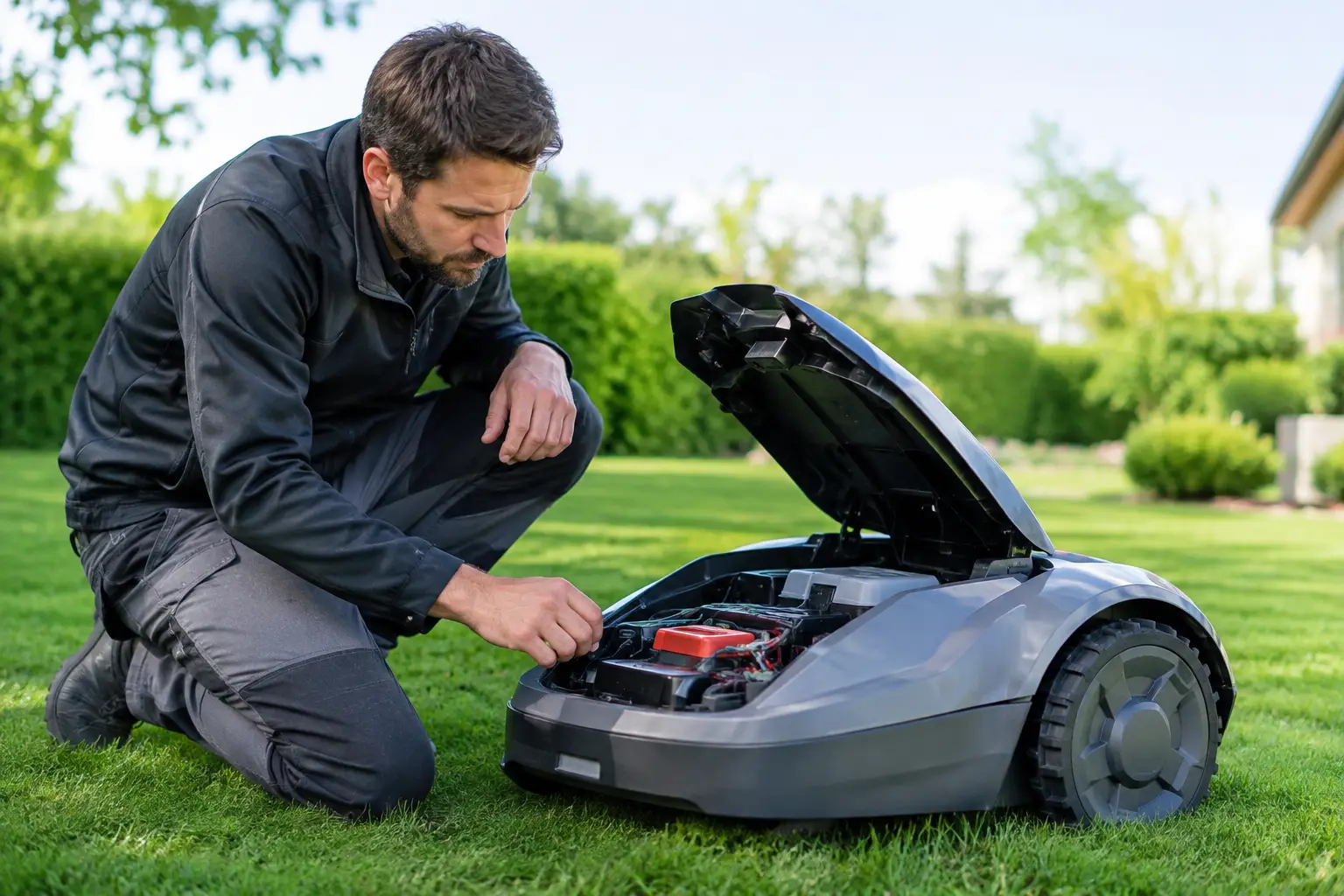
A robotic mower stopping halfway through a scheduled cut is not simply an equipment issue. On a golf course, sports pitch or high-profile estate, it can leave an inconsistent finish, interrupt labour planning and create avoidable pressure before play or an event. Most robot mower faults are traceable to a small number of operational causes – and the quickest fix starts with separating the symptom from the root cause.
Professional autonomous mowing systems are designed to work repeatedly within defined conditions. When those conditions change, whether through turf growth, surface contamination, a damaged reference system or poor charging performance, the machine is usually signalling a condition that needs attention rather than failing without reason.
Start with the fault pattern, not the error message
An on-screen alert is useful, but it rarely tells the full story. The same message can result from several conditions. A mower reporting a navigation or boundary issue, for example, may have encountered a genuine signal problem, a physical obstruction, a recent site alteration or a section of turf that has become unsuitable for reliable travel.
Before resetting the machine, record what it was doing when the fault occurred. Note the location, time, weather, battery level, cutting programme and whether the issue has happened in the same area before. This gives the grounds team a repeatable diagnostic picture rather than a one-off observation.
A useful first distinction is whether the fault is isolated or recurring. An isolated stoppage after heavy rain may point to short-term surface conditions. A repeat fault at the same point on a fairway, around a goalmouth or beside a bunker is more likely to indicate an installation, route or site-layout issue.
The robot mower faults that affect professional sites
Navigation, boundary and positioning errors
Autonomous mowers depend on accurate positioning and clearly managed working areas. Faults in this category often show up as hesitation, repeated turning, failure to enter a zone, loss of position or a machine stopping at the edge of its operating area.
Check first for physical changes around the route. New signage, temporary fencing, parked maintenance equipment, altered access paths and construction activity can all affect how a mower moves through a site. On sports grounds, seasonal changes such as pitch protection, temporary spectator infrastructure or revised line-marking access can have the same effect.
Where a system uses a boundary wire or reference infrastructure, inspect the affected section methodically. Damage from aeration, verti-draining, edging work, rodents or vehicle traffic may not be visible from the surface. Avoid treating repeated navigation alerts as a software issue until the physical installation has been ruled out.
For satellite-guided systems, consider the wider environment. Dense tree cover, buildings, grandstands and temporary structures can influence signal availability in specific locations. The answer may be a revised work area, altered route logic or a change to operational timing, rather than expecting the mower to perform identically across every part of a complex site.
Charging and battery-related stoppages
A mower that fails to complete its planned working time may be suffering from poor charging, excessive travel distance, higher-than-normal cutting load or battery deterioration. The charging station should be clean, stable and supplied correctly. Dirty contact points, poor alignment or debris around the docking area can prevent a full connection even when the mower appears to have returned normally.
Battery performance also has to be judged in context. Wet, dense spring growth, prolonged leaf contamination and steep or undulating ground all increase energy demand. If a machine is working harder to maintain cut quality, its daily productive area may reduce. This is not necessarily a fault, but it does require a programme that reflects actual conditions.
Compare current run time with the machine’s established performance under similar conditions. A gradual decline is more likely to be maintenance or battery related. A sudden change after an electrical event, impact or station relocation warrants a more focused inspection.
Cutting system and drive faults
Poor finish quality is often the first visible warning. Stragglers, torn leaf tips, missed strips or uneven height can indicate worn cutting components, grass build-up, reduced blade rotation or an unsuitable mowing schedule. On fine turf and closely managed surfaces, minor degradation can become apparent quickly.
Do not wait for a complete stoppage before inspecting the cutting system. Follow the manufacturer’s isolation procedure, then check for accumulated clippings, twine, wire, roots or other material around moving parts. Inspect blades, discs or cylinders for wear and damage, and confirm that replacement intervals match the workload rather than a calendar assumption.
Drive faults may present as wheel slip, poor traction, repeated recovery attempts or an inability to climb an area the machine previously handled. The cause may be mechanical, but it may equally be related to surface conditions. Dew, wet clippings, worn turf, compacted soil and slopes that become unstable in winter can all reduce dependable traction.
Obstacle detection and safety stoppages
Safety-related robot mower faults should never be bypassed to keep a schedule moving. If a machine repeatedly detects an obstacle where none is apparent, inspect the area for low-profile hazards, loose debris, ruts, exposed irrigation heads or changes in ground level. A mower can also respond to long grass, overhanging vegetation or poorly defined transitions between hard surfaces and turf.
If the machine has made contact with an object, inspect its bodywork, sensors, wheels and cutting area before returning it to service. Even a low-speed impact can affect alignment or create a condition that becomes a repeat fault later in the programme.
A practical diagnostic sequence for grounds teams
When a mower stops, the temptation is to restart it immediately. That can be appropriate after a clearly identified temporary obstruction, but repeated resets hide useful evidence. A controlled sequence protects uptime over the longer term.
First, make the machine safe and inspect the immediate area. Remove loose debris only where it is safe to do so and look for signs of wheel spin, impact, flooding or turf damage. Next, review the event record and compare it with the mower’s position on site. Then inspect the relevant operating system: charging, cutting, drive, navigation or safety detection.
Before releasing the mower again, confirm that the underlying condition has been addressed. A reset should verify a repair, not replace one. If the fault recurs, take the mower out of the rotation and escalate with the recorded details. Repeated unplanned recovery trips consume more staff time than a structured inspection and can undermine confidence in an otherwise well-designed autonomous operation.
For larger estates or multi-machine fleets, keep a simple fault log covering date, machine, location, alert, weather, action taken and outcome. It soon reveals patterns that are difficult to spot from individual call-outs. A particular wet hollow, charging bay or boundary transition may account for a disproportionate number of interventions.
Preventing faults through the mowing plan
The most effective maintenance is operational. Robotic mowers perform best when their working areas, cut frequency and access routes are designed around the turf operation rather than added as an afterthought.
Build routine checks into the weekly maintenance plan. Keep charging areas clear, inspect cutting components, remove debris from wheels and underside surfaces, and review any recurring alerts. During periods of rapid growth, increase attention to cut frequency and clipping build-up. During autumn, leaf management becomes part of mower reliability, not simply presentation.
Coordinate autonomous mowing with aeration, topdressing, irrigation repairs, spraying, event set-up and line-marking. These activities may temporarily change the surface or introduce obstacles that a mower cannot safely interpret. A clear handover between the robotic mowing operator and the wider grounds team prevents many avoidable stoppages.
It is also worth setting realistic expectations by area. A tightly presented green, a broad fairway, a training pitch perimeter and an uneven amenity space do not place the same demand on a machine. The right mower, programme and operating boundary depend on the surface, target finish and access constraints. Precision comes from matching the system to the task.
When a fault needs specialist support
Escalate early where there is evidence of electrical damage, repeated charging failure, persistent safety-system alerts, unexplained loss of positioning or a recurring mechanical issue. Continuing to operate with an unresolved fault can turn a minor adjustment into component damage, lost mowing capacity or turf marking.
For professional sites, support should be based on operational evidence. Provide the fault message, photographs where relevant, the precise location, recent site changes and details of what has already been checked. This allows a supplier or service technician to diagnose the issue faster and recommend a corrective action that suits the mowing system and the site.
At GrassRobotics, the objective is not merely to keep a machine moving. It is to maintain reliable autonomous output that protects presentation standards, reduces reactive labour and gives the grounds team confidence in the daily plan.
A well-managed robotic mowing operation should become quieter in the background over time. When faults are logged, investigated and used to refine the working plan, the result is less intervention, more predictable cutting and greater control over every managed surface.