
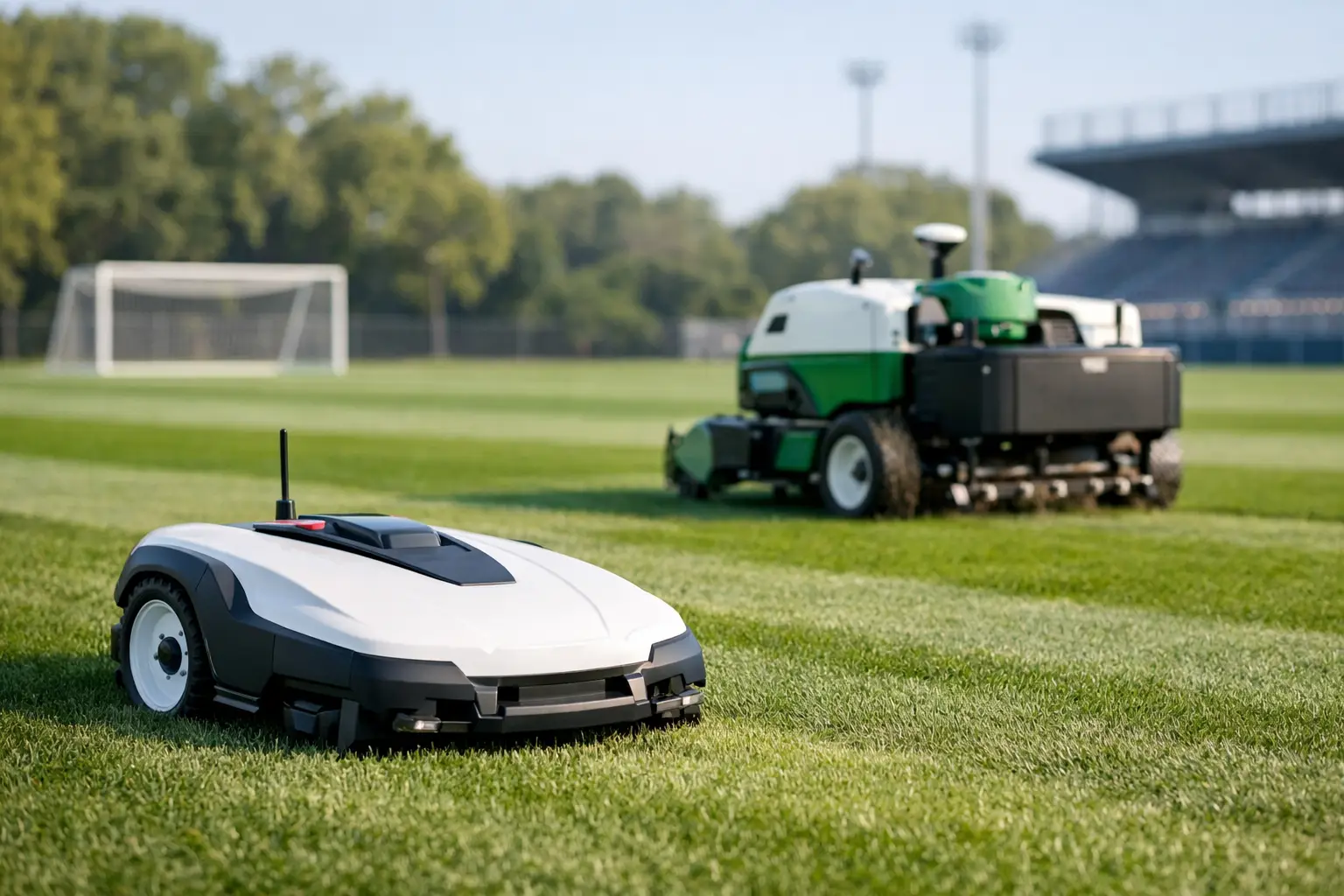
A missed mowing window is rarely just a missed mowing window. On a golf course, it can affect green speed, fairway presentation and the working day of the whole team. On a sports site, it can leave a pitch below standard before training or matchday. Turf robotics gives professional operators a practical way to maintain cutting frequency and surface consistency without making every result dependent on available labour.
This is not about replacing the judgement of a head greenkeeper or sports turf manager. It is about assigning repeatable cutting work to autonomous equipment, so skilled people can concentrate on preparation, renovation, irrigation, nutrition, disease monitoring and the details that separate acceptable turf from exceptional playing surfaces.
Why turf robotics is becoming an operational priority
The labour challenge in professional grounds maintenance is well understood. Recruiting and retaining capable staff remains difficult, while expectations for presentation have not reduced. Courses, clubs, schools, local authorities and contractors must still deliver clean, consistent surfaces across long operating hours and increasingly tight budgets.
Robotic mowing addresses one of the most time-intensive routine tasks: maintaining regular mowing over defined areas. A machine can work to a programmed schedule, including outside the busiest hours, and return to its charging point without requiring a member of the team to be present for every pass. The value is not simply fewer hours spent sitting on a mower. It is a more reliable maintenance rhythm.
Frequent, light cutting supports a neater finish and avoids the visual disruption that comes when grass has been allowed to get ahead. On suitable areas, autonomous mowing can keep growth under control through periods when staff are covering other priorities. That may mean early-season preparation, post-event repairs, irrigation checks or a sudden response to disease pressure.
The commercial case depends on the site, the area and the current working method. A robot will not remove every mowing task, and it should not be assessed as if it will. Its strongest contribution is taking ownership of repeatable routes and surfaces where consistent frequency creates a measurable operational advantage.
Precision is more than a clean finish
For professional turf teams, mowing quality is inseparable from surface performance. Height of cut, direction, clipping management and timing all influence appearance and plant response. The right autonomous system must therefore be selected around the turf area, not simply the total square metres on a specification sheet.
Greens, tees and close-mown areas
Fine turf calls for a different approach from larger amenity spaces. Where presentation, ball roll and a refined finish matter, robotic cylinder mowing can provide frequent, accurate cutting while reducing the repetitive workload placed on staff. Greens and tees are also areas where a missed cut is immediately visible to members and visitors.
The correct deployment still requires professional oversight. Growth rates change with weather, fertility and season. A robot needs an appropriate cutting schedule, a well-maintained cutting unit and clear operating boundaries. It is a precision tool, but its performance is shaped by the standards set around it.
Fairways, rough and larger managed areas
On larger areas, autonomous rotary mowers can provide dependable coverage while freeing up tractors and operators for work that cannot be automated so easily. Fairways, surrounds, practice grounds and amenity grass can be particularly suitable where regular cutting is needed over long periods.
There are practical considerations. Slopes, access routes, trees, water hazards, public movement and narrow passages all influence system design. A good site assessment identifies where a robot can operate efficiently, where it should be excluded, and how mowing routes fit around golfers, players, spectators and maintenance activity.
Marked sports pitches
Sports facilities must balance a uniform presentation with the demands of bookings, training blocks and fixtures. Autonomous mowing can maintain routine cutting between use periods, allowing the grounds team to protect time for line marking, goalmouth repairs, divoting, aeration and fixture preparation.
For marked playing surfaces, route accuracy and boundary control are central. The system must respect pitch edges, run-off areas and site access arrangements while operating at times that do not interfere with users. The objective is straightforward: a predictable cut, completed consistently, with less pressure on the team before each booking.
Where the productivity gain actually comes from
The strongest business case for turf robotics is not based on a single headline labour saving. It comes from the accumulated effect of better task allocation. When autonomous mowers handle scheduled cuts, experienced operators can spend more time on work that requires observation, decision-making and specialist skill.
That shift can improve daily planning. A team is less exposed when one operator is absent, a machine is required elsewhere, or wet conditions compress the available mowing window. Robots can also work during quieter periods, reducing conflict between maintenance operations and customer use.
Productivity also includes machine utilisation. Conventional equipment may sit idle while staff are assigned to another task. An autonomous unit can continue delivering scheduled work within its operating plan. Over a season, that consistency can reduce the backlog that often builds after rain, heavy growth or event weeks.
There is, however, no value in automating a poor process. If mowing responsibilities, access arrangements and charging locations are not properly planned, the expected gain will be diluted. Robotics works best when it is introduced as part of the maintenance programme, not added as an isolated piece of equipment.
Selecting the right robotic mowing system
Professional sites should begin with the turf outcome required, then work back to machine type and deployment. A green, a stadium pitch, a fairway and a broad estate lawn may all need autonomous mowing, but they do not need the same solution.
A proper evaluation should consider cutting technology, target height, daily operating time, area size, terrain, obstacles, transport between zones and expected use of the surface. Connectivity, theft protection, service access and local support should also be part of the decision. A lower purchase price can be a false economy if the machine cannot meet the expected workload or requires excessive intervention.
It is equally important to define what remains manual. Presentation mowing before a major event, collection work, stripes, directional finishing and specialist cuts may still be carried out conventionally. In many cases, the most effective model is a mixed fleet: autonomous equipment for routine frequency and skilled operators for high-value finishing work.
Questions to settle before deployment
Before committing to turf robotics, establish the area that will be automated, the target cut frequency and the window in which the machine can work safely. Confirm how it will cross paths, roads or separate zones, and who will inspect the turf and equipment each day.
Also consider the service model. Blades, cutting reels, batteries and software settings need attention if output is to remain consistent. Autonomous equipment reduces routine mowing labour, but it does not remove the need for professional maintenance discipline.
Making autonomous mowing part of the team
The best introductions are usually phased. Start with a defined, high-frequency area where the current labour demand is clear and the operating environment is controlled. Measure the time released, the quality of finish, intervention levels and feedback from users. This provides evidence for expanding the system to further areas.
Team engagement matters. Staff should understand that the purpose is to reduce repetitive pressure and improve standards, not to disregard the expertise that keeps surfaces performing. The people who know the site best are often the ones who identify the ideal operating times, awkward access points and areas requiring a different mowing approach.
Managers should review performance through the season rather than judging the system after its first week. Growth patterns, weather and venue calendars change. Schedules may need adjusting, and the most suitable areas for automation may become clearer once the team sees how the equipment fits the wider programme.
A practical investment in higher standards
For golf and sports venues, autonomy is most valuable when it protects the standard of the playing surface while giving skilled people more capacity to manage it properly. It creates a dependable baseline of mowing frequency, reduces exposure to labour gaps and helps maintenance teams plan with greater certainty.
The right system will not make agronomy automatic, nor should it try to. It will give the team more time to apply their expertise where it has the greatest effect: the condition, consistency and presentation of the turf that players see and feel every day.