
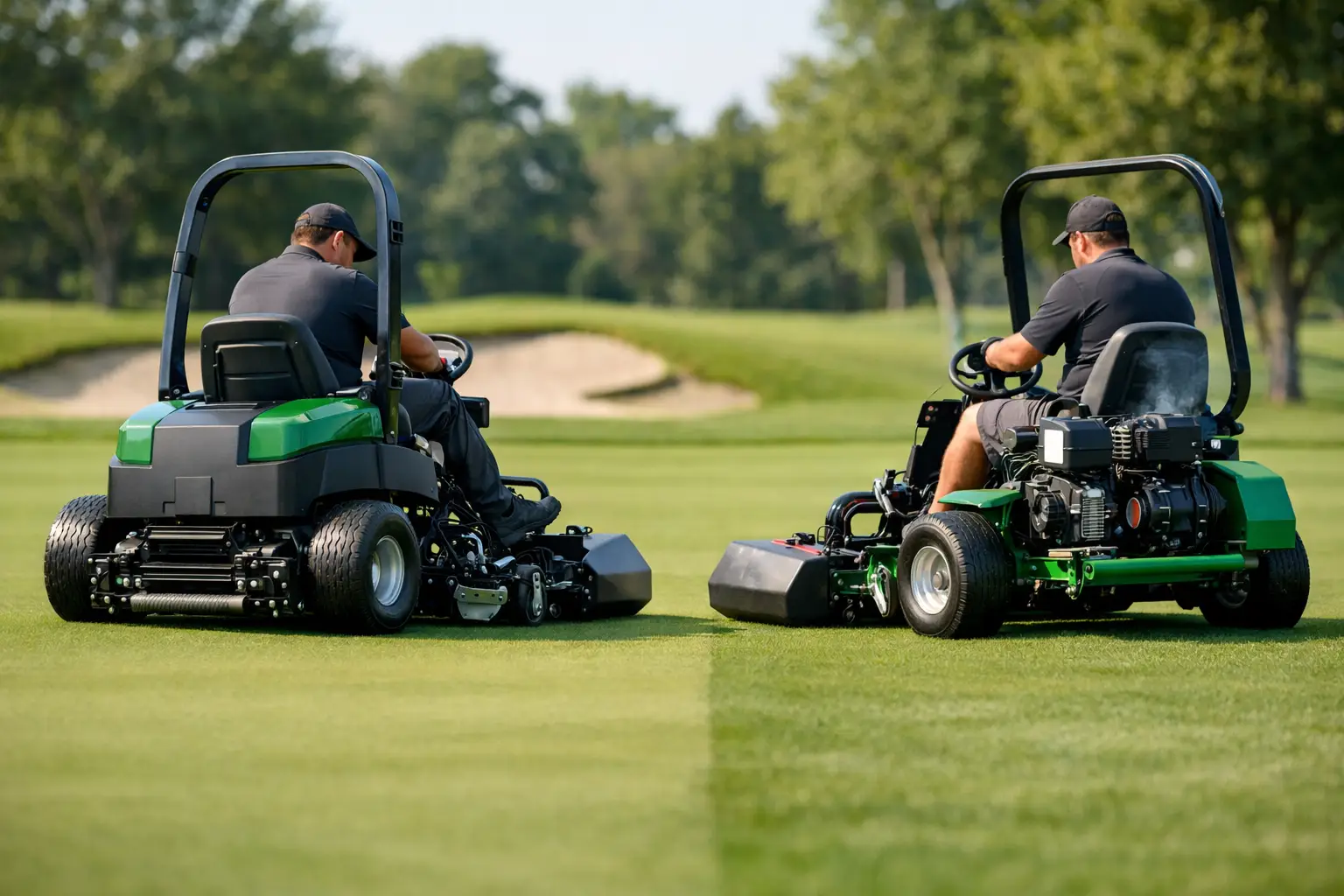
A missed morning cut, an engine that will not start, or a team delayed while a machine is refuelled can quickly affect green presentation. The battery greens mower vs petrol decision is therefore not simply about choosing a power source. It is a decision about labour deployment, cutting windows, noise management, maintenance workload and the consistency of every pass.
For professional golf facilities, petrol remains a proven option with familiar operating characteristics. Battery technology, however, has moved well beyond the light-duty equipment many greenkeeping teams remember. The right choice depends on the size and number of greens, the expected daily workload, available charging infrastructure, machine specification and the standards required at the putting surface.
Battery greens mower vs petrol: the practical difference
Both battery and petrol greens mowers can produce an excellent finish when the cutting unit is correctly set, sharp and matched to conditions. Power source does not replace sound mowing practice. Reel-to-bedknife contact, frequency of cut, clip rate, grass species, moisture and operator discipline still determine the final result.
The difference is in how the machine supports the operation around that cut. Petrol machines provide rapid refuelling and long-established suitability for continuous, intensive use. Battery machines remove local emissions, reduce noise and simplify the daily routine, particularly where multiple greens, early starts and residential boundaries create operational pressure.
A conventional petrol mower may still make sense for a site that requires extended running time without predictable charging access. A battery mower becomes highly persuasive where work is planned, charging can be managed overnight and the facility wants a quieter, lower-maintenance fleet.
Cut quality is about consistency, not fuel type
There is a persistent assumption that petrol power delivers a superior cylinder cut because it has more force available. In practice, a well-designed battery greens mower can maintain a precise, consistent cylinder speed through normal greens mowing conditions. For the operator, this can mean a clean presentation without engine vibration, exhaust heat or variations associated with engine speed management.
The key question is whether the mower can sustain performance through the real workload. Heavy dew, strong growth, accumulated clippings, slopes and damp morning conditions all increase demand. A machine assessed only on a dry, lightly presented green may not represent its performance during peak season.
When comparing options, evaluate the complete cutting system rather than headline battery capacity or engine size alone. Consider the cutting width, number of blades, traction system, cylinder speed, height-of-cut accuracy, grass box capacity and machine balance. For fine turf, the quality of the cut and the repeatability of the set-up matter more than the source of energy driving the mower.
Where petrol still has an advantage
Petrol retains an operational edge where the day is unpredictable. If a team is mowing a large number of greens, moving between remote areas, double-cutting for a competition, or responding to weather disruption, refuelling takes minutes. There is no need to bring the machine back to a charging point or wait for a battery cycle.
That flexibility is valuable on courses with dispersed infrastructure or a limited equipment fleet. A petrol mower can also suit teams that need a familiar machine which can be kept running throughout a long shift with fuel available on site.
However, petrol flexibility comes with a greater daily maintenance burden. Fuel management, oil checks, air filters, belts, spark plugs and engine servicing all demand time and attention. None of these tasks is difficult for an experienced workshop, but they are recurring requirements that need to be accounted for in whole-life cost.
Where battery has the advantage
Battery power is strongest where mowing routes and operating windows are structured. A machine charged at the end of the day can be ready for the next morning’s programme without refuelling or engine warm-up. This is particularly useful for greens teams working close to accommodation, clubhouses, practice areas or neighbouring properties.
The lower noise level can change how a team schedules work. Greens may be cut earlier with less disruption to members, guests and staff. Communication around the machine is easier, which can improve awareness when working near players, pedestrians and other maintenance activity.
There is also an environmental and presentation benefit. No local exhaust emissions around the green is a meaningful consideration for clubs improving sustainability credentials, reducing fuel handling and creating a more refined working environment.
Calculate operating cost across the full season
Purchase price is only one part of the comparison. Petrol mowers may have a lower initial cost in some categories, but fuel, engine servicing and downtime should be considered over the expected life of the machine. Battery equipment has fewer engine-related service items, although batteries, chargers and electrical components must be supported by a reliable supplier and service plan.
Battery replacement is often raised as a concern. It should be treated as a planned lifecycle cost, not an unknown. Ask about battery chemistry, warranty, expected charging cycles, replacement cost, charging time and performance in colder conditions. A professional battery system should give clear answers on all of these points.
For petrol, calculate actual fuel consumption rather than relying on an estimate. Include fuel storage, delivery, spillage risk and the time spent refuelling. On a busy course, small interruptions repeated every day become a measurable labour cost.
The most useful comparison is cost per season or cost per cut, based on the course’s own routine. Include operator time, servicing, consumables, energy or fuel, transport between greens and the value of reduced disruption during playing hours.
Charging and refuelling shape the daily workflow
Battery mowing only works well when charging is treated as part of the operating system. A secure, ventilated charging area, appropriate electrical capacity and a clear end-of-shift routine are essential. Teams should know who connects machines, checks charge status and reports any issue before the next morning.
For some sites, a spare battery or additional machine may be appropriate during tournament weeks or periods of vigorous growth. This is not necessarily a drawback. It can provide useful fleet resilience, provided it is specified around the real work programme rather than purchased as an afterthought.
Petrol has its own workflow requirements. Fuel must be stored safely, machines checked before use and servicing scheduled to avoid failures during peak presentation periods. The familiar nature of petrol can conceal these costs because they are spread across the season rather than visible in one charging installation.
Noise, emissions and the member experience
Greens mowing is highly visible work. Players associate the sound, appearance and timing of maintenance with course standards. Petrol equipment remains accepted across the industry, but quieter battery machines offer a practical way to reduce disturbance without reducing mowing frequency.
This matters most at facilities with early tee times, practice activity close to greens, hospitality operations or sensitive neighbouring land. Lower noise also supports better working conditions for the grounds team, particularly where machinery is used for several hours each morning.
The emissions case is equally operational. Reducing petrol use can support sustainability reporting and lower exposure to fumes for operators. It should not be the only reason to change equipment, but it is a credible benefit when combined with dependable cut quality and a workable charging plan.
The case for automation in greens maintenance
The battery versus petrol debate is also part of a wider shift in turf operations. Autonomous, battery-powered mowing can take repetitive cutting work away from already stretched teams, allowing skilled greenkeepers to focus on agronomy, course set-up, detail work and member-facing tasks.
For suitable areas and applications, robotic solutions introduce scheduled, repeatable mowing with no operator required for every pass. That is not a direct replacement for every precision greens mowing task, particularly where tournament preparation demands close human judgement. It is, however, a practical way to reduce labour dependence across the wider maintenance programme.
GrassRobotics works with professional operators looking to apply that same principle of autonomy and precision across greens, fairways, tee boxes and sports turf. The strongest results come from assessing the entire site workflow, rather than viewing each mower as an isolated purchase.
Which option suits your course?
Choose petrol where continuous runtime, remote working areas and immediate refuelling are the overriding priorities. It remains a capable, proven choice for demanding schedules, especially when a well-supported workshop and fuel infrastructure are already in place.
Choose battery where predictable daily routes, quiet operation, reduced local emissions and lower routine engine maintenance will improve the programme. It is particularly compelling for facilities seeking earlier operating windows, a more comfortable operator environment and a clear route away from fuel-dependent machinery.
Before committing, test the machine on representative greens during genuine working conditions. Measure not only finish quality, but also charge or fuel use, travel time, noise, operator feedback and the time required to prepare the machine for the next shift. The best mower is the one that delivers the required standard reliably while giving the team more control over the working day.