
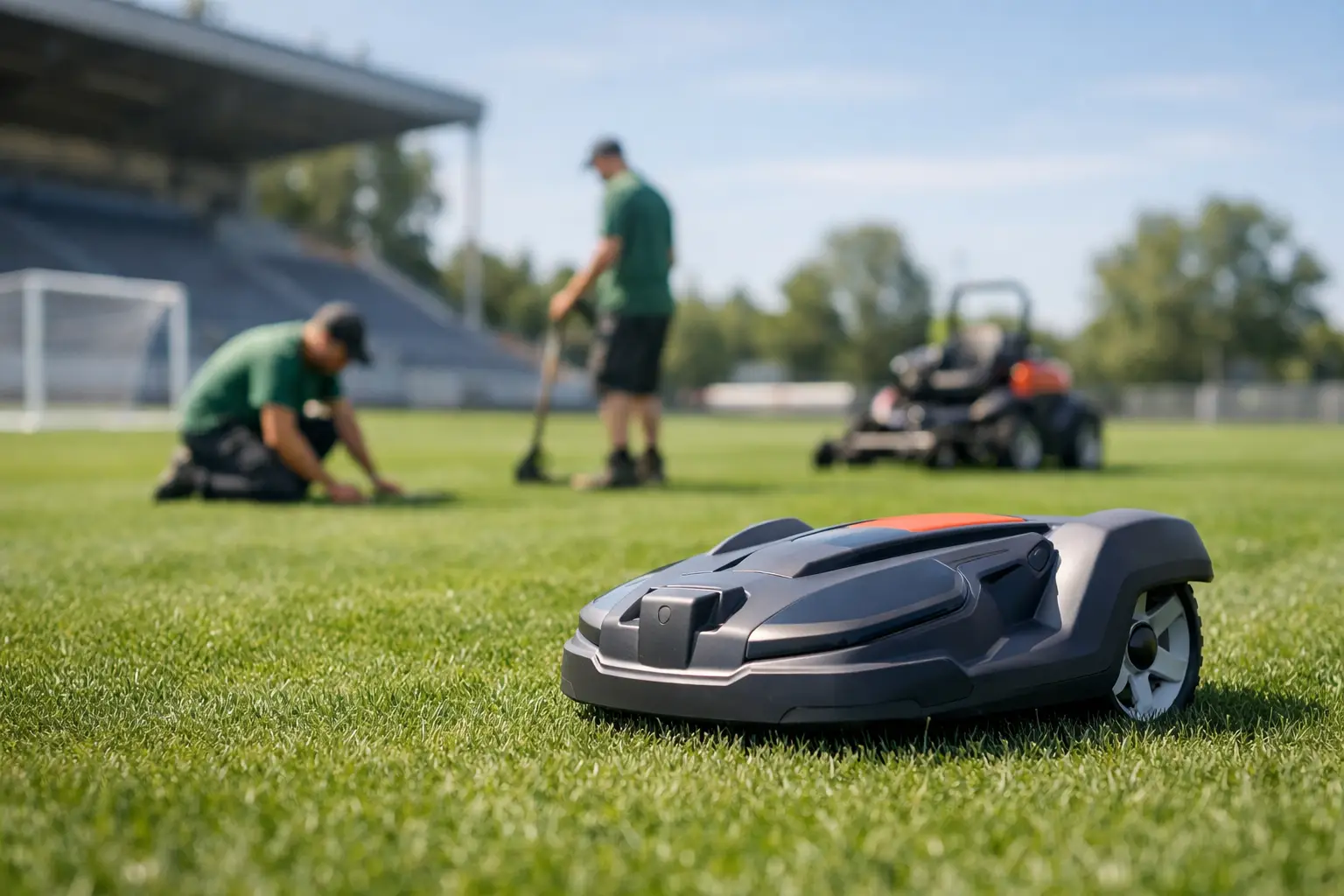
A first-tee presentation check, a pitch inspection or a tournament morning rarely allows room for compromise. That is why the question is not simply, can robotic mowers replace groundstaff? It is whether autonomous mowing can remove enough repetitive cutting work to let a skilled grounds team spend more time on the tasks that protect turf quality, playability and presentation.
For most professional sites, robotic mowing is not a wholesale replacement for experienced people. It is a change to the operating model. Autonomous machines take responsibility for planned, repeatable mowing, while groundstaff retain control of agronomy, set-up, repairs, detail work and the judgement that separates acceptable surfaces from exceptional ones.
Can robotic mowers replace groundstaff across a site?
Not entirely, and they should not be assessed on that basis. A robotic mower cannot assess disease pressure, rebuild a worn goalmouth, alter a renovation programme or decide whether a wet area needs protecting from traffic. It cannot replace the experience of a head greenkeeper or sports turf manager.
It can, however, replace a substantial proportion of routine mowing hours when the application, machine specification and site set-up are right. This is particularly valuable where staff are spending early mornings or large parts of the day covering predictable areas such as fairways, rough, training grounds, outfields, amenity grass and selected pitch surrounds.
The strongest case for robotics is not fewer people for the sake of it. It is better use of the people available. Labour remains one of the most constrained resources in professional grounds care, especially at sites with extended opening hours, seasonal pressure and high expectations from players, members or visitors. If autonomous mowing releases qualified staff from repetitive passes, they can focus on tasks that demand expertise and are often deferred when labour is tight.
That may include hand finishing, bunker work, irrigation checks, line marking, machinery maintenance, aeration, divoting, surface repairs and proactive turf health monitoring. These are not secondary jobs. They are the work that protects standards when conditions become difficult.
What autonomous mowing can take off the daily workload
Robotic systems are most effective when they are allocated clearly defined, repeatable areas and a consistent mowing programme. Rather than waiting for an operator and machine to become available, a robotic mower can cut to its schedule, return to charge and resume work across long operating windows.
On golf facilities, this can mean maintaining frequent cuts on designated fairway areas or managing larger expanses of rough while the team concentrates on greens, tees and presentation priorities. On sports sites, autonomous equipment can support regular mowing across training pitches, school grounds, club facilities and peripheral areas without taking an operator away from match-pitch preparation.
Consistency is as valuable as time saved. Frequent, lighter cuts can support a neater visual finish and reduce the sudden changes in grass length that occur when mowing is delayed by weather, staffing gaps or competing priorities. The result is a more dependable baseline standard across the site.
There is also a practical benefit in how mowing labour is scheduled. A conventional machine requires an operator for every productive hour. A robotic mower does not remove the need for supervision and maintenance, but it can work outside the narrow periods when a team is available. That creates capacity without extending every shift or relying on seasonal recruitment to cover routine cutting.
For contractors, the same principle can improve service delivery across multi-site portfolios. A machine assigned to a secure, suitable area can maintain output between visits, allowing the mobile team to direct its time towards inspections, specialist works and sites that require a physical presence.
The work that still needs skilled groundstaff
The limits matter. Professional turf maintenance is not mowing alone, and a site that treats automation as a simple labour substitution risks losing the very standards it intends to protect.
Groundstaff remain essential for quality control. They set cutting heights, assess grass response, inspect the mowing result, manage the transition between surfaces and respond to weather. They also decide when a programme should change. A dry spell, disease outbreak, fixture congestion or a forthcoming event may require a different approach immediately.
Detail areas also need consideration. Tight edges, obstacles, steep or irregular ground, temporary infrastructure and areas with frequent public movement may need conventional equipment or manual finishing. Robotic capability continues to develop, but every site has locations where the practical and safe answer is a different machine or a skilled operator.
On high-performance playing surfaces, the mower must match the required finish. A fairway, a stadium pitch, a bowling green and a putting green are not interchangeable applications. Cut quality, striping requirements, direction of presentation, collection needs and surface tolerance should all determine the equipment strategy. Autonomous mowing is a professional turf-care tool, not a one-machine answer to every hectare.
Start with a task audit, not a machine choice
The best robotic mowing projects begin with the workload. Before selecting equipment, identify where labour is currently being spent, which mowing tasks are repetitive and which areas routinely fall behind when the team is under pressure.
A useful assessment should examine the area to be cut, target height, required mowing frequency, terrain, access routes, charging arrangements, obstacles, safety requirements and the expected level of finish. It should also account for the reality of the calendar. A site may have ample capacity in winter but a very different requirement during peak growing conditions or fixture periods.
The commercial calculation should include more than operator hours. Consider fuel or energy use, conventional machinery wear, maintenance demand, missed-cut risk, seasonal labour availability and the value of reallocating staff to higher-priority work. The return often comes from a combination of lower routine labour dependency and stronger consistency, rather than one dramatic saving in isolation.
It is equally important to define ownership. Someone must remain responsible for daily visual checks, cleaning, blade condition, boundary integrity, schedule adjustments and performance review. Autonomous equipment reduces manual operation, but it performs best within a disciplined maintenance process.
Integration matters more than replacement claims
A well-run robotic mower programme sits alongside the existing fleet and team. It does not force every acre into one cutting method. Conventional rotary, cylinder and specialist machines still have a clear role where collection, presentation patterns, specialist finishes or changing site conditions demand them.
This blended approach gives managers flexibility. Robotics maintain routine output in the background, while operators deploy conventional equipment where their skill and presence create the most value. On a busy golf course or sports complex, that can mean fewer compromises when several priorities land at once.
The change also needs staff engagement. Teams are more likely to support automation when its purpose is clear: reducing repetitive workload, improving reliability and giving them more time for skilled turf management. Positioning it as a tool that protects standards is more credible than suggesting technology can replace professional judgement.
When robotic mowing is the right investment
Robotic mowing tends to be most compelling where there are significant areas of regularly maintained grass, a repeatable route or operating zone, high labour pressure and a clear need for frequent cutting. It is especially relevant where managers are trying to maintain standards with lean teams, or where recruitment and retention make routine mowing difficult to resource.
It may be less suitable as a first priority where the site has highly fragmented access, constant temporary obstacles, very limited charging infrastructure or an operational need for a specific collected finish across every area. These conditions do not necessarily rule out robotics, but they affect the design and may favour a smaller, targeted deployment.
The right question is not whether a robot can cover every mowing task. It is which tasks it can perform consistently enough to free the team for work only people can do. For professional operators, that distinction is where the real productivity gain sits.
A practical next step is to map one representative week during the main growing season. Record every mowing hour, the area covered, the finish required and the jobs delayed as a result. That evidence will show where autonomous precision can take pressure out of the programme while leaving your groundstaff where they make the greatest difference.