
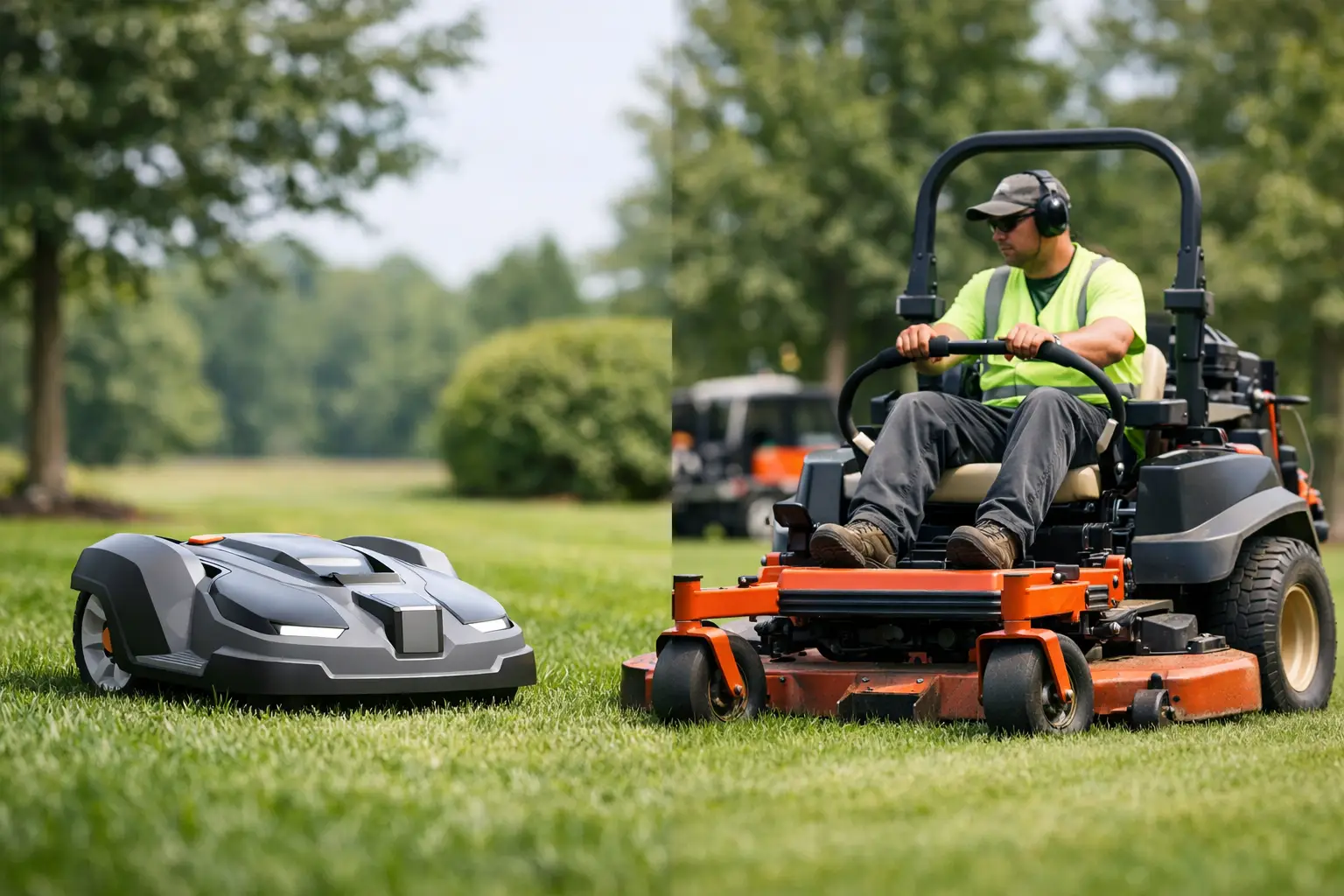
A missed cut before a Saturday fixture, a contractor delayed by wet weather, or a team pulled away to prepare bunkers and surrounds can quickly disrupt presentation standards. For professional operators, autonomous mowing versus contract mowing is not simply a choice between two machines or suppliers. It is a decision about control, consistency, labour allocation and the long-term cost of maintaining playing surfaces.
Contract mowing remains a valid option for many sites, particularly where demand is seasonal or specialist work is required. Autonomous mowing, however, changes the operating model. It brings routine cutting in-house, running to a defined plan and releasing skilled staff to focus on the work that has the greatest impact on turf condition and player experience.
Autonomous mowing versus contract mowing: the operational difference
A contract mowing service purchases a result: a contractor supplies labour, machinery, transport and management within an agreed schedule. The arrangement can reduce capital expenditure and is straightforward to understand. It can also leave the site dependent on another organisation’s availability, route planning and staffing levels.
Autonomous mowing brings the routine element of cutting under site control. A robotic mower works within mapped areas and scheduled operating windows, returning repeatedly to maintain an even finish rather than relying on fewer, heavier cuts. The grounds team retains responsibility for standards, but the repetitive travel and cutting workload is handled autonomously.
The distinction matters most where presentation cannot wait. Golf fairways, tees, greens surrounds and marked playing areas all benefit from predictable cutting frequency. When the mower is already on site and scheduled around play, the maintenance plan is less exposed to a contractor’s resourcing pressures or a last-minute change in priorities.
Consistency is often the deciding factor
For high-use turf, mowing quality is not measured only by whether grass has been cut. It is measured by uniformity, clipping control, surface appearance and the ability to hold the target height without placing unnecessary stress on the plant.
Frequent light cutting supports presentation
Autonomous systems are designed to cut little and often. This approach limits the amount of leaf removed in each pass and helps maintain a consistently tidy surface. On fairways and sports areas, that can improve visual uniformity across the week rather than concentrating the result immediately after a contractor visit.
The benefit is especially relevant in peak growing conditions. A fixed weekly or fortnightly contract visit may be adequate during slower periods, but growth does not follow an invoice cycle. Robotic mowing can be adjusted to match seasonal growth, fixture schedules and the standard expected by members, players or clients.
Professional oversight still matters
Autonomy does not remove agronomy or skilled judgement. It does not replace renovation work, selective presentation cuts, striping requirements, debris clearance, irrigation management or a greenkeeper’s assessment of disease pressure and plant health. It takes over a defined, repeatable task so that experienced staff can apply their time where it is harder to automate.
For a course or sports venue, the strongest model is often not ‘robot versus person’. It is automation for routine coverage, supported by a professional team that manages the wider turf programme.
Labour resilience has become a commercial issue
Recruiting and retaining capable grounds staff remains difficult across many parts of Great Britain. Contract mowing can ease an immediate labour shortfall, but it does not always remove dependency. A contractor faces the same recruitment market, and its staff may be working across several sites on a tight route.
An autonomous mower creates capacity that stays on the premises. Once installed, mapped and integrated into the maintenance plan, it can carry out scheduled work without requiring an operator to be allocated for every hour of cutting. This gives head greenkeepers and grounds managers more freedom to deploy staff on line marking, pitch preparation, machinery maintenance, edging, detail work and customer-facing tasks.
There is also a health and safety consideration. Reducing operator hours on repetitive mowing can lower exposure to noise, vibration and long periods on equipment. That does not remove the need for safe operating procedures, inspections and site management, but it can improve the quality of the working day for the team.
Compare whole-life cost, not only the monthly invoice
Contract mowing is commonly attractive because the cost is visible and spread over an agreed period. There is no large equipment purchase, and maintenance responsibility may sit with the provider. For sites with irregular need, that flexibility can be financially sensible.
The limitation is that contract fees continue as long as the service is needed, often with annual increases linked to labour, fuel, transport and overheads. Additional visits, altered schedules and out-of-scope work can also change the final cost. Over several seasons, routine mowing purchased as a service may represent a substantial recurring commitment.
Autonomous mowing requires upfront investment, site assessment, installation and staff familiarisation. It also needs an allowance for servicing, blades, connectivity and ongoing support. The financial case becomes stronger where there are large, repeatable areas to maintain and where existing staff spend significant hours on routine mowing.
A useful comparison should account for operator hours, contractor charges, fuel or electricity, transport, machinery depreciation, maintenance, downtime risk and the value of redeploying labour. It should also recognise that not all savings appear as a line removed from the budget. A better-presented surface, more reliable pre-fixture preparation and fewer rushed mowing decisions can protect revenue and reputation.
When contract mowing is still the right choice
Autonomous mowing is not a universal replacement for every contracted service. Small sites with limited mowing demand may not generate a compelling return. Sites with constantly changing access, extensive temporary obstructions or highly fragmented work areas may require a more tailored assessment.
Contractors can also remain valuable for seasonal peaks, large-scale rough cutting, clearance work, steep or inaccessible areas, and tasks requiring specialist attachments or a larger crew. A venue without an in-house maintenance team may prefer the accountability of a full managed service.
In some cases, the most practical route is a hybrid model. Autonomous equipment maintains core areas at a frequent, consistent height, while a contractor or internal team handles periodic presentation cuts, specialist operations and work outside the robot’s defined zones. This approach can reduce contract scope without forcing an all-or-nothing decision.
Build the decision around the site, not the brochure
The right solution starts with an honest review of mowing patterns. Identify which areas are cut most frequently, how many labour hours they consume, when they need to be available and what prevents the current programme from meeting the desired standard. Fairways, tee complexes, sports pitches and large open amenity areas can each have a different operational case.
Next, consider the practical environment. Boundaries, slopes, crossings, trees, public access, charging locations, storage, connectivity and fixture schedules all affect system design. Professional robotic mowing should be assessed as part of the full maintenance operation, not treated as a consumer product placed on a commercial site.
Equipment selection should then reflect the surface and finish required. Rotary systems may suit broad coverage and productive maintenance, while autonomous cylinder mowing is particularly relevant where a finer cut and premium presentation are required. GrassRobotics approaches this through professional applications rather than a one-size-fits-all mower choice.
Finally, agree how success will be measured. That may include weekly labour hours released, cut frequency, surface uniformity, contractor spend reduced, availability before play, or the ability to maintain standards during staff absence. Clear measures turn automation from an interesting purchase into an accountable operational improvement.
The strongest decision is rarely based on whether a robot can cut grass. It is based on whether it gives your team more control over the surfaces that define your venue, while allowing skilled people to spend their time where their expertise matters most.