
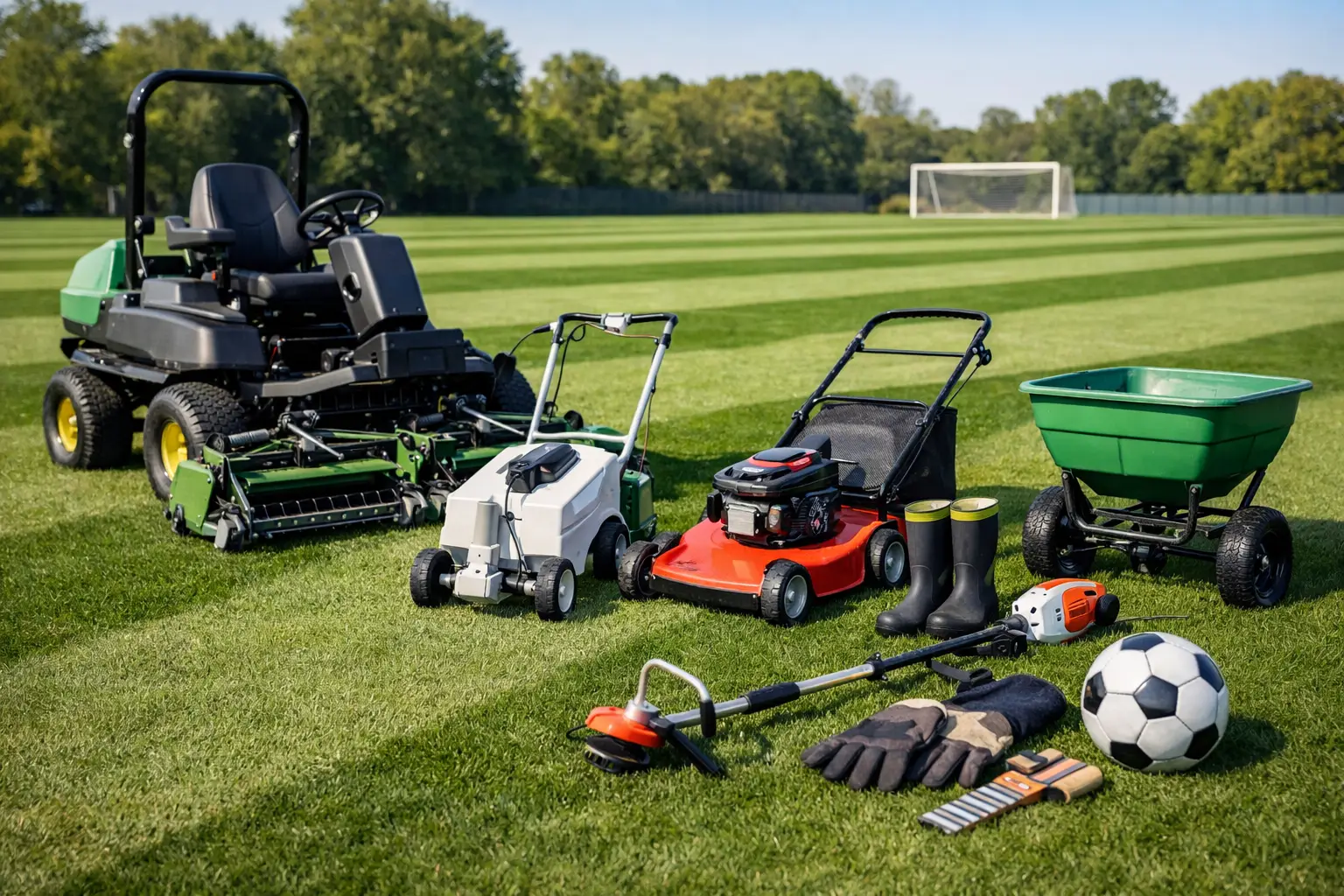
A crisp stripe is not created by cutting alone. It comes from laying grass consistently in opposing directions, at the correct height, with a finish that holds from the touchline to the centre circle. The best equipment for striped pitches therefore needs to do more than remove leaf. It must deliver a clean cut, controlled grass lay and repeatable passes without placing further pressure on an already stretched grounds team.
For professional sports turf, the right choice depends on pitch use, grass species, cutting height, labour availability and the standard of presentation expected on matchday. A machine that produces a strong visual pattern can still be the wrong investment if it is too slow, too disruptive, or unable to keep pace with intensive fixture schedules.
What Produces a Strong Pitch Stripe?
Striping is a light-reflection effect. Grass bent towards the viewer appears darker; grass bent away appears lighter. The cutting unit establishes the height and finish, while a rear roller or dedicated striping roller lays the leaf in one direction. Alternating the direction of travel creates the familiar light and dark bands.
That distinction matters when comparing mowing equipment. A mower can produce an excellent, uniform cut without creating a defined traditional stripe. Conversely, a heavy roller may create a bold pattern while causing avoidable stress if it is used on wet or vulnerable ground.
The best results come from a planned mowing system: sharp cutting units, stable height of cut, sensible travel lines and enough frequency to prevent excessive leaf removal. Stripe quality is an outcome of that system, not simply a feature of one machine.
Best Equipment for Striped Pitches: Core Choices
Cylinder mowers for the match finish
For fine sports turf and formal match presentation, a professional cylinder mower with an effective roller remains the benchmark. Its scissor-like cut gives a clean finish at lower heights of cut, while the roller provides the grass lay required for visible stripes.
This is particularly relevant for football, rugby, hockey surrounds and cricket outfields where presentation is judged closely. A well-set cylinder mower can produce a disciplined, even pattern with a finish that photographs well and supports a premium playing environment.
There is a trade-off. Cylinder mowing demands disciplined maintenance. Bottom blades, cylinders, bearings and height settings all affect cut quality. A poorly adjusted cylinder will tear leaf tips rather than cut them cleanly, reducing both turf appearance and plant health. It also requires an operator or autonomous platform that can follow accurate, repeatable paths.
Roller configuration matters as much as the cutting unit
A full-width rear roller creates the most pronounced stripe, but it should be selected with the surface condition in mind. On firm, well-managed pitches, a roller provides the definition expected for first-team fixtures and televised games. On soft ground, however, repeated weight in the same routes can contribute to compaction, marking and wear.
Grounds managers should be able to vary pattern direction rather than repeatedly following the same stripes. Changing the line of travel helps distribute traffic and prevents the surface developing a persistent grain. For routine presentation, a lighter striping roller may be preferable to a heavier setup, particularly through wet winter periods.
Autonomous mowing for frequency and consistency
Autonomous mowing is not a replacement for every presentation pass. It is a way to remove repetitive cutting hours from the weekly programme while maintaining consistent turf height across large areas.
For striped pitches, an autonomous system is most valuable when it supports the wider maintenance strategy. Frequent autonomous cutting keeps leaf growth under control, reduces the amount removed at any one time and leaves the surface ready for a scheduled cylinder-and-roller finish. This can be highly effective on multi-pitch sites where labour must be prioritised for line marking, repairs, fixture preparation and renovation work.
Purpose-built robotic cylinder mowing also deserves close consideration where regular precision cutting is required. The suitability depends on the machine’s cut quality, navigation accuracy, operating pattern, safety approach and ability to work around pitch schedules. A traditional striped finish still requires deliberate directional mowing and grass lay, so do not assume that any robotic mower will create prominent bands simply because it cuts frequently.
Rotary mowers for utility and broader areas
Professional rotary mowers have a role around sports facilities, especially on training grounds, larger amenity areas, rougher grass margins and secondary pitches maintained at a higher height. They are productive and versatile, but they do not usually offer the same close finish or striping definition as a cylinder mower with a roller.
That does not make them a poor choice. For many facilities, a rotary autonomous mower can protect labour capacity by handling extensive routine areas, allowing the grounds team to reserve cylinder mowing for show pitches and key playing surfaces. The strongest equipment plan is often a combination of machine types, each used where it adds most value.
Match the Machine to the Playing Surface
A stadium pitch with tight mowing tolerances needs a different approach from a community sports site with three grass football pitches and limited staff. The first may justify dedicated presentation equipment and detailed striping plans. The second may gain more from automation that reliably maintains height across all pitches, with a conventional stripe pass reserved for weekend fixtures.
Grass species also affects the decision. Fine-leaved ryegrass and smooth, dense surfaces tend to show stripe contrast clearly when cut at an appropriate height. Coarser, uneven or stressed turf will not deliver the same effect, regardless of roller weight. If stripes disappear quickly, assess turf density, nutrition, moisture and cutting frequency before buying heavier equipment.
Cutting height is equally important. Lower is not always better. The correct height should be driven by the sport, season, grass condition and the surface’s ability to recover. Chasing visual impact by cutting too low can weaken the sward, reduce recovery from wear and create a poorer playing surface. Strong stripes should complement turf performance, never compromise it.
Build a Workflow Rather Than Buying a Single Machine
The most efficient facilities separate routine mowing from presentation work. Autonomous units can maintain regularity across the wider estate, operating within agreed safe windows and reducing reliance on manual coverage. A cylinder mower with a roller can then be deployed for scheduled pitch preparation, using a defined pattern that suits the fixture and venue standard.
This approach reduces the risk of skilled staff spending hours on repetitive passes when their expertise is needed elsewhere. It also improves resilience during peak growth, staff absence and busy fixture periods. The operational value is not just fewer mowing hours. It is the ability to protect quality when the maintenance programme is under pressure.
Navigation and site setup are central to this. Autonomous equipment needs clear operating zones, exclusion areas, charging or docking plans and reliable procedures around public access and pitch use. On marked playing surfaces, the route plan should avoid disrupting line-marking operations or running machinery across vulnerable ground immediately after irrigation, heavy rain or renovation work.
Questions to Ask Before Investing
Start with the result you need to deliver. Is the objective a pronounced matchday stripe, consistent weekly height across multiple pitches, or both? Then consider how much operator time is currently spent mowing and whether that time could be redirected towards higher-value turf tasks.
Ask suppliers to demonstrate cut quality on comparable turf, not just on a tidy demonstration area. Review the stripe produced after several passes, the finish at turns, the machine’s performance on slopes and its operation in realistic weather conditions. For autonomous equipment, examine route accuracy, safety systems, remote monitoring, service support and how the machine fits around actual fixtures.
Also assess the cost of maintaining the cutting system. Cylinder performance relies on sharp, correctly adjusted components, while autonomous fleets require a practical support and maintenance plan. The lowest purchase price can become expensive if the machine does not produce the required finish or cannot operate reliably within the site’s programme.
A striped pitch should look deliberate, not merely mown. Select equipment that protects the grass, gives your team control of presentation and keeps routine cutting moving without consuming the working day. That is where autonomous precision and professional mowing discipline become a genuine operational advantage.