
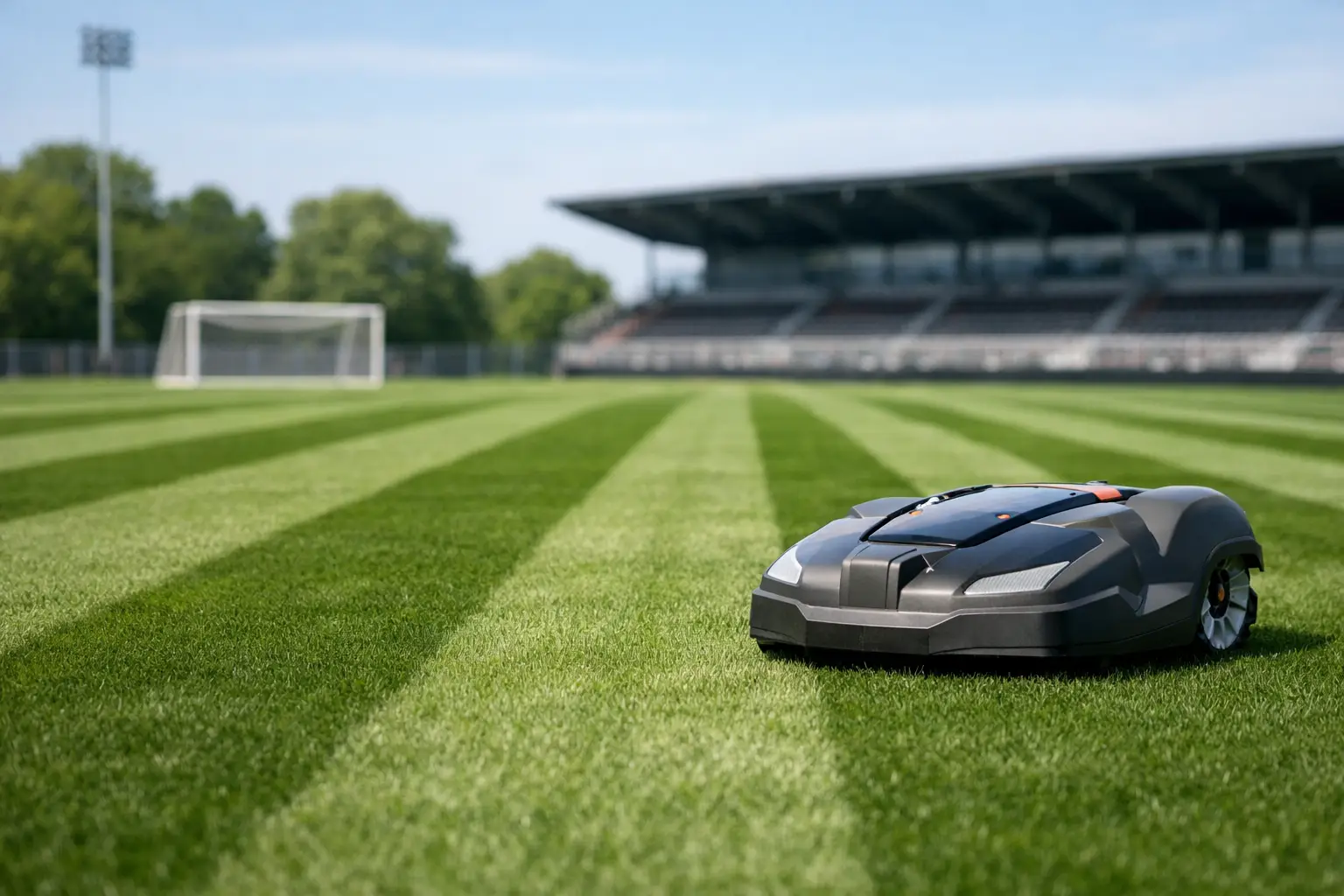
A well-defined stripe is not simply a visual extra. On a football, rugby or cricket outfield, it signals control of the surface, supports venue presentation and gives players, spectators and broadcasters a clear impression of quality. So, can robotic mowers stripe pitches? Yes, but only where the machine, cutting system and operating programme are designed to create and maintain a directional finish.
The key distinction is between cutting grass and laying it over. Many robotic mowers are built to maintain a consistent height using frequent, autonomous cutting. That delivers real labour and productivity benefits, but it does not automatically produce the alternating light and dark bands expected on a professionally presented pitch. Striping depends on the direction in which the leaf is brushed or rolled after cutting.
Can Robotic Mowers Stripe Pitches With a Professional Finish?
A robotic mower can create visible pitch stripes when it combines accurate repeatable routes with a roller or equivalent grass-laying system. As the mower travels in one direction, the roller bends the grass leaf slightly. The next pass travels in the opposite direction, bending the leaf back. Light reflects differently from each direction, creating the familiar stripe effect.
The cutting unit matters. A cylinder mower with a rear roller is naturally suited to a fine, formal finish because it cuts cleanly and conditions the turf in the same operation. For high-profile football grounds, stadium training areas and closely managed cricket outfields, this is generally the most appropriate approach.
A rotary robotic mower can still maintain a pitch effectively, particularly where frequent cutting and reduced labour reliance are the main objectives. However, without a purpose-built roller and disciplined directional mowing, it is unlikely to create the sharp, presentation-led stripes associated with traditional cylinder mowing. This is not a weakness in autonomy. It is a question of choosing the correct machine for the required finish.
Route Planning Is What Makes Stripes Repeatable
Traditional striping relies on an operator driving straight, overlapping lines, then changing the pattern between cuts. Autonomous equipment must reproduce that discipline through route planning rather than operator judgement.
For a stripe pattern to remain clean, the mower needs reliable positioning, consistent lane spacing and controlled turns at the headland. A system that follows random or variable routes may maintain height well, but it will not hold a recognisable pattern. Conversely, a robotic mower programmed for parallel passes can repeat a straight-line presentation pattern with far less daily intervention.
This accuracy offers a practical advantage for multi-pitch sites. Once a preferred route has been established, the pattern can be repeated across training pitches or scheduled around use. Grounds teams retain control over the visual standard without tying a skilled operator to every mowing pass.
There is still a place for variation. Repeatedly travelling the same direction can encourage grass to lean and may contribute to wheel tracking or compaction in vulnerable conditions. Changing the mowing angle through the week – for example, from lengthways to diagonally across the pitch – keeps the surface standing more evenly while refreshing the visual finish. A capable autonomous programme should support this rotation rather than treat every cut as identical.
The Turf Conditions That Determine Stripe Quality
Even the right robotic cylinder mower cannot create a strong stripe on poor or unsuitable turf. The finish depends on grass species, density, height of cut, moisture levels and the condition of the surface.
Fine-leaved, healthy swards generally show striping more clearly than sparse or stressed turf. A slightly longer leaf gives the roller more material to lay over, which is why strong visual patterns are often easier to achieve on football and rugby pitches than on very closely cut surfaces. At lower heights of cut, the stripe can be subtler, but clean directional presentation is still possible with the right equipment.
Surface firmness also requires attention. On a soft pitch, repeated travel over the same turn points can leave marks that undermine the finish. Operators should manage turning areas, alter start points and avoid mowing when conditions make marking unavoidable. Autonomous operation should reduce routine workload, not remove professional judgement from the programme.
Dew is another consideration. It can enhance the contrast of a freshly striped pitch, but heavy moisture increases the risk of clippings collecting, wheels carrying debris and turf bruising where the surface is vulnerable. Mowing schedules should reflect local conditions, drainage performance and fixture demands rather than simply run at the same time every day.
Striping Is Only One Part of Pitch Presentation
A striped pitch can look excellent while still falling short in playability. Professional grounds teams must balance appearance with cutting quality, ball roll, surface density and recovery. Autonomous mowing is most valuable when it supports those wider outcomes.
Frequent light cuts can help maintain a more consistent canopy and reduce the peaks in growth that occur between conventional mowing sessions. This is particularly useful during active growing periods, when teams are under pressure to prepare several surfaces while managing other essential tasks. By taking on routine mowing, robotic equipment gives staff more time for renovation, line marking, irrigation checks, divot repair and match preparation.
That does not mean every pitch should be striped every day. For many training sites, a consistent, even cut is the priority and a formal pattern may add little operational value. At a stadium, academy showcase pitch or televised venue, striping has greater value because it contributes directly to presentation. The right specification should follow the site standard, not a generic expectation of what a robot ought to do.
Choosing a Robotic Mower for Striped Sports Pitches
When assessing autonomous equipment, start with the finish required at the end of the working week. If the venue expects traditional bands, look beyond headline autonomy claims and assess the cutting and rolling arrangement in detail. A professional robotic cylinder mower is the logical choice where a defined striped finish is central to the brief.
Route control should be equally high on the specification. The machine must be able to work accurately within the pitch boundary, follow planned mowing lines and operate safely around changing site activity. Consider how it handles headlands, access routes, slopes, obstacles and the transition between multiple areas. A pitch is not an isolated rectangle in day-to-day operation.
Also assess charging and working windows against the maintenance programme. The mower must complete its work without conflicting with training, school use, grounds staff activity or fixture preparation. For contractors and multi-site operators, the strongest case for autonomy is often not one immaculate stripe pattern. It is the ability to maintain more turf, more consistently, with fewer routine machine hours tied to manual operation.
GrassRobotics approaches this as a professional turf-care decision rather than a consumer automation purchase. The appropriate solution is determined by the grass area, expected finish, operating environment and the workload that needs to be removed from the grounds team.
Where Robotic Striping Works Best
Robotic striping is particularly well suited to regularly shaped pitches with clear boundaries, predictable access and a consistent presentation requirement. Football training grounds, school and university sports facilities, rugby clubs and managed cricket outfields can all benefit where mowing is a frequent demand on a limited team.
It is less straightforward on heavily used community pitches with irregular layouts, constantly changing portable goals or poor surface conditions. In these settings, autonomous mowing can still offer major value, but an immaculate stripe may not be the primary measure of success. Reliable height control, safe operation and improved labour allocation may matter more.
The most effective implementation is usually a blended maintenance programme. Use autonomous mowing for planned routine cuts and repeated presentation patterns, while retaining skilled staff for inspections, match-day preparation, renovation and the situations where turf conditions require an experienced eye.
A robotic mower can stripe a pitch to a professional standard when the equipment is specified for rolling as well as cutting, and when routes are planned around the finish required. Treat the stripe as the visible result of precise turf management, not as a feature that autonomy delivers by default.