
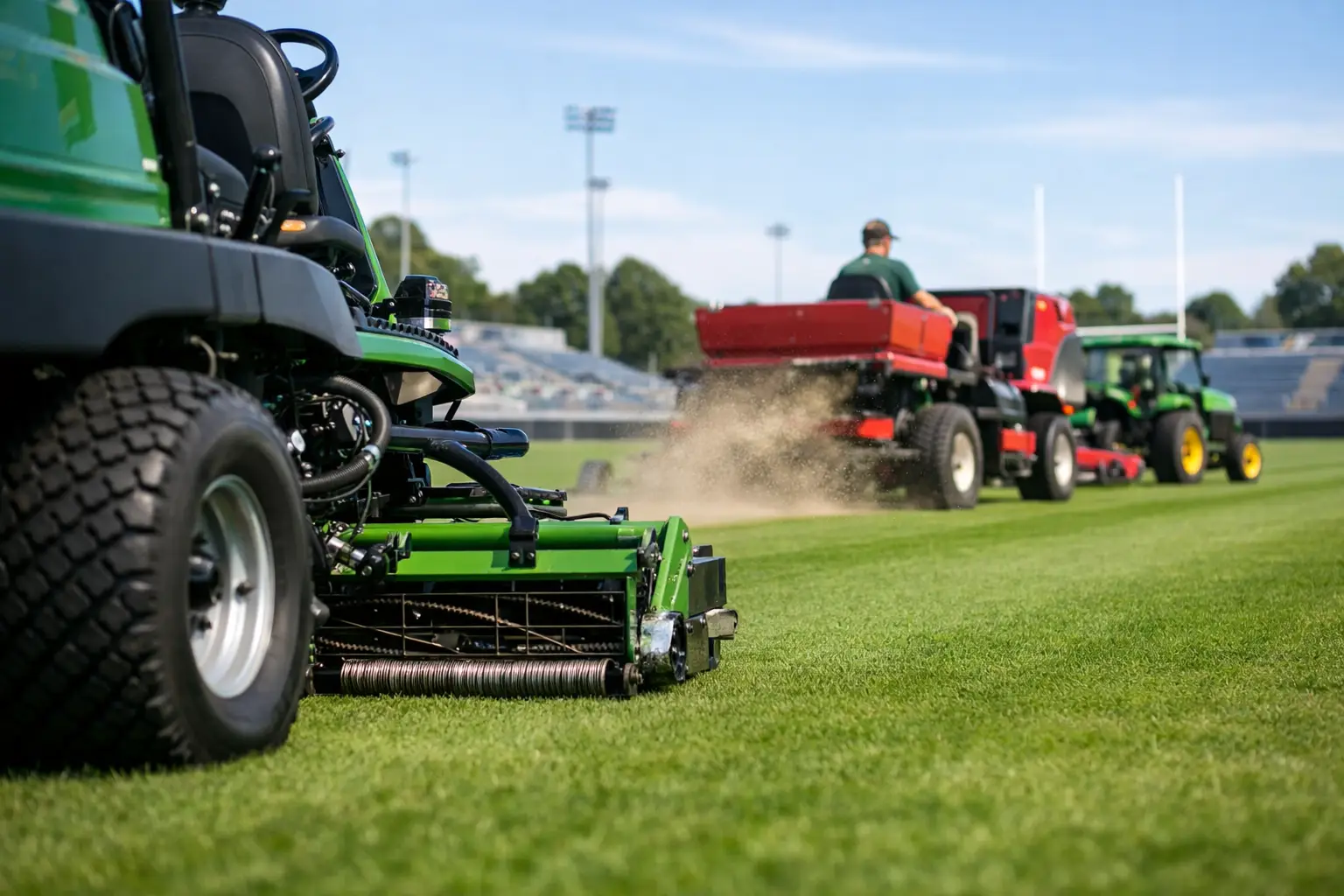
A Saturday fixture rarely exposes just one weak cut. It exposes inconsistent presentation, missed edges, uneven growth and a grounds team forced to recover time they did not have. The right sports turf machinery changes that position. It gives professional operators more control over cutting frequency, surface consistency and labour deployment, without lowering the standards expected by players, clubs and facility users.
For sports grounds, machinery selection is not simply a question of buying the newest mower. It is a workflow decision. The equipment must suit the surface, the fixture calendar, access routes, staffing model and the level of finish required across the site. Autonomous mowing now has a clear role in that decision, particularly where routine cutting absorbs skilled labour that is needed elsewhere.
Sports Turf Machinery Is a System Decision
A well-managed sports site rarely has one mowing requirement. Stadium-quality natural turf, training pitches, cricket outfields, school playing fields and multi-use grounds all demand different cutting approaches. Even within a single football or rugby facility, the main pitch may require a tightly controlled finish while perimeter areas, warm-up zones and adjacent grassland need a more practical maintenance programme.
That is why the most effective machinery fleets are built around defined jobs rather than brand loyalty or habit. Cylinder mowing remains central where presentation and cut quality are the priority. Rotary mowing provides useful capacity on longer or less refined areas. Autonomous equipment can take on frequent, repeatable mowing routes, keeping turf within its target height while reducing the pressure on operators during the working week.
The result is not necessarily fewer machines. It is a better division of work. A robotic mower may maintain routine growth across a defined area, allowing the grounds team to focus on pitch preparation, line marking, repair work, irrigation checks and post-match recovery.
Match the Machine to the Playing Surface
Before comparing specifications, define what the surface needs to achieve. A machine that performs well on a broad training area may not deliver the finish required on a closely presented match pitch. Likewise, a premium cylinder solution can be difficult to justify for areas where cutting frequency and reliable coverage matter more than striping.
Fine turf and presentation pitches
For high-profile football, rugby and hockey environments, cut quality is only one part of the picture. Operators need predictable height of cut, clean presentation, minimal disruption and the ability to prepare the surface around fixtures. Cylinder mowers are the established choice where a precise, close finish is required, especially when regular mowing supports density and appearance.
Autonomous cylinder mowing can strengthen this approach where the site layout and operating plan are suitable. Regular, lightly managed cutting helps avoid excessive leaf removal in a single pass and can support a consistently presented surface. It does not remove the need for professional judgement. It gives that judgement more time to be applied where it matters.
Training grounds and multi-pitch estates
Training sites face a different pressure: acreage, traffic and a constant requirement for playable grass. Here, the value of autonomous mowing is often most obvious. Multiple pitches and surrounding areas can consume hours of routine mowing each week, particularly during peak growth periods.
A professional robotic mower can maintain programmed areas at frequent intervals, including during periods when the team is committed to match preparation or other scheduled work. This is particularly valuable for facilities with lean staffing, extended operating hours or large numbers of pitches to manage.
Larger, variable grass areas
Rotary and high-capacity robotic mowers have a place where grass is maintained for use, safety and overall presentation rather than fine finish. Club approaches, spectator zones, boundary areas and general amenity grass often require efficient coverage and dependable operation over a larger footprint.
The trade-off is straightforward. A wider, faster solution may improve capacity but will not always produce the same surface finish as a cylinder mower. The correct choice depends on the standard required for that particular zone, not on applying one mowing method across the entire estate.
Where Robotic Mowing Creates Capacity
Robotic mowing is most valuable when it is assigned to consistent, repeatable work. It is not a replacement for every task performed by an experienced grounds professional, nor should it be sold as one. It is a practical way to remove the routine cutting burden that prevents skilled staff from completing higher-value maintenance.
On a sports site, that can mean maintaining a pitch or training area between scheduled presentations, repeatedly mowing designated outfield zones, or keeping grass growth controlled around the venue. The machine works to a planned operating pattern while the team directs its attention to turf health, fixture demands and surface detail.
This change matters because labour availability remains a serious operational constraint. When one operator spends several hours each day carrying out repetitive mowing, essential work can become reactive. Aeration, repairs, renovation planning, irrigation adjustments and disease monitoring are all easier to manage when routine mowing no longer dictates the entire day.
At GrassRobotics, professional autonomous solutions are positioned for this operational purpose: precision mowing that supports the wider maintenance programme, rather than consumer-grade automation adapted to a commercial setting.
Plan the Operating Model Before You Buy
The strongest machinery investment begins with a site assessment. Consider the practical realities that determine whether a mower will deliver its intended value: surface area, gradients, obstacles, access between zones, charging or service locations, mowing windows and the frequency of public or player activity.
For robotic equipment, boundary definition and route planning deserve particular attention. Marked playing surfaces, goal areas, drainage features, trees, bunkers, paths and changing site access all affect how an autonomous solution should be deployed. A professional installation should reflect the way the venue actually operates, including match-day restrictions and seasonal changes.
Charging capacity and working time also need to be assessed against growth rates. A mower that is correctly sized for a dry summer week may struggle if the mowing programme has not allowed for fast spring growth, wet conditions or additional areas being added later. Building in capacity protects consistency when demand rises.
Integration with the existing fleet is equally important. The robotic mower may handle routine maintenance, while a cylinder mower remains available for pre-match presentation and a rotary mower manages rougher or peripheral ground. That combination is often more productive than trying to force one machine into every role.
Measure Value Beyond Labour Hours
Labour saving is an important reason to invest in sports turf machinery, but it should not be the only measure of value. A credible business case considers the quality and timing of work released by automation. If routine mowing is reduced, what can the team complete instead? Better repairs, closer inspection, more accurate line marking and earlier intervention can all protect playing quality.
Consistency also has commercial value. Facilities that host fixtures, hire pitches or serve members are judged by the condition of their surfaces. Reliable mowing intervals help maintain a professional appearance and reduce the peaks and troughs that occur when cutting is delayed by weather, absence or a packed fixture schedule.
There are costs to acknowledge. Autonomous machinery requires planned installation, operator familiarisation, servicing and a clear response process for alerts or site changes. It also needs the right environment. A fragmented site with difficult transfers between areas may require several units, revised access arrangements or a different mix of equipment. The investment works best when the operating model is designed around it.
Keep the Grounds Team in Control
Autonomy should improve decision-making, not distance the grounds team from the surface. The best results come when operators review cutting performance, adapt schedules to weather and growth, and retain control of the final presentation standard. A machine can repeat a route accurately; it cannot replace a head groundsman’s understanding of a stressed goalmouth, a wet corner or the demands of an upcoming fixture.
The practical goal is a maintenance operation with more capacity and fewer compromises. Choose sports turf machinery that gives each surface the right level of care, then use autonomy where repeatability produces genuine operational gains. When routine mowing is planned rather than chased, the team has more time to deliver the playing conditions that people notice.