
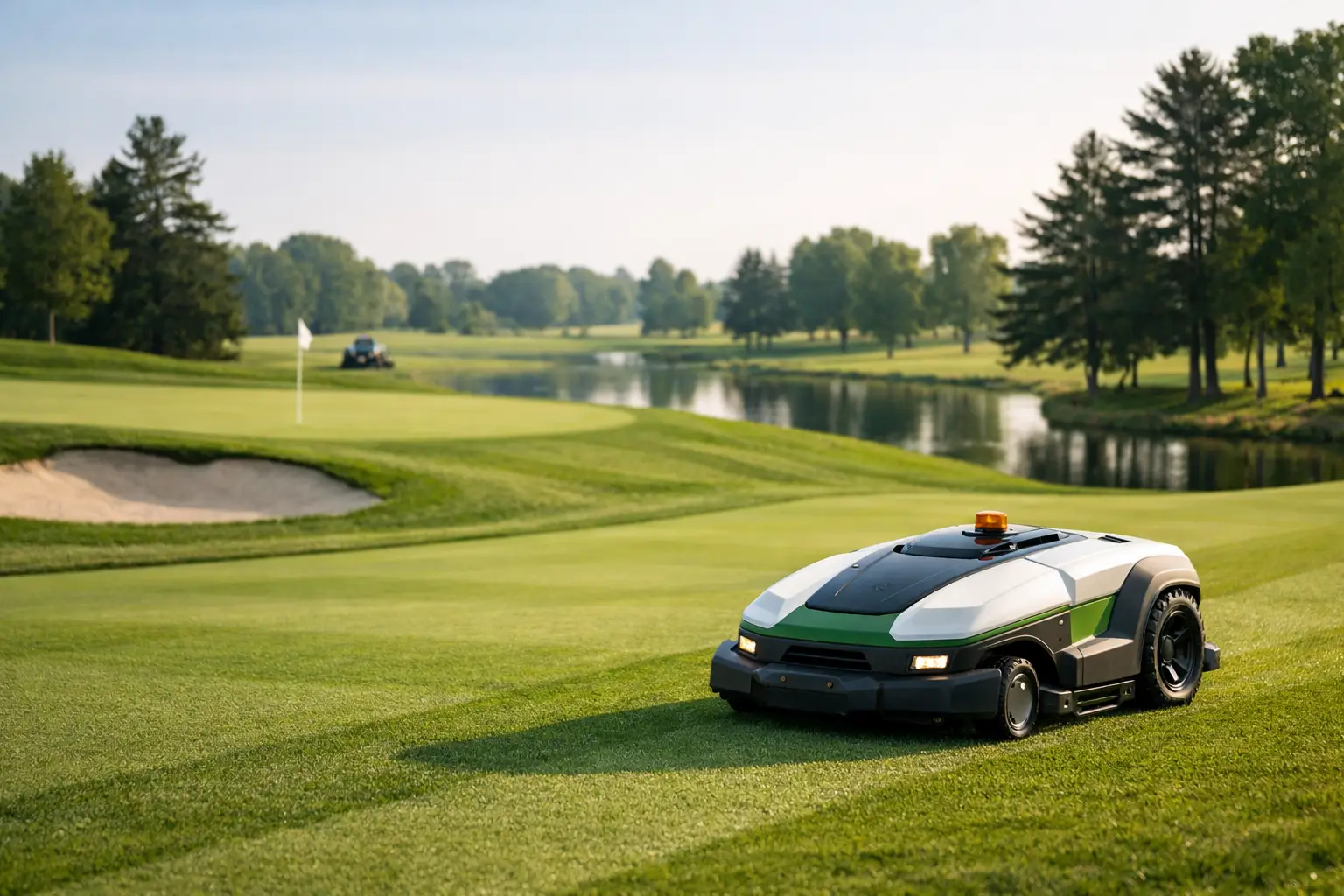
Fairway presentation is judged over hundreds of metres, often before a player reaches the first green. Missed areas, inconsistent stripe definition and cutting carried out at the wrong time quickly affect the perception of the course. This guide to autonomous fairway cutting explains how golf operators can introduce robotic mowing without compromising turf standards, daily set-up discipline or the wider maintenance programme.
Autonomous mowing is not a replacement for sound agronomy or experienced greenkeeping. It is a method of delivering planned, repeatable cutting across large areas while allowing skilled staff to focus on detail work, course preparation and seasonal priorities. The strongest results come when the machine, mowing plan and team workflow are designed together.
Start with the fairway objective
Before selecting equipment or mapping a route, define what each fairway needs to achieve. A championship course preparing for regular competitions may prioritise striped definition, precise edge control and carefully timed presentation cuts. A busy members’ club may place greater value on reliable daily coverage, reduced labour pressure and a consistent height of cut across a large acreage.
Autonomous fairway cutting works best when those expectations are clear. The aim is not simply to make a mower travel independently. It is to maintain an agreed standard of finish at a frequency that supports play, turf health and available resources.
Height of cut, mowing frequency and direction should still be set according to grass species, growth rate, weather and the playing calendar. During strong growth, a machine may need more frequent passes at a conservative removal rate. In slower periods, the programme may be reduced to avoid unnecessary trafficking and energy use. The operating plan must remain flexible enough for the course manager to respond to conditions.
Assess the site before deploying autonomy
Fairways are rarely uniform working areas. They include changing slopes, bunkers, trees, water hazards, irrigation infrastructure, crossing points and rough transitions. A successful installation begins with a detailed site assessment rather than an assumption that every hectare should be treated identically.
Map each operating zone and identify access routes, narrow passages, protected areas and locations where manual finishing will remain necessary. Consider how the machine will travel between work areas, where it will charge, and whether there are predictable interruptions from golfers, maintenance vehicles or events.
Drainage patterns also matter. Wet hollows, soft turn areas and heavily shaded ground can require different scheduling from open, free-draining fairway. Autonomous mowing provides useful consistency, but it should not force mowing when soil conditions make trafficking undesirable. Establish clear stop rules for saturated ground, frost, lightning risk and course closures.
Understand slopes, obstacles and boundaries
A fairway may look straightforward from a distance but include banks, swales and undulating approaches that affect traction and cut quality. Assess the steepest working gradients, the surface condition at turns and the space available around hazards. Purpose-built professional robotic mowers should be matched to the terrain, workload and cutting requirement rather than chosen on area capacity alone.
Boundaries need the same attention. Defined virtual work zones can improve control, but they do not remove the need for a finishing strategy around bunker faces, tree bases, marker posts and tightly shaped fairway edges. In most operations, autonomous mowing handles the main area efficiently while a member of the team completes selected detail work with the appropriate machine.
Build a cutting programme around play
The value of autonomy is not only in labour reduction. It is the ability to schedule repeatable mowing windows that fit the rhythm of the course. Fairways can be maintained outside peak playing periods, with work planned around competitions, member traffic, visitor start times and maintenance activity.
For many sites, the best model is a regular autonomous maintenance cut supplemented by a presentation pass before key events. This approach keeps growth under control through the week and reduces the pressure on staff during competition preparation. It can also help prevent the familiar cycle of delaying fairway mowing because the team is committed to greens, tees, bunkers and essential reactive tasks.
Direction remains a management decision. Alternating patterns can support presentation and help avoid establishing visible traffic lines over time. However, a striped finish should never take priority over practical routing, safe operations or turf condition. On complex fairways, zones may require different patterns or start times to produce a clean, controlled result.
Choose cutting technology for the required finish
The appropriate machine depends on the finish expected, the area to be covered and how the fairway mowing programme sits alongside the rest of the fleet. Rotary robotic mowers can be a practical choice for broad, regular maintenance where productivity and dependable coverage are central. Robotic cylinder mowing may suit areas where a tighter, more refined cut and formal presentation are required.
The decision should account for clipping management as well as the cut itself. Frequent mowing usually produces smaller clippings, which can return to the surface more effectively where conditions allow. Yet heavy growth, wet leaf tissue or periods of stress may change the picture. Review how the chosen cutting system performs across the seasons, particularly during spring flushes and late-autumn growth.
GrassRobotics works with professional operators who need to match autonomous mowing capacity to real turf-care demands, not headline figures. A machine should be evaluated against terrain, daily operating hours, charging time, safety features, cut quality and the support required to keep it productive.
Set up for consistent autonomous fairway cutting
The installation phase determines whether autonomy becomes a dependable part of the maintenance operation or another item that needs constant intervention. Take time to create accurate working areas, safe exclusion zones and sensible routes. Test the programme in normal site conditions, not only on an empty fairway after installation.
Assign clear ownership within the team. Someone should review machine status, inspect the cutting result and record any recurring issues. This does not need to become a time-consuming daily task, but accountability matters. A quick morning check can identify an obstacle, worn blade, damaged turf edge or schedule conflict before it affects the playing surface.
Blade condition deserves particular attention. Dull or damaged blades reduce cut quality and can tear leaf tissue rather than making a clean cut. Maintain a planned inspection and replacement routine based on operating hours, turf conditions and the manufacturer’s guidance. Keep charging areas clean, accessible and protected from avoidable disruption.
Keep manual work in the programme
Autonomy is most effective when it removes repetitive area mowing from the critical path. It does not eliminate the need for professional judgement or finishing work. Bunker surrounds, severe slopes, intricate edges, high-wear turning areas and temporary course set-ups may still require hands-on attention.
This is a strength, not a limitation. When the main fairway area is being maintained consistently, skilled staff have more time for the tasks that genuinely need them: hand mowing, detail presentation, irrigation checks, divot repairs, disease monitoring and preparation for play.
Measure performance beyond hours saved
Labour saving is an obvious starting point, but it is not the only measure of value. Track the consistency of the cut, the number of missed mowing windows, staff hours released for higher-value work and the reliability of the machine across the season. Compare the quality of presentation before and after deployment, particularly on days when the maintenance team is under pressure.
Also measure intervention. If a machine frequently stops because of poor route design, obstacles or unsuitable zones, the issue may be in the operating plan rather than the equipment. Refine boundaries, timings and handover procedures until the autonomous workflow is stable.
Budgeting should include installation, training, routine maintenance and any supporting infrastructure, not simply the purchase price. The commercial case differs between sites. A large course with recruitment challenges may place the greatest value on labour resilience, while a well-staffed venue may focus on freeing experienced greenkeepers for higher-standard presentation work. Both can benefit, provided the mowing plan is realistic.
Treat autonomy as part of course management
Autonomous fairway cutting performs best when it is integrated with irrigation, nutrition, renovation, traffic management and the competition schedule. Share the mowing plan with the whole team so that spraying, topdressing, bunker work and contractor access do not create avoidable interruptions.
Start with a defined area, prove the workflow and expand when the team is confident in the quality and reliability of the result. The most effective robotic mowing programmes are not the ones with the fewest human decisions. They are the ones that give course managers more control over where skilled time is spent, while fairways remain consistently ready for play.