
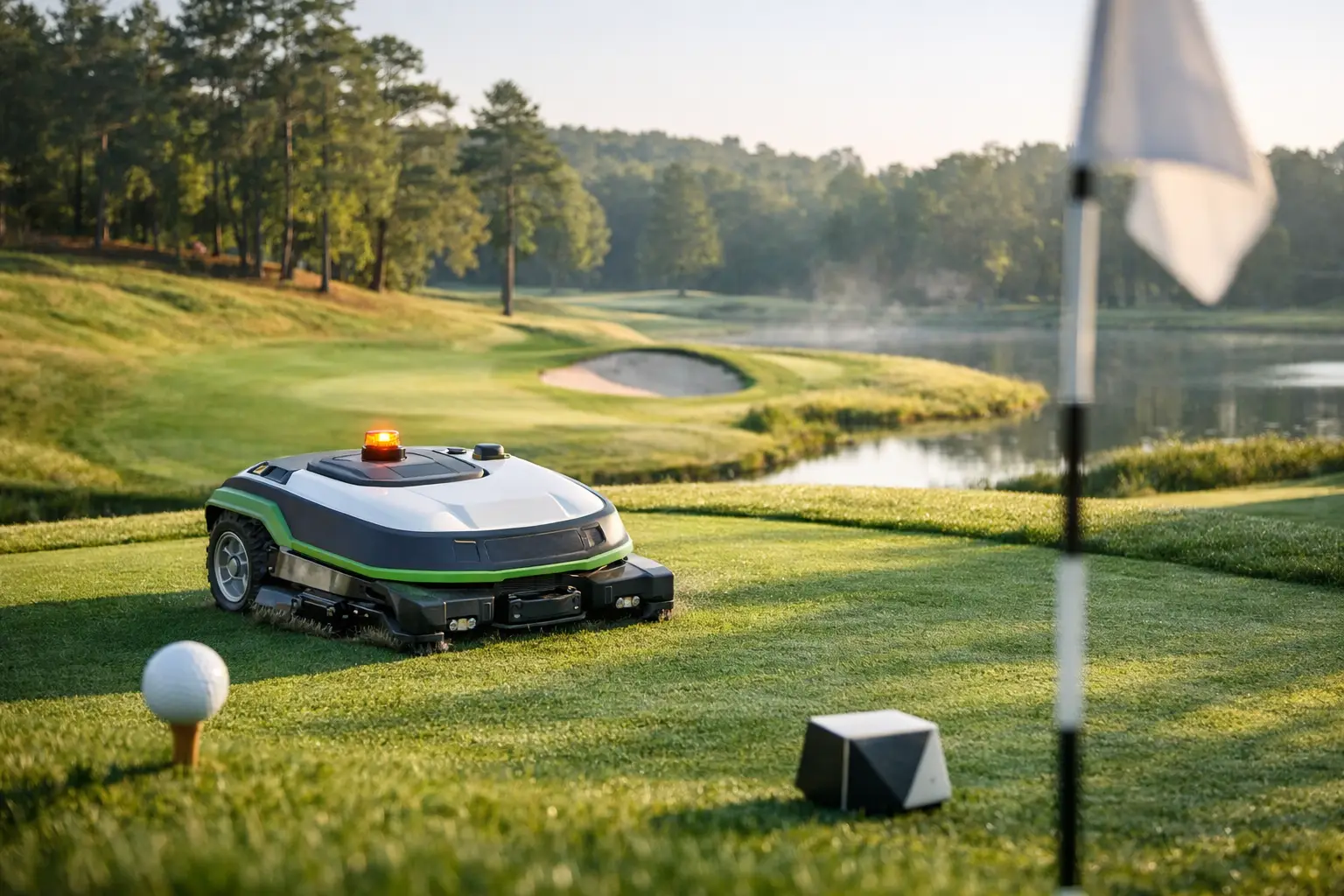
A tee can be only a small part of the course, but it is one of the first surfaces a golfer sees and one of the most exposed to scrutiny. When starts are busy, labour is stretched and presentation standards cannot move, knowing how to automate tee mowing becomes a practical operational question, not a technology experiment.
The right autonomous mowing system can keep teeing areas consistently presented while releasing skilled staff for mowing that requires judgement, course set-up, agronomy and detail work. The result depends less on simply deploying a robot and more on defining the mowing task properly, preparing the site and building a programme around play.
Start with the tee standard, not the machine
Before selecting equipment, define what each tee complex needs to look and play like. A championship tee, a frequently used members’ tee and a forward tee may sit within the same complex but have different traffic, cut-height and presentation requirements. Automation works best when those differences are acknowledged in the operating plan.
Set the target height of cut, preferred mowing frequency, acceptable clipping volume and finish required around markers, bins and paths. Also decide whether the robot will manage the full tee surface or a defined core area while the team completes perimeter work and final detailing. In many cases, that division of labour is the most productive approach.
Autonomous mowing is particularly effective where frequent, light cuts support a clean appearance and even turf response. It is not a replacement for agronomic decision-making. Growth flushes, drought stress, disease pressure and recovery from heavy wear still require the course team’s assessment.
Assess each tee complex before automation
A site survey should be specific to tee mowing, rather than treating the course as one large mowing area. Tee boxes often include changes in level, tight edges, surrounding rough, bunkers, paths, irrigation hardware and busy player routes. Each feature affects boundary design, machine access and safe operating windows.
Measure the usable mowing area and note slopes, abrupt banks, drop-offs and narrow transitions between tees. Identify where a robotic mower can enter and leave without crossing a playing line, damaging an edge or conflicting with pedestrian traffic. The charging point needs a secure, level position with reliable power and a route that does not create disruption during the morning start.
Satellite reception and communications should be checked at every proposed working area. Mature trees, buildings and landform can affect positioning performance, especially on enclosed tee complexes. Where the site uses virtual boundaries and satellite-guided operation, this survey is fundamental to reliable cut patterns and repeatable working zones.
Separate tees from surrounds where needed
It can be tempting to include the tee, approach paths and surrounding semi-rough in one automated area. That only works if all surfaces share a compatible cut-height and mowing objective. More often, the tee should be a dedicated zone, with precise boundaries that protect its presentation edge.
Treating adjoining areas separately gives the greenkeeping team better control. It prevents a robot set for tee quality from spending unnecessary hours in low-priority grass and makes it easier to pause work on a specific tee during competitions, maintenance or repairs.
Choose a mower that matches the finish
The decision is not simply robotic versus manual. It is about the cutting system, capacity, manoeuvrability and control method that suit the standard of the surface.
For close-cut, high-presentation tees, an autonomous cylinder mower may be the correct fit where the required finish and cut quality demand it. For larger or less intensively presented teeing grounds, a professional robotic mower configured for frequent maintenance may provide the most efficient route to consistency. The right choice depends on grass species, desired height of cut, area size, terrain and the amount of complementary hand work retained in the programme.
Avoid selecting on headline area capacity alone. A machine may have sufficient capacity on paper but lose productive time negotiating transfers, waiting for charging, avoiding busy routes or cutting sections that are better handled by another mower. The useful measure is whether it can complete the planned work within the available operating window, with reserve capacity for peak growth.
Map boundaries and exclusions with precision
Once the mowing zones are agreed, map the working boundaries carefully. The edge should reflect how the tee is actually maintained, not merely the broad outline visible from a plan. Leave appropriate buffers around bunker faces, retaining edges, steep drops, water features and fixed furniture.
Create exclusion zones for irrigation boxes, marker storage points, sign bases and any obstacle that is not reliably detectable or should not be approached. If tee markers are moved daily, design the programme so the mower operates when they have been removed, relocated or are clearly outside the cutting area.
A well-defined map also gives the team control over temporary changes. After overseeding, topdressing, aeration or repair work, a tee can be paused without affecting the rest of the autonomous fleet. That flexibility is more valuable than a rigid all-or-nothing programme.
Build a mowing schedule around play and growth
The strongest case for automated tee mowing is consistency. Frequent mowing reduces the need to remove large volumes of leaf material in a single pass and helps maintain a tidy surface through the week. However, frequency must be matched to growth, not left unchanged because the system is autonomous.
Schedule work in periods that minimise interaction with golfers and routine course activity. Early morning, quiet afternoon periods or overnight operation may suit the course, provided visibility, safety procedures and local conditions support it. During competitions, reserve a clear no-mow window for key tees and use the system’s zone controls to protect the presentation of the course set-up.
Weather should also influence the programme. Persistent rainfall can increase wheel-marking risk and soften access routes. During dry periods, consider whether mowing frequency, operating hours or travel routes should be adjusted to reduce stress on the sward. A robot can work to a programme, but the programme should remain responsive to the turf.
Put safety and daily checks into the workflow
Professional autonomy requires clear responsibility. Establish who checks the mowing zones, who can start or pause work, and who responds to alerts. A quick morning inspection should confirm that the area is clear of loose items, temporary signage, debris and new hazards created by weather or course operations.
The team should also inspect cut quality, wheel tracking, edges and clipping distribution. These checks are not an admission that automation needs constant intervention. They are how a professional operation verifies that a repeatable process continues to meet the required standard.
For busy sites, define protocols for golfers, contractors and maintenance staff working near autonomous equipment. If a particular tee is being prepared, irrigated or set for an event, take that zone out of service rather than relying on informal communication.
Measure the result in labour quality, not just hours saved
Labour reduction matters, but it is only one measure of success. Track the manual mowing hours removed from tee maintenance, then record where those hours are redeployed. The best outcome is not simply fewer hours on a timesheet. It is more time available for hand finishing, bunker detail, irrigation inspection, machinery care and the work that shapes playing conditions.
Review presentation and turf performance as well. Compare cut consistency, complaints, recovery after wear and the number of missed mowing windows before and after deployment. If the robot is producing a reliable baseline while the team has more capacity for high-value tasks, the system is doing its job.
Initial commissioning should include a period of adjustment. Boundaries may need refining, schedules may need shortening and certain transfers may prove unsuitable once the course is in full use. That is normal. Treat the first weeks as operational tuning rather than a fixed installation.
For golf operators considering how to automate tee mowing, the practical route is to automate repeatable cutting while retaining professional control over standards, timing and turf health. GrassRobotics can help frame that decision around the tee complex, the course routine and the performance level expected by members and visitors. Done properly, autonomous mowing gives the greenkeeping team something more useful than extra machinery: dependable capacity when the course needs it most.