
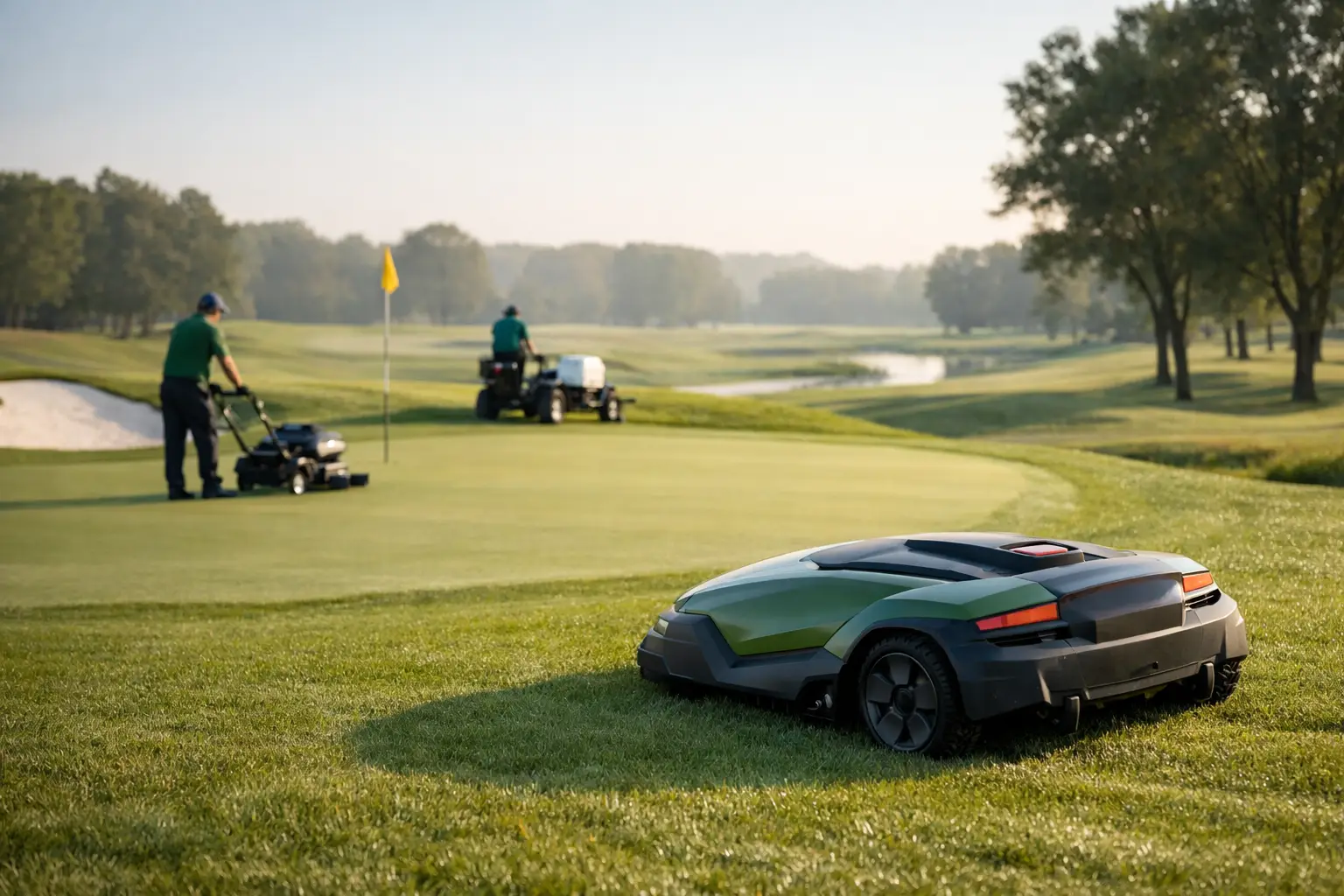
When a course is carrying vacancies, seasonal pressure and rising expectations all at once, labour stops being a staffing issue and becomes an operational risk. That is why more managers are asking how to reduce greenkeeping labour without letting presentation slip, surfaces drift, or the team spend every morning chasing the same routine tasks.
The short answer is not to ask fewer people to do more forever. That approach usually leads to rushed setup, inconsistent cutting windows, delayed detail work and higher wear on the team you are trying to retain. A better route is to remove avoidable labour from the system, starting with the tasks that are repetitive, time-sensitive and difficult to staff reliably.
How to reduce greenkeeping labour without lowering standards
On most sites, labour pressure is not spread evenly. It sits heavily around mowing frequency, transport time between areas, machine changeovers, line marking or setup work, and the constant need to react to weather and play schedules. If you want to reduce labour properly, you need to look at where skilled hours are being consumed by predictable work.
That matters because not all greenkeeping hours deliver the same value. A qualified operator checking greens performance, managing moisture, planning inputs or resolving wear on high-traffic areas is using judgement. A skilled operator spending large parts of the week repeating broad-area mowing is spending judgement on a task that can increasingly be standardised or automated.
For golf and sports turf environments, the labour-saving opportunity usually starts with mowing because it is frequent, visible and expensive in accumulated hours. It also affects the rest of the working day. When routine cutting absorbs the morning, everything else moves back – presentation tweaks, repairs, course setup, bunker work and reactive agronomy.
Start with a labour map, not a machine brochure
Before changing equipment or workflows, map your week in practical terms. Look at total labour hours by task, but also look at timing. A job that takes six hours a week may be less of a problem than a job that demands three staff between 5.30 am and 8.00 am every playable day.
Most sites benefit from breaking labour use into three categories. First, essential skilled tasks that need trained staff on the ground. Second, repeatable operational tasks that are necessary but not the best use of skilled labour. Third, avoidable friction such as transporting kit, waiting for access, duplicated passes, or mowing schedules that exist because they always have.
This is where many labour-reduction plans become more realistic. The goal is not simply to cut headcount. The goal is to protect scarce skilled labour for work that genuinely improves playing quality and site condition.
Ask where labour is fixed and where it is flexible
Some labour demand is fixed by the site. Greens still need close attention. Sports surfaces still need presentation and recovery work. Competition schedules still create pressure points. But a surprising amount of labour is flexible if the mowing model changes.
If fairways, rough margins, outfields, surrounds or selected approach areas can be maintained autonomously, the site gains more than hours on paper. It gains planning freedom. Staff can start the day on jobs that require inspection, adjustment and finish quality rather than simply trying to get around the property in time.
Reduce routine mowing hours first
If you are serious about how to reduce greenkeeping labour, broad-area mowing is usually the first place to act. It is one of the biggest recurring calls on labour, fuel, transport and machine time, especially across larger golf and sports sites.
Autonomous mowing changes the labour equation because it converts a repeated manual task into a controlled process. Instead of assigning staff to cover acres on a set route, the mowing is handled continuously or to a defined schedule, with human input focused on oversight, deployment and exceptions rather than constant operation.
That shift is valuable even before you calculate direct labour savings. Turf managers know that consistency is hard to maintain when staffing levels fluctuate, weather windows close, or one machine operator is pulled elsewhere. Autonomous systems bring repeatability to the areas where repeatability matters.
There is, however, a trade-off. Not every area should be treated the same way, and not every site needs the same level of autonomy. Tight presentation zones, specialist finishes and tournament preparation may still suit conventional or semi-autonomous approaches in parts of the property. The strongest labour-reduction strategies are selective. They automate where consistency and hours matter most, then keep staff focused on surfaces and details where judgement remains critical.
Rebuild the day around higher-value work
Once routine mowing is reduced, the next gain comes from reorganising the team’s day. This is where some operators miss the real benefit. They save mowing hours but leave the rest of the workflow unchanged, so the labour saving never fully appears.
A better approach is to redesign the daily plan around skilled interventions. Use early hours for inspections, play preparation, moisture management, setup accuracy and repairs. Move from reactive working to planned attention. If staff are no longer tied to long mowing runs, they can get ahead of the issues that usually grow into labour-heavy problems later in the week.
That change often improves standards as well as efficiency. Better timing on detail work produces more visible results than simply adding speed to a stretched mowing rota.
Focus staff on finish, not repetition
Professional turf quality is rarely lost because there were too few mowing hours in isolation. It is usually lost because the team had no time left for refinement. Scar edges were ignored, wear points were left another day, presentation details were compressed, and surface performance checks became rushed.
Reducing labour demand from routine cutting allows experienced staff to work where they make the greatest difference. That is a stronger long-term model than relying on constant recruitment in a market where skilled greenkeepers and grounds staff remain difficult to source.
Standardise the jobs that create hidden labour
Not all labour pressure comes from major tasks. Smaller inefficiencies accumulate quickly across a week. Repeated machine swaps, awkward movement between detached areas, duplicated mowing patterns, and manual marking or trimming routines can quietly consume substantial time.
The fix is not glamorous, but it is effective. Standard operating routes, clear area allocation, planned charging or refuelling windows, and reducing unnecessary machine movements all cut wasted minutes. On a large site, those minutes become meaningful labour.
Autonomous equipment supports this because it reduces the need for constant operator presence in the first place. But the equipment alone is not the answer. Labour falls fastest when autonomy sits inside a disciplined operating plan.
Choose equipment around labour outcome, not novelty
There is now plenty of talk about robotics in turf care, but professional buyers know the question is not whether a machine is autonomous. The question is whether it removes real labour from the operation while maintaining a standard the site can defend.
That means assessing machines by application. Greens, fairways, tee boxes, sports pitches and larger managed areas all have different expectations around finish, frequency and manoeuvrability. The right choice depends on the area being automated, the quality target, site layout and how the machine fits into the broader maintenance plan.
For some venues, the labour win will come from autonomous mowing on fairways and surrounds. For others, it may be marked playing surfaces, rough management or repeat cutting on sports turf where consistency matters and labour is tight. A solution-led approach will always outperform buying on headline features alone.
This is where specialist suppliers such as GrassRobotics are strongest. The value is not only in supplying autonomous machines, but in matching the right system to the actual labour bottleneck on site.
Measure labour saved properly
If you want a credible case for investment, measure the result in more than hours removed from mowing. Track redeployed hours, reduced overtime pressure, fewer delayed tasks, improved consistency of cut, and the extent to which key standards are maintained during staff shortages or peak periods.
That broader view matters because labour reduction is often about resilience as much as simple cost. A site that can maintain quality with fewer staffing vulnerabilities is in a stronger operational position than one that depends on every rota gap being filled.
It is also worth being honest about implementation. Autonomous systems still need planning, boundary design, maintenance oversight and periodic review. They reduce labour, but they do not remove management. The practical gain is that management time replaces repetitive operating time.
The strongest labour strategy is selective automation
For most professional turf environments, the answer to how to reduce greenkeeping labour is not a single change. It is a combination of removing routine mowing hours, protecting skilled labour for technical work, tightening daily workflows and using autonomous equipment where it delivers dependable operational value.
That approach is more sustainable than simply asking teams to work harder with less. It gives course managers and grounds professionals a way to stabilise standards, improve productivity and reduce dependence on labour that is increasingly difficult to recruit and retain.
If labour pressure is becoming the factor that dictates what your site can and cannot deliver, that is usually the point where automation stops being a future idea and starts becoming a practical management decision.