
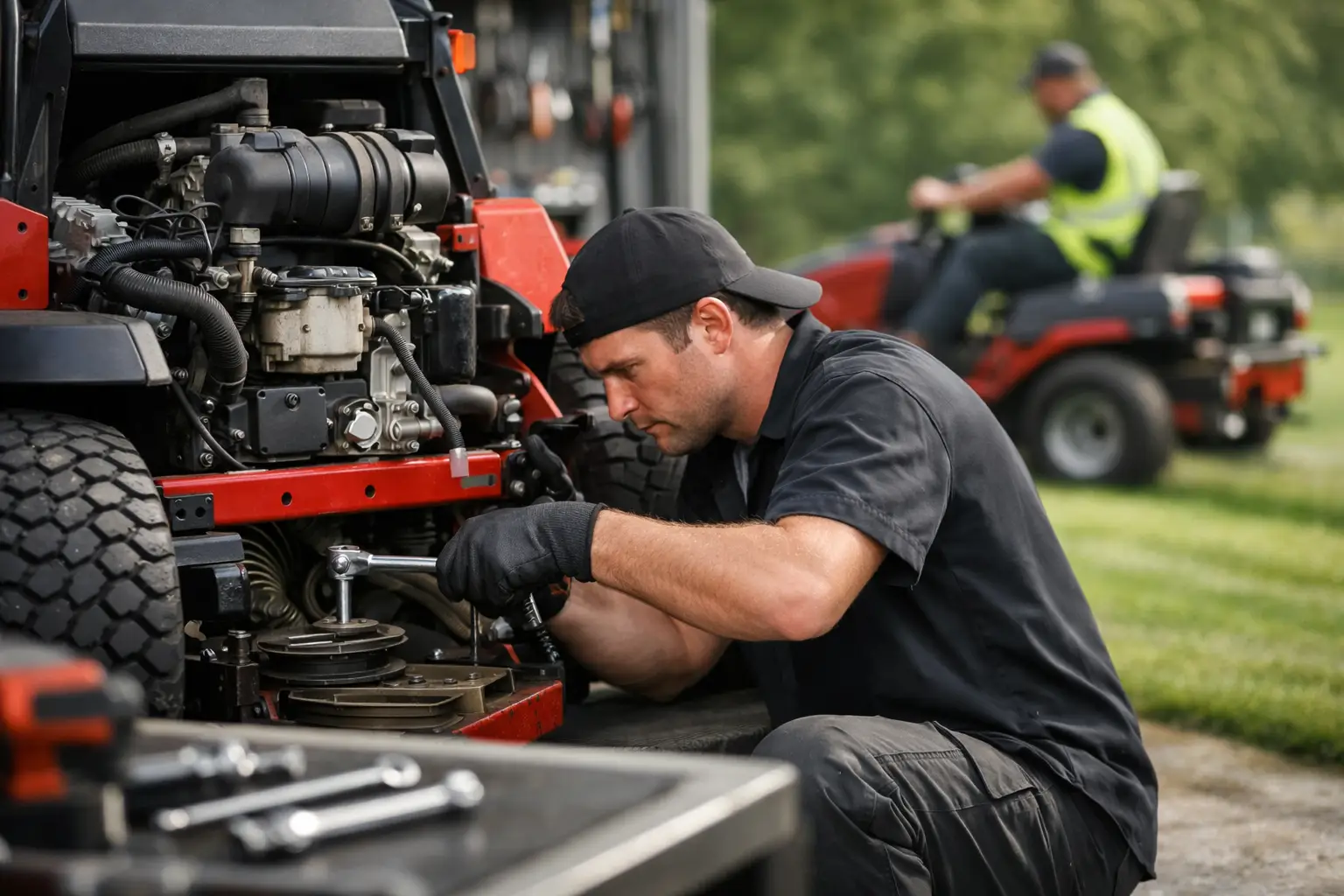
Lost mowing hours rarely come from one major failure. More often, they disappear in small delays – waiting for an operator, moving machines between areas, stopping for fuel, dealing with missed cuts, or pulling a unit out of rotation when conditions change. If you are looking at how to reduce mowing downtime, the real issue is not simply machine reliability. It is how the whole mowing operation performs across the day, the week and the season.
For golf courses, sports pitches and large managed turf sites, downtime has a direct cost. Presentation drops, labour gets diverted, and reactive work starts to replace planned maintenance. That is why reducing downtime is less about squeezing more speed from the same process and more about removing the weak points from the system.
How to reduce mowing downtime by fixing the workflow
Many teams first look at maintenance intervals or replacement parts, which matters, but that is only one part of the picture. A site can run dependable machines and still lose hours because the mowing workflow is inefficient.
Start with handover points. If mowing depends on one key operator being available at a specific time, the schedule is fragile. If one fairway unit is tied up elsewhere, the next task slips. If clippings management creates repeated emptying stops, the machine is technically running but output is still lower than planned.
The most effective operators look at downtime in three categories. The first is mechanical downtime, where the machine is unavailable because of faults or servicing. The second is operational downtime, where the machine is ready but not cutting because of transport, setup or staffing issues. The third is quality downtime, where the area needs to be revisited because the first pass did not meet standard. That last category is often underestimated.
Once those categories are clear, patterns usually emerge quickly. Greens may be delayed by morning labour pressure. Sports pitches may lose time around line marking or fixture preparation. Fairways may look efficient on paper but still absorb hours in transport and supervision.
The biggest causes of mowing downtime on professional turf
Labour dependency remains one of the main causes. On many sites, mowing capacity is limited less by the number of machines available and more by the number of competent operators available at the right moment. Absence, turnover and seasonal staffing gaps all create downtime, even when equipment is in full working order.
Transport and repositioning are another frequent issue. Large sites often lose more time moving machines to the work area than cutting once they arrive. This is especially true where teams are covering dispersed greens, tee boxes, fairways or multiple pitches with conventional equipment.
Weather also creates a more complex downtime problem than many schedules allow for. Wet conditions do not just delay cutting. They can compress the whole maintenance window, forcing crews to prioritise urgent areas and defer others. That can then create a backlog which increases pressure on labour and machinery later in the week.
Then there is inconsistency of cut. If the machine or the operating method produces variable results, teams end up correcting rather than progressing. Double cutting, edge cleanup and unplanned return visits all count as downtime in practical terms, even if the machine is technically active.
Match the machine to the surface, not the habit
A common reason downtime persists is that sites continue using familiar machine types for jobs that would benefit from a different approach. That does not mean every area should be automated or every conventional machine should be replaced. It means the mowing setup should reflect the surface, the frequency required and the labour reality on site.
High-frequency areas such as greens approaches, fairways, surrounds and sports pitches often benefit most from autonomous mowing because the time burden is repetitive and predictable. Where the standard depends on regularity rather than occasional heavy intervention, autonomy can remove the daily pressure points.
By contrast, specialist presentation work or recovery situations may still suit conventional manned equipment. The point is not to force one method everywhere. The point is to stop using labour-intensive processes in areas where automation can deliver the same or better consistency with far less interruption.
This is where professional robotic mowing differs sharply from consumer-grade expectations. On managed turf, the question is not whether a robot can cut grass. The question is whether it can sustain output, maintain quality and reduce dependence on scarce labour across demanding surfaces. When specified correctly, that answer is increasingly yes.
How autonomous mowing reduces downtime in practice
Autonomous mowing reduces downtime because it removes several failure points from the process at once. It reduces reliance on operator availability, cuts transport inefficiency, and supports a more consistent cutting frequency. Instead of waiting for a crew slot, the area can be maintained continuously within a planned operating window.
That matters because turf quality is strongly tied to consistency. When grass is cut little and often, the result is more predictable and the workload becomes easier to control. There is less catch-up mowing, fewer visible fluctuations in presentation and less need to reorganise labour around missed intervals.
Autonomous systems also improve resilience. If one member of staff is diverted to irrigation, bunker work or repairs, mowing output does not disappear with them. The machine keeps working. That changes the labour model from constant direct input to supervised productivity.
For sites managing multiple priorities, this is often where the strongest commercial value appears. Labour can be reallocated to specialist tasks that still require judgement and finishing skill, while routine cutting continues in the background. GrassRobotics positions this correctly as a practical productivity upgrade, not a novelty purchase.
Build maintenance around uptime, not around breakdowns
Even the best mowing setup will suffer if maintenance is purely reactive. Professional sites need a maintenance rhythm designed to protect uptime.
That starts with daily checks that are actually used, rather than treated as box-ticking. Blade condition, cleanliness, battery or charging performance, wheel condition, sensor function and cut quality all affect uptime before a machine ever fails outright. A poor-quality cut is often the first sign of a problem.
It also means planning service intervals around the operating reality of the machine. Equipment running on high-frequency schedules across large acreage needs servicing based on actual workload, not generic assumptions. Waiting until performance drops is usually too late.
There is a trade-off here. Tighter maintenance discipline can appear to increase planned stoppages. In reality, it reduces disruptive stoppages and protects the schedule. For most professional operators, planned maintenance is easier to absorb than lost output during a peak growth period.
Use data to spot hidden downtime
If your team only tracks whether mowing was completed, you may miss where time is being lost. The better approach is to track productive cutting time against total machine time, revisit rates, labour hours per hectare and schedule adherence by surface type.
Those figures show whether a problem sits with machine capacity, staffing, route planning or quality control. They also help justify investment decisions. If a fairway programme is repeatedly absorbing skilled labour for routine work, that may support a move towards autonomous mowing. If a pitch operation is missing windows because transport and setup consume too much time, that points to a workflow redesign.
Data is especially useful when comparing perception against reality. Many teams assume breakdowns are the main source of downtime, then find the bigger issue is simply waiting for labour or repeatedly revisiting areas due to inconsistent cutting.
Where to start if you want to reduce downtime quickly
The fastest gains usually come from one targeted change, not a full operational overhaul. Start with the area that combines high mowing frequency, strong visibility and repeated labour demand. On a golf site, that might be fairways, surrounds or approaches. On a sports site, it may be a main stadium pitch, training grid or a cluster of regularly used surfaces.
From there, assess three things. First, how often is mowing delayed because labour is unavailable or redirected? Second, how much output is lost to transport, setup and supervision? Third, how often does the area need corrective attention because the mowing interval slipped?
If those pressures are recurring, automation is worth serious consideration. Not because it replaces every part of the maintenance team, but because it removes routine pressure from the system. That is usually the difference between a site that is constantly recovering and one that is operating to plan.
Reducing downtime is not about chasing a perfect machine or a perfect week. It is about creating a mowing operation that keeps delivering when labour is tight, conditions shift and standards stay high. The more your setup can maintain output without constant intervention, the more control you gain over the rest of the turf programme.