
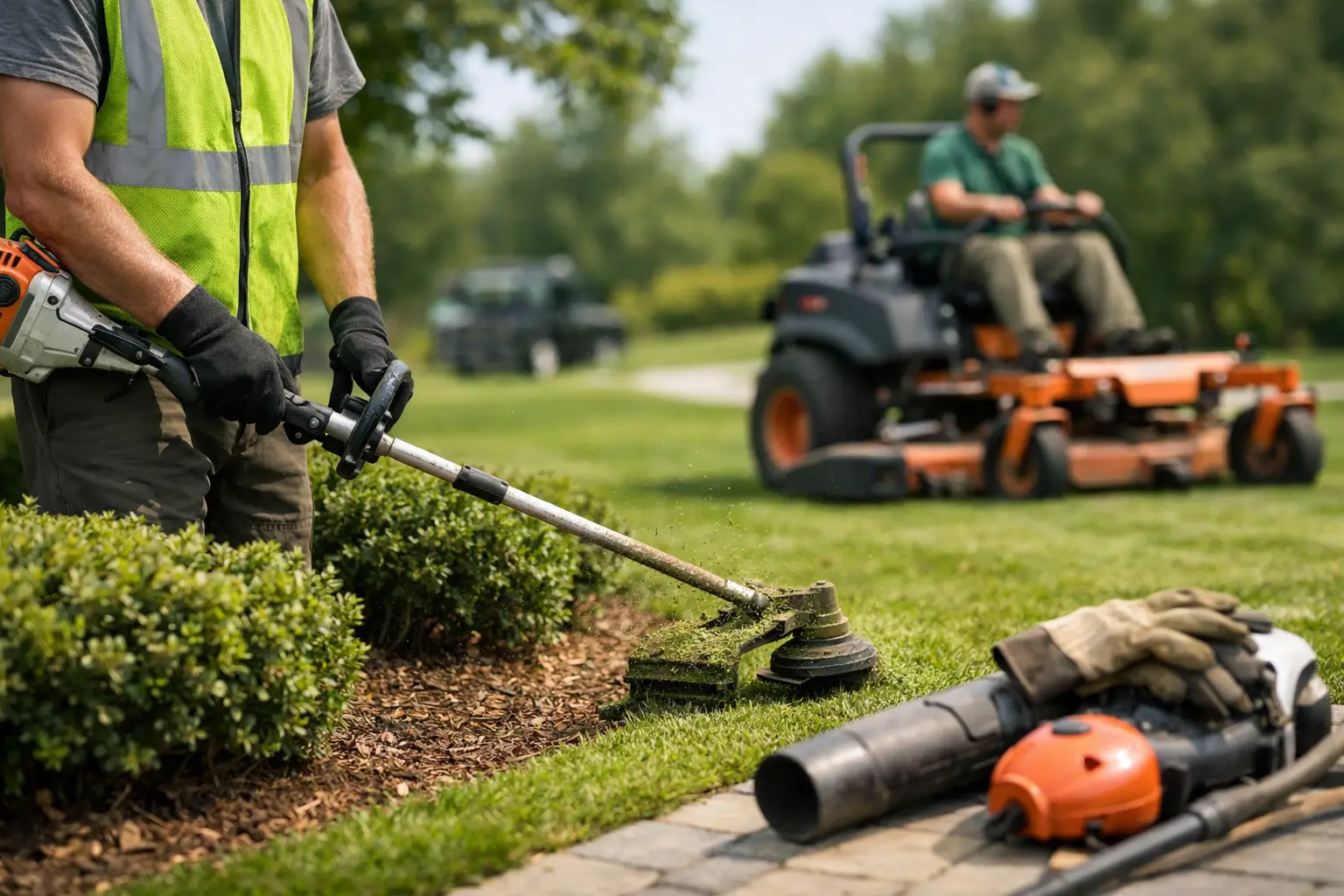
When a skilled operator spends half the morning on repetitive mowing instead of presentation work, line marking, repairs or turf improvement, labour cost is already running in the wrong direction. For sites under pressure to reduce labour costs grounds maintenance budgets often absorb the strain first – especially across golf, sport and large commercial turf where standards cannot slip.
The difficulty is not simply hourly wage inflation. It is the combined effect of recruitment pressure, inconsistent labour availability, rising expectations around presentation, and the amount of time tied up in repeatable tasks. If you are managing fairways, tee boxes, rough, training grounds or marked sports surfaces, the real question is not whether labour costs are rising. It is where labour is being wasted, and which work should no longer rely on manual input.
Where labour costs really build in grounds maintenance
Most grounds teams do not lose efficiency on specialist tasks. They lose it on frequency. Mowing is the obvious example because it happens constantly, across large areas, and often at times when labour could be better used elsewhere.
A team may look fully occupied while still being inefficient. One operator is mowing outfield, another is transporting equipment, someone else is covering edging or trimming created by a previous pass, and a supervisor is reorganising the day around weather or staff absence. None of that is unusual. The issue is that repeated manual deployment across predictable tasks creates a cost base that keeps growing without improving output.
This is why labour reduction should not be approached as simple headcount cutting. In professional turf care, that is usually the wrong lens. The better objective is to shift labour away from repetitive area maintenance and into skilled, higher-value work. That protects standards while improving cost control.
Reduce labour costs grounds maintenance teams can actually control
The fastest savings usually come from changing task design, not demanding more from the same staff. If mowing routes, machine choice, hand-off points and operator time are poorly structured, even a strong team will underperform commercially.
Start with task mapping. On most sites, a relatively small number of activities consume a disproportionate share of labour hours. Large-area mowing, repeated transport between zones, manual cutting of predictable spaces, and reactive rescheduling after weather events are common examples. Once those hours are visible, the next step is deciding which tasks truly need a person on the machine.
That distinction matters. High-skill work such as presentation detailing, renovation support, surface assessment and problem-solving still depends on experienced staff. Straightforward, repeatable mowing over defined areas increasingly does not. That is where automation has a direct effect on labour cost.
Why autonomous mowing changes the cost structure
Autonomous mowing is not just another equipment upgrade. It changes how labour is allocated across the site. Instead of assigning a member of staff to hours of repetitive cutting, the machine completes that cycle independently while the team focuses on work that improves condition, playability and presentation.
For golf and sports turf operators, the value is practical. Autonomous machines maintain scheduled cutting without requiring constant operator presence. That reduces dependency on available staff for routine area coverage and lowers the operational risk created by sickness, vacancies or seasonal recruitment gaps.
There is also a consistency benefit. Manual mowing quality can vary by operator, time pressure and fatigue. Robotic systems are designed for repeatable results, which supports a more stable presentation standard across fairways, rough, surrounds or sports surfaces. In commercial terms, that means less labour spent correcting inconsistency.
This is where many managers see the shift. Labour is no longer consumed by the basic act of keeping grass under control. It is redirected to the areas where human judgement actually adds value.
The best labour savings come from the right areas first
Not every zone should be automated first. The strongest return usually comes from large, predictable, high-frequency mowing areas where coverage time is significant and the cutting pattern is consistent.
On a golf course, fairways, semi-rough, selected rough areas and some approach zones are often strong candidates. On sports sites, training pitches, outfields, and repeat-maintenance areas can offer the clearest gain. The decision should be based on labour intensity, not novelty.
This is one of the main trade-offs. If a site automates a low-hour area simply because it seems easy, the result may be underwhelming. If it targets the areas absorbing the most operator time, the labour saving is much more visible. That is why professional implementation matters. The goal is not to add robotics to the fleet. It is to remove repeat manual hours from the weekly schedule.
Scheduling is where hidden labour cost often sits
Even without adding headcount, many grounds departments carry unnecessary labour cost through reactive scheduling. A day built around machine availability, late weather decisions and ad hoc task switching creates idle time and duplicate handling.
Autonomous systems improve this because they bring predictability. When routine mowing is pre-planned and handled independently, supervisors can schedule staff against tasks that genuinely require flexibility or judgement. That reduces the stop-start pattern that makes labour expensive.
The effect is even greater on sites struggling to recruit. If your plan depends on every operator being present, one absence can disrupt the whole week. If repetitive mowing is automated, the team has more resilience. Labour planning becomes less fragile, and overtime pressure often eases with it.
Labour reduction without compromising turf standards
For professional buyers, cost reduction only matters if standards hold. Cheap labour strategies often fail because they create visible decline – missed cuts, inconsistent finish, worn staff and delayed reactive work. That is not efficiency. It is deferred damage.
A better model is to protect quality by using labour more intelligently. Autonomous mowing supports that by keeping cutting frequency high and consistent. Turf appearance can improve because the surface is maintained on a tighter cycle, while the team concentrates on detail, set-up and corrective work.
There are, of course, site-specific considerations. Complex boundaries, access points, terrain changes and mixed-use scheduling can affect deployment strategy. Some environments benefit from a single autonomous unit covering a defined zone. Others require a broader fleet approach or a mix of robotic and conventional equipment. The right answer depends on acreage, layout, presentation standard and labour pressure.
That is why a professional grounds operation should assess robotics as part of workflow design, not as a standalone machine purchase.
How to assess whether automation will pay back
The basic calculation is straightforward. Look at how many paid hours are currently tied to repetitive mowing across the week, then compare that with the cost of automating those hours and redeploying staff elsewhere.
But payback is not only about direct wage substitution. It also includes reduced overtime, lower disruption from vacancies, fewer missed maintenance windows, and better use of skilled staff. When a qualified team member is removed from repetitive cutting and reassigned to higher-value work, the return is broader than payroll alone.
This is especially relevant for sites where presentation drives revenue or reputation. Golf clubs, sports venues and institutional estates cannot simply cut service levels to save money. They need output that stays professional while the labour model becomes leaner. That is where purpose-built robotic mowing stands apart from consumer-grade automation. The commercial case depends on reliability, precision and suitability for managed turf.
At GrassRobotics, that conversation is typically about matching autonomous equipment to the real workload on site – greens, fairways, pitches, marked surfaces or larger amenity areas – so labour saving is measurable rather than theoretical.
A practical route to reduce labour costs grounds maintenance managers can defend
If you need a labour reduction strategy that stands up to budget scrutiny, start with evidence. Measure the weekly hours spent on repetitive mowing. Identify where skilled staff are being used as machine operators rather than turf professionals. Then look at which zones could be maintained autonomously without lowering finish.
The strongest case usually combines three outcomes. First, fewer paid hours tied to routine cutting. Second, a more stable presentation standard through consistent autonomous operation. Third, better use of experienced staff on tasks that support surface quality, reliability and venue performance.
That approach is easier to defend internally because it is not based on vague innovation claims. It is based on labour reallocation, operational resilience and turf output.
Grounds maintenance is becoming more specialised at the same time as labour becomes harder to secure. The sites that respond well will not be the ones asking stretched teams to do more with less. They will be the ones removing low-value repetition from the day and protecting skilled labour for the work that actually needs it.