
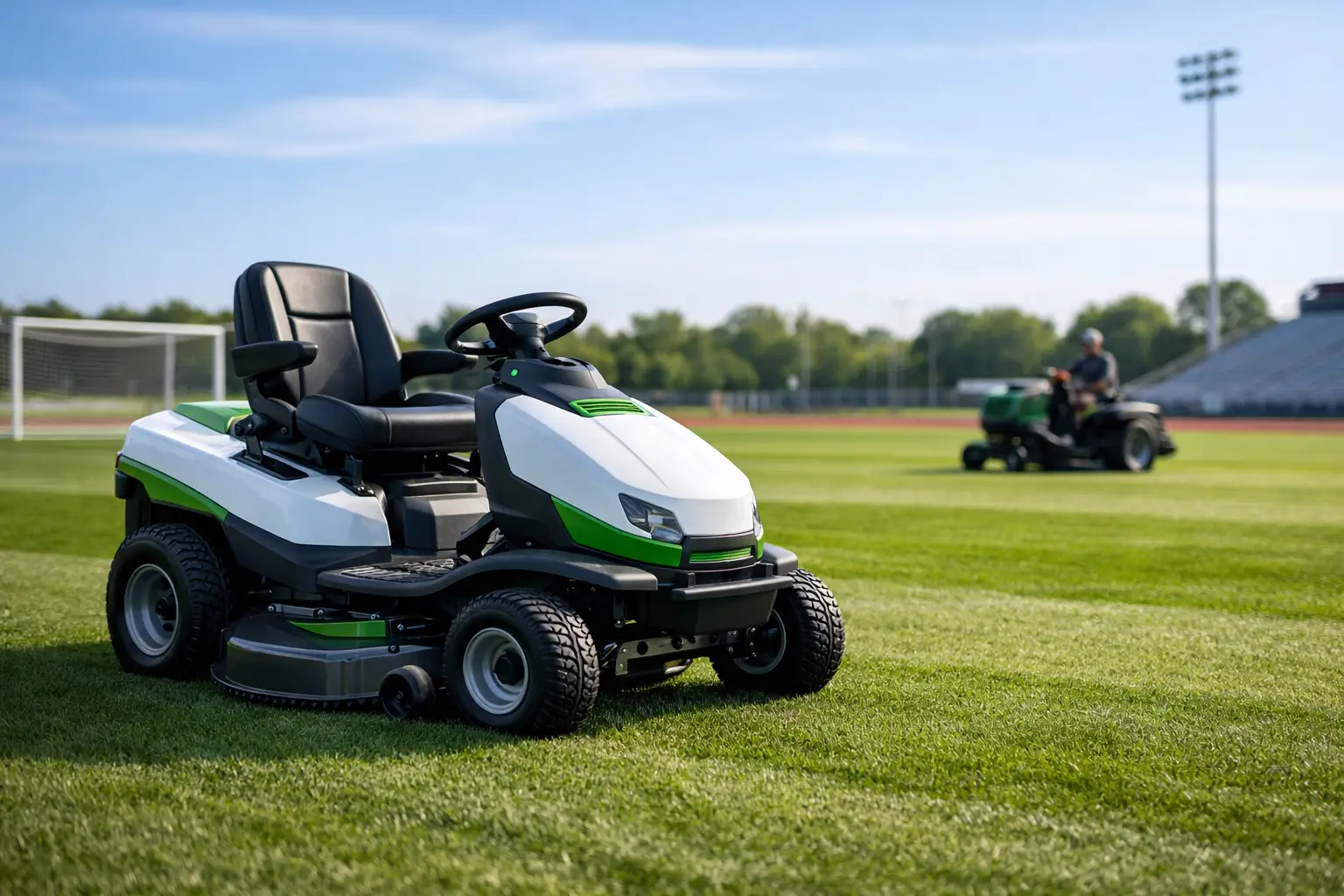
A football pitch at 7am tells the truth about your mowing setup. You can see striping consistency, missed edges, wheel marks, and how well the surface has recovered from the last fixture or training block. That is why choosing an electric mower for sports grounds is not simply a power-source decision. It is an operational decision that affects presentation, labour planning, cutting frequency and the standard players experience underfoot.
For professional sports turf, the real question is not whether electric mowing is viable. It is whether the machine in front of you can meet the standard your surface demands, day after day, with fewer labour pressures and more predictable output. In many cases, the answer is yes. But the right fit depends on the surface, the site layout and the level of autonomy you actually need.
What an electric mower for sports grounds needs to deliver
On managed sports turf, mowing quality is the first test. A machine can offer low noise, lower running costs and reduced emissions, but if it cannot hold a clean, even cut across a marked playing surface, those advantages do not count for much. Football, rugby, cricket outfields and school sports pitches all place different demands on the mowing operation, yet they share the same basic requirement – consistent presentation without compromising plant health.
That means an electric mower for sports grounds has to do more than replace a petrol or diesel unit with a battery. It needs to deliver repeatable cut quality, work reliably around fixtures and training schedules, and fit into a wider maintenance programme that includes line marking, aeration, nutrition and recovery work. Professional buyers are not looking for novelty. They are looking for dependable output and fewer operational bottlenecks.
The strongest electric mowing systems also support higher cutting frequency. That matters because regular, lighter mowing generally produces a cleaner finish than infrequent, heavier cuts. On sports surfaces, especially during peak growth, that consistency can make a visible difference to density, ball roll and overall presentation.
Why more sports sites are moving to electric mowing
Labour pressure is the obvious driver. Many venues are being asked to maintain high standards with leaner teams, tighter recruitment conditions and less time available for routine tasks. Mowing is essential, but it is also repetitive and time-consuming. Shifting that workload to an electric or autonomous system can release skilled staff for renovation work, repairs, presentation ahead of play and the finer detail that still needs human judgement.
Running costs are another factor. Electric machines typically reduce fuel use and can simplify parts of the maintenance routine, although that does not mean they are maintenance-free. Blades, drive systems, batteries and software all still need attention. The gain is usually in lower day-to-day operating cost and better use of labour, rather than a total removal of upkeep.
Noise also matters more than some operators expected. Schools, universities, leisure sites and clubs in residential areas often have narrow working windows. A quieter machine can expand when mowing takes place, especially in the early morning or around public use. That flexibility has practical value when pitches are booked heavily.
Autonomous or ride-on – which electric approach suits the site?
This is where the decision becomes more specific. Not every site needs the same kind of machine.
A conventional electric ride-on or pedestrian mower may suit venues that want lower-emission mowing but prefer a fully operator-led process. That can make sense where layouts change often, access is tight, or the team wants complete manual control over timing and route choice.
Autonomous mowing, however, changes the labour equation more dramatically. For many sports grounds, especially those with repeatable mowing patterns and defined areas, robotic systems offer the stronger long-term case. They can maintain surfaces continuously or near-continuously, keeping growth under control without tying up staff for hours at a time. That is particularly useful on training grounds, multi-pitch facilities and larger institutional sites where mowing demand is constant.
The trade-off is planning. Autonomous systems require correct setup, boundary definition, charging strategy and site assessment. If the surface is highly fragmented, regularly obstructed or subject to constant ad hoc change, deployment needs more thought. The best results come when the machine, the site and the maintenance workflow are properly matched.
Key factors when selecting an electric mower for sports grounds
Cut quality comes before headline features
Professional buyers should start with the finish. Rotary and cylinder systems each have their place, depending on the surface and expected standard. If you are maintaining formal sports turf where presentation and clip quality matter, the cutting system should be assessed with the same seriousness as any conventional professional mower.
It is easy to be distracted by battery runtime, app controls or autonomy claims. Those matter, but they sit behind the core requirement of producing a consistent, accurate cut on the target surface.
Site size and layout affect productivity
A single stadium pitch is one thing. A school campus, academy complex or local authority sports hub is another. The more area you need to cover, and the more separate zones involved, the more carefully productivity needs to be assessed.
Battery capacity, charging cycles, travel between areas and the practicality of managing multiple pitches all influence whether a machine will genuinely save time. A mower that looks efficient on paper can become less convincing if it spends too much of the day travelling, charging or waiting for manual intervention.
Surface type matters
Sports grounds are not a single category. Fine turf, reinforced natural turf, community pitches and hybrid surfaces all respond differently to cutting. The mower needs to suit the grass plant, the target height of cut and the expected frequency.
For example, a system that performs well on regularly maintained football pitches may not be the right answer for more refined surfaces or for areas where stripe definition is part of the visual standard. The mowing specification should follow the surface requirement, not the other way round.
Reliability matters more than novelty
If a machine stops unexpectedly on a weekday morning, that is irritating. If it fails before a weekend fixture programme, it becomes a problem for presentation and staffing. Reliability, support and ease of troubleshooting carry real weight in professional environments.
This is one reason specialist suppliers matter. The right partner should understand sports turf conditions, not simply battery technology. GrassRobotics, for example, positions robotic mowing as a practical professional upgrade because the buying decision is ultimately about output on real turf, not interest in automation for its own sake.
Where the savings usually come from
The clearest saving is labour reallocation. Grounds teams still have plenty to do, but routine mowing no longer consumes the same share of skilled time. That can reduce overtime pressure, improve responsiveness around fixtures and allow more attention to detail elsewhere on site.
Fuel reduction is also meaningful, particularly across larger operations or contractor fleets. Over time, lower energy costs can improve the business case, though the exact result depends on electricity pricing, operating hours and machine type.
Then there is consistency. A well-deployed electric or robotic mower can cut more frequently and more predictably than a team forced to juggle competing priorities. That steadier mowing pattern often supports cleaner presentation and more uniform turf growth. It is not always the most obvious line in a cost calculation, but it is one of the most valuable operational gains.
Common mistakes buyers should avoid
One common mistake is buying to a headline claim rather than a site requirement. “Electric” is too broad to be a specification. The decision needs to be based on cut quality, area capacity, navigation, charging and the actual maintenance standard required.
Another is underestimating setup. Even excellent machines need proper implementation. Mapping, handover, staff confidence and a clear operating plan all affect the result. If those steps are rushed, the machine may be blamed for problems that are really deployment issues.
It is also worth avoiding false comparisons with domestic robotic mowers. Professional sports turf demands a different level of durability, precision and output. Consumer-grade experience is not a useful benchmark for managed playing surfaces.
Is an electric mower for sports grounds the right move now?
For many professional sites, yes. If labour is stretched, mowing frequency is hard to maintain, or you are looking to improve consistency without simply adding more man-hours, an electric mower for sports grounds deserves serious consideration. The strongest case tends to be on sites where mowing is repetitive, standards are visible and time pressure is constant.
That said, it is not a one-size-fits-all answer. Some venues will benefit most from a fully autonomous system. Others may prefer an electric machine that remains operator-led. The right decision comes from matching the mower to the surface, the schedule and the working reality of the team.
The useful way to frame it is simple: if a machine can protect cut quality, reduce labour dependence and keep your surfaces consistently ready for use, it is not just replacing an engine. It is improving how the whole operation runs.