
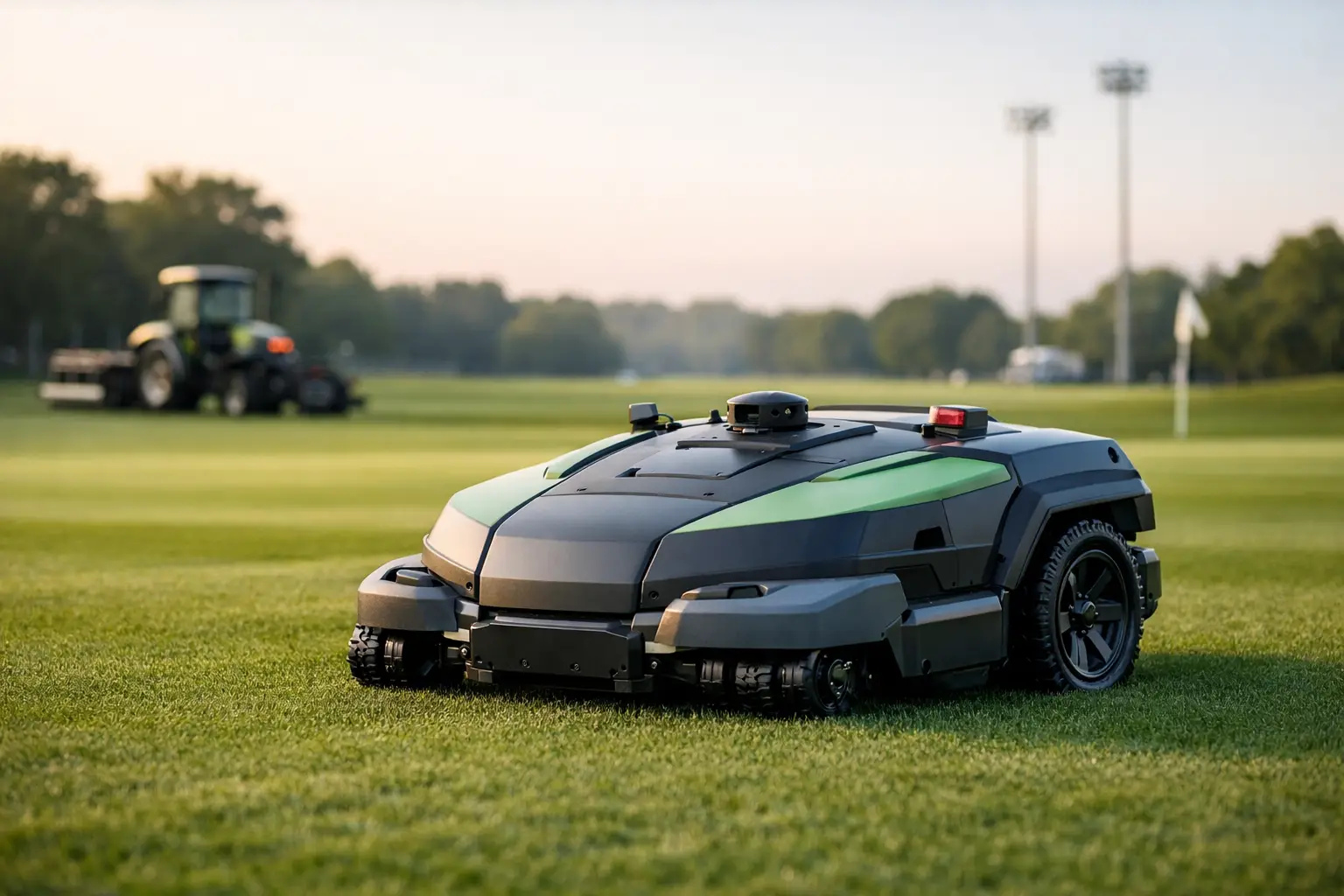
If you are assessing autonomous mowing for a golf course, sports venue or managed estate, an rm21 robotic mower review needs to answer one question first – does it perform like professional kit, or does it behave like a scaled-up domestic machine? That distinction matters. In professional turf management, labour pressure, presentation standards and daily reliability all sit on the same line.
The RM21 is better understood as a productivity tool for serious turf operations than a gadget with blades. Its value is not simply that it cuts grass without an operator on board. The real case for it is consistent output, repeatable presentation and reduced dependence on hard-to-source labour across areas where mowing frequency drives surface quality.
RM21 robotic mower review: where it fits best
The RM21 makes the strongest case on sites that need regular, disciplined mowing over large managed areas, particularly where the standard of finish must remain high through variable staffing levels. Golf environments are an obvious fit, especially fairways, semi-rough interfaces, approaches and other areas where consistency matters but labour time is often stretched. Sports grounds and institutional estates can also benefit where there is a need to maintain presentation over broad acreage without committing operator hours every day.
That said, site fit is everything. A robotic mower can be excellent on the right terrain and operational plan, then become underwhelming if it is expected to solve every mowing problem on a complex site. Steep transitions, fragmented zones, intensive event schedules and frequent temporary obstructions all affect the business case. The RM21 is most compelling where autonomous mowing can be integrated into a planned maintenance system rather than treated as a one-machine answer to all turf work.
Cutting quality and turf presentation
For professional buyers, the finish comes before the novelty. If the machine cannot hold visual standards, no labour saving will justify it. The RM21’s advantage is not dramatic single-pass impact in the way a large ride-on can sometimes appear after a heavy cut. Its strength is sustained, frequent mowing that keeps the sward in control and reduces the peaks and troughs that come with less frequent manual schedules.
On fairways and other presentation-led areas, this approach can improve uniformity. Regular cutting supports a cleaner visual result, tighter canopy control and a more predictable playing surface. Where teams are fighting weather windows or staff shortages, that consistency becomes commercially significant.
There is a trade-off, however. Autonomous mowing performs best when grass growth is managed proactively. If the site repeatedly allows areas to get away, any robotic platform will be less efficient than a conventional machine brought in for recovery work. The RM21 suits programmes built around maintaining standard, not rescuing neglected growth.
Labour saving is the main commercial argument
Most professional interest in robotic mowing starts with labour, and rightly so. Recruitment remains difficult in many parts of the UK turf sector. Even where teams are stable, skilled staff are often tied up on routine mowing when they could be deployed on irrigation, surface preparation, renovation planning, bunker work or line marking.
This is where the RM21 can make a measurable difference. By taking repetitive mowing hours out of the schedule, it allows labour to be reassigned to higher-value tasks. That does not mean the machine eliminates staffing needs. It means it changes where skilled people spend their time.
That distinction is important in any fair review. If you expect the RM21 to remove the need for operational oversight, transport, edge finishing or wider turf management input, expectations will be misaligned. If you view it as a force multiplier for a professional team, the proposition is much stronger.
Reliability, autonomy and day-to-day use
Any review of a professional robotic mower has to look beyond brochure language and focus on daily practicality. Autonomy only has value if the machine can operate predictably within a real working site. Golf courses and sports facilities are not controlled laboratory environments. They involve public interfaces, maintenance traffic, changing conditions, seasonal growth shifts and narrow operating windows.
The RM21’s appeal lies in bringing autonomous precision into that setting in a structured way. For operators, the benefit is not only unmanned cutting but repeatable scheduling and controlled route behaviour. A machine that starts when planned, cuts where intended and returns reliably creates confidence. That confidence is what allows teams to plan around it.
The quality of deployment matters here. Successful robotic mowing is not just about choosing a capable machine. It depends on correct site assessment, suitable zoning and a realistic view of traffic patterns, access points and working priorities. On a well-mapped site, autonomy supports operational discipline. On a poorly planned site, even good hardware can look ordinary.
RM21 robotic mower review: strengths and limits
The RM21’s strongest qualities are consistency, labour reduction and suitability for professional environments that require frequent mowing over defined areas. It aligns well with facilities that want predictable turf presentation and a more resilient maintenance model. It is especially relevant where management teams are under pressure to do more with the same headcount.
Its limits are the same limits that apply to any serious robotic mowing platform. It is not a universal substitute for all ride-on or pedestrian mowing equipment. Specialist areas, detailed perimeter work, highly ornamental sections and recovery cutting still need the right supporting machinery and people. In other words, the RM21 works best as part of a system.
That should not be read as a weakness. In professional turf care, very few machines do everything well. Buyers usually get the best return when equipment is chosen for a clear role. The RM21 has a clear role, and that is one of its strengths.
What professional buyers should assess before purchase
The right question is not simply whether the RM21 is a good machine. It is whether your site can convert its capabilities into measurable gain. Start with mowing frequency. If your standards depend on regular cutting and your team is stretched, the case becomes easier. Then look at acreage, layout and how often skilled staff are currently assigned to repetitive mowing.
You should also assess the value of consistency. On golf sites, that may be visual quality and ball presentation across fairways or approaches. On sports sites, it may be the ability to hold surface standards during busy periods without expanding labour hours. For contractors, the value may sit in scaling output across multiple managed properties without adding the same proportion of staff.
The final part is operational readiness. Autonomous equipment rewards disciplined implementation. If the site is willing to define zones properly, manage workflows around the machine and treat robotics as a core maintenance asset, the upside is stronger. If the plan is vague, the return will be harder to prove.
Is the RM21 worth it?
For the right professional setting, yes. The RM21 is not trying to imitate consumer robotics at a larger size. Its relevance comes from professional application: controlled autonomous mowing, steady turf presentation and meaningful labour efficiency in environments where standards are non-negotiable.
That does not mean it will suit every venue equally. Smaller sites with low mowing pressure may struggle to justify the investment in the same way as a busy golf facility or large sports complex. Equally, sites with highly fragmented terrain may need a mixed fleet strategy rather than relying too heavily on one autonomous machine.
What stands out in this rm21 robotic mower review is that the value proposition is operational, not cosmetic. If your objective is to modernise turf maintenance, protect standards and reduce reliance on routine operator hours, the RM21 deserves serious consideration. For professional teams looking at the next stage of productive, precision-led mowing, that is usually the point that matters most.
The most useful way to judge any robotic mower is to ask how it improves the working week, not just the machine list. If it gives your team more time for the jobs that really move surface quality forward, it is doing exactly what professional automation should do.