
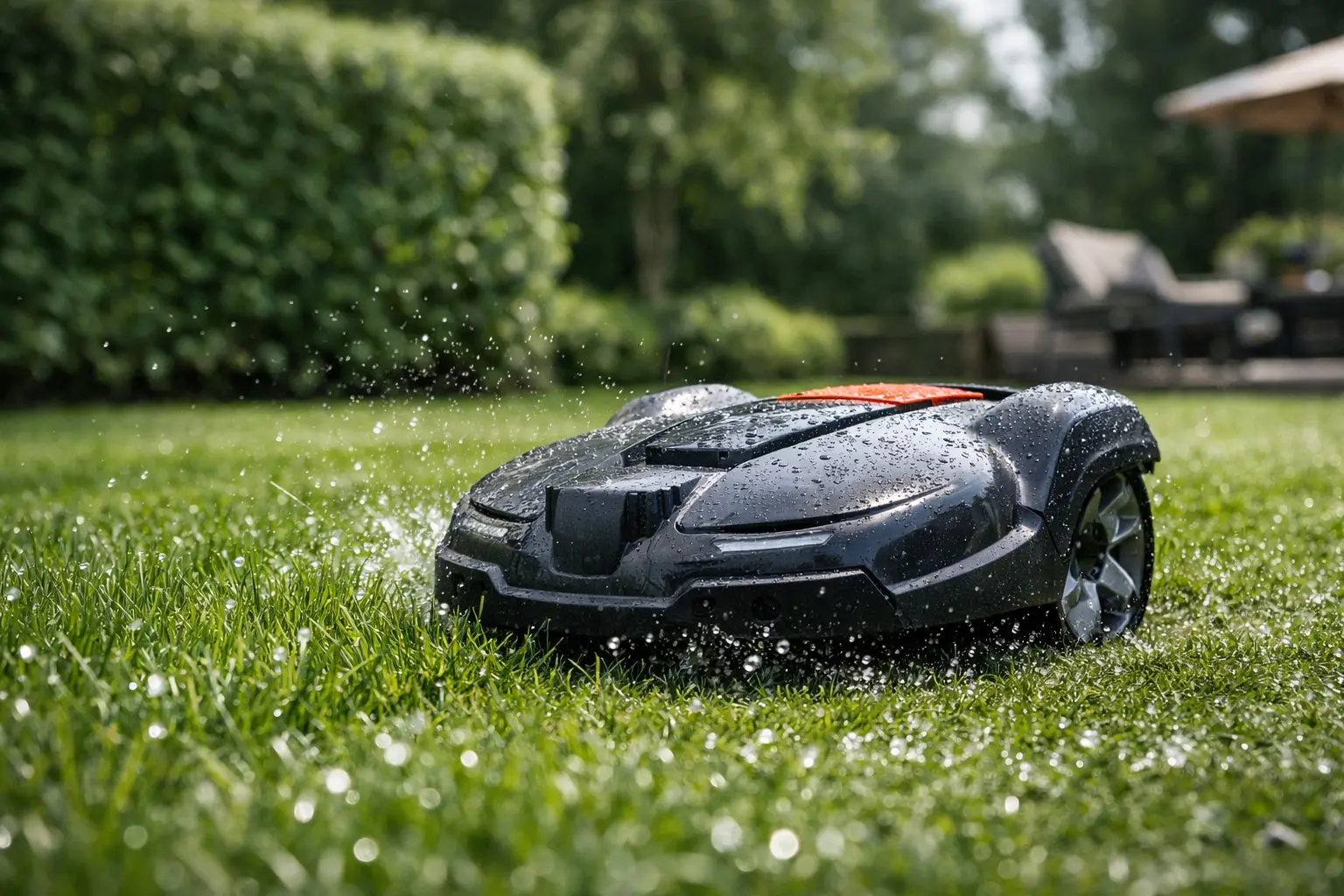
A mower leaving clumps behind on a damp fairway margin or smearing a sports surface after overnight rain is not a minor issue. It affects presentation, plant health, clean-up time and, in professional settings, confidence in the machinery. So when operators ask can robotic mowers cut wet grass, the right answer is yes – but only within the limits set by turf condition, rainfall level, machine design and the standard of finish required.
For professional turf teams, the better question is not simply whether a robotic mower can operate in the wet. It is whether it can do so without compromising cut quality, traction, safety and surface performance. That distinction matters on greens approaches, tee surrounds, sports pitches and other managed areas where consistency is non-negotiable.
Can robotic mowers cut wet grass in real conditions?
In real working conditions, many robotic mowers can cut damp or lightly wet grass. Dew, light drizzle or residual surface moisture will not always prevent operation, particularly where the machine has suitable tyres, sharp blades and a mowing pattern designed for frequent cutting.
What changes in wet conditions is the margin for error. Grass bends rather than standing upright. Clippings become heavier and more likely to adhere to decks, wheels and guards. Tyre slip increases, especially on slopes, compacted ground or high-wear access routes. Even if the machine keeps moving, the finish may fall below the standard expected on professional turf.
That is why experienced operators treat wet-weather mowing as a performance decision rather than a simple yes-or-no capability. A robotic unit may be able to continue cutting, but the correct choice depends on the surface, the weather event and the required presentation level.
Wet grass affects more than cut quality
On professional sites, wet grass changes the whole mowing environment. The first effect is on clipping behaviour. Fine, dry clippings disperse cleanly and break down quickly. Wet clippings gather, stick and can form localised deposits, which are particularly unwelcome on sports surfaces and closely managed golf areas.
The second effect is plant presentation. Wet leaf tissue tends to lay over, so rotary systems in particular may not achieve the same upright, even finish they deliver in drier conditions. Frequent robotic mowing helps reduce the amount removed in any one pass, which can limit visible disruption, but it does not remove the underlying issue.
The third effect is traction and route accuracy. Autonomous mowing depends on predictable movement. On saturated ground, wheel slip can affect turns, edge tracking and repeated travel lines. For large commercial areas, this matters because small losses in traction can become visible wear if they are repeated day after day.
Where robotic mowing performs well in damp weather
There are plenty of situations where autonomous mowing remains effective despite moisture. Light morning dew is usually manageable. So is a surface that is damp underneath but not waterlogged at leaf level. Fairways, roughs and outfield areas with firmer soil structure often tolerate robotic mowing well when rainfall has been modest.
This is one reason robotic systems are attractive to professional operators. Frequent, low-volume cutting means the machine is not trying to remove a heavy flush of growth in one pass. When conditions are only mildly wet, that lighter workload supports better results than a conventional schedule that waits for a larger cut window.
Purpose-built professional units also tend to be more capable than domestic machines in these conditions. Better traction control, more stable construction and more precise operating logic all contribute to usable performance when the weather is less than ideal.
When wet grass becomes a problem
The threshold is reached when surface moisture becomes standing water, the leaf is heavily saturated, or the ground beneath loses stability. At that point, even if the mower physically continues, the quality and agronomic outcome can deteriorate quickly.
On sports pitches, this may mean smearing, wheel marking or inconsistent presentation across high-use zones. On golf surfaces, it can mean a poorer visual finish and unnecessary disturbance around turns, narrow entries or sloping transitions. On premium fine turf, the cost of a poor pass is often higher than the value of keeping the machine running.
Heavy rain also raises a practical issue with clipping management. Wet growth is more likely to accumulate beneath the deck or around cutting components, reducing efficiency and increasing maintenance attention. If operators are trying to save labour, repeated intervention to clear build-up defeats part of the purpose.
Can robotic mowers cut wet grass without damaging turf?
They can, but only when the machine, programme and site conditions are aligned. Damage is far less likely on firm surfaces with moderate moisture than on soft, saturated or weakly rooted ground. It is also less likely when the mower is set up to minimise repeated stress in the same areas.
For professional operators, the biggest risk is not usually blade damage to the plant. It is traffic stress. Repeated autonomous movements across the same turning points, pinch points or perimeter routes can create wear if the ground is soft enough. This is particularly relevant on access corridors, sidelines, goalmouth approaches and shaped golf features where routing options are naturally limited.
Good deployment planning matters here. If a site routinely holds moisture, the answer is not simply to ask more of the robot. It may be to adjust schedules, rotate operating zones, restrict use during peak saturation or select a platform better suited to that environment.
What determines wet-weather performance?
Machine type is the starting point. A professional robotic mower designed for commercial turf care is built for more demanding and more predictable output than a lightweight domestic unit. Weight distribution, wheel design, blade system and navigation all affect results when the surface turns damp.
Cutting frequency is equally important. Regular mowing reduces clipping volume per pass, which helps in moisture. If the machine is trying to recover overgrown grass after a wet spell, performance will be less consistent and the likelihood of visible residue increases.
Surface type also matters. A free-draining sand-based profile behaves very differently from heavier native soil. The same mower may perform well on one and struggle on the other after similar rainfall. Slope, shade, compaction and local traffic patterns all shift the real operating threshold.
Then there is the finish standard. A utility area may remain perfectly acceptable after damp-weather mowing. A showpiece entrance lawn, striped sports venue or tightly presented golf feature may not. Wet-weather capability is always relative to the expectation of the surface.
How professional operators should manage robotic mowing in wet periods
The strongest approach is controlled flexibility. Rather than treating the robotic mower as either fully available or fully unavailable, set practical operating rules around moisture level and site sensitivity.
On many sites, that means allowing autonomous mowing through dew and light surface moisture, then pausing when rainfall becomes persistent or the ground softens. It may mean prioritising robust areas while holding back on fine turf or high-visibility zones until conditions improve. It can also mean using robotic mowing to maintain frequency around weather windows rather than forcing operation through the worst conditions.
This is where a solution-led setup makes the difference. The right machine on the right area, with realistic programming and a clear understanding of agronomic thresholds, delivers productivity without asking the surface to absorb unnecessary stress.
The commercial question behind wet-weather mowing
For turf managers and contractors, this is not only about whether a machine can cut wet grass. It is about whether autonomous mowing can protect output when labour is stretched and weather windows are narrowing.
A robotic platform that works reliably through marginal conditions offers a real operational advantage. It can maintain frequency, reduce catch-up mowing and help teams focus labour on detail tasks, presentation work and reactive maintenance. But that advantage only holds if the machine is used with discipline.
Professional automation is not about running regardless of conditions. It is about making smarter use of available cutting time. That is the difference between treating robotics as a gadget and using it as a serious turf-management asset.
For operators managing golf, sport or large institutional landscapes, wet grass should not be seen as an automatic stop signal or a green light. It is a condition to assess. If the surface is firm, the moisture is light and the mower is properly specified, robotic mowing can continue productively. If the ground is saturated and the finish requirement is high, pausing is often the better decision. The most effective systems are the ones that respect both the machine’s capability and the turf’s limits.