
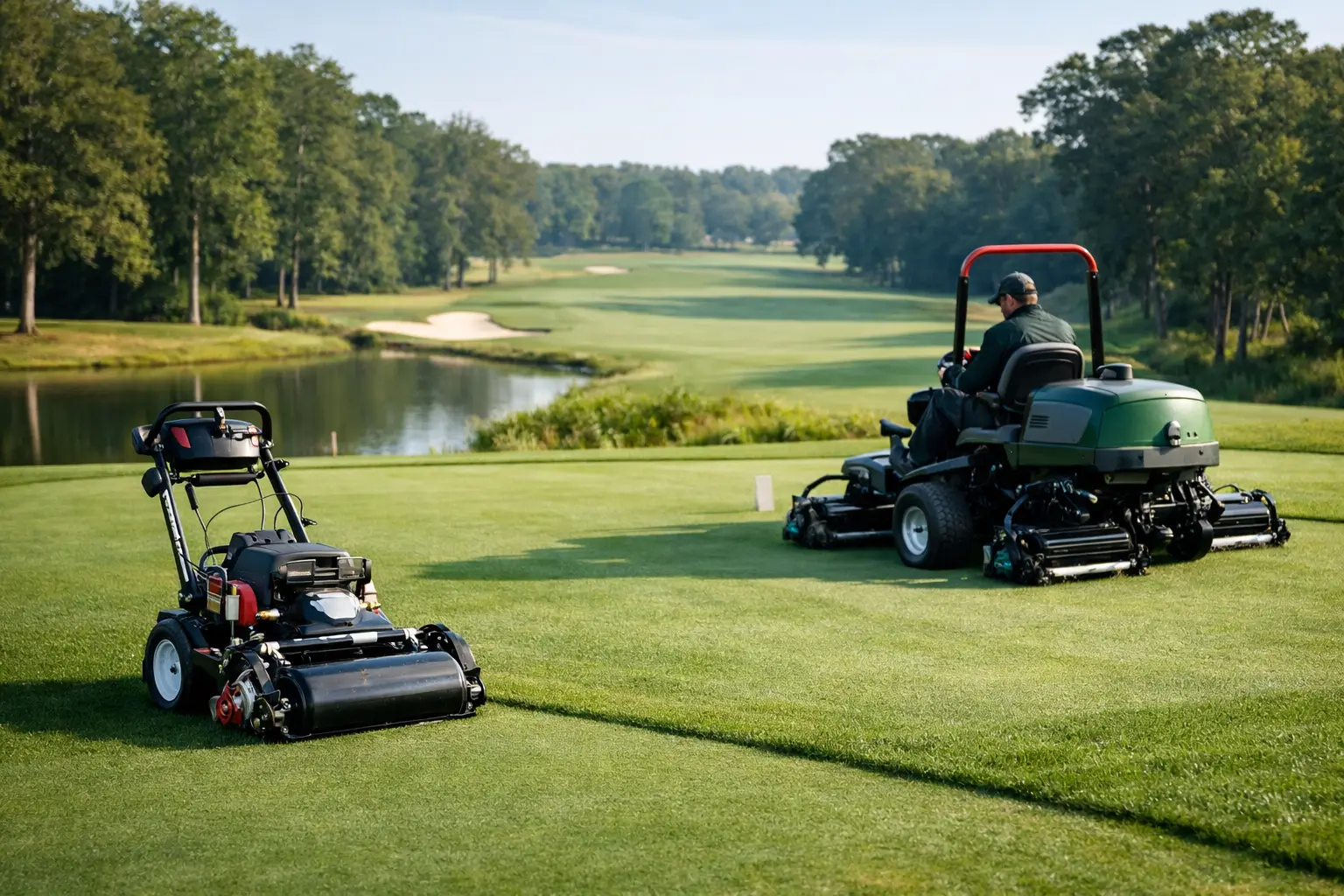
Tee complexes expose every weakness in a mowing setup. Tight perimeters, walk-on wear, small approach areas, shifting presentation lines and high player visibility all combine to make them one of the most demanding parts of a golf course to maintain. That is why choosing the best mowers for tee complexes is less about headline machine size and more about precision, consistency and how well the mower fits the wider maintenance operation.
For most courses, the right answer is not simply the smallest machine or the cheapest route into automation. Tee surfaces sit in an awkward middle ground. They need a consistently refined finish, but they also need practical throughput across multiple tees, variable layouts and often constrained labour windows. A mower that looks efficient on paper can become a poor fit if it struggles around markers, bunker edges, walk-offs or narrow linking routes.
What the best mowers for tee complexes need to do
A tee complex mower has to deliver a high visual standard without creating extra handling, trimming or repair work elsewhere in the day. Cut quality matters, but so does repeatability. If the finish fluctuates between tees, or if the machine regularly misses edges and leaves too much hand work, the labour saving disappears quickly.
Precision is the starting point. Tee areas are compact, visible and often framed by sharp landscaping features. Any inconsistency in tracking, overlap or boundary control stands out. That is particularly true on courses where tee boxes form part of the overall presentation standard expected by members, visitors and societies.
Productivity comes next. A mower may produce an excellent finish on a single tee, but if it requires frequent transport, supervision or setup changes across the full tee estate, it can still be the wrong choice. The best machines reduce operator dependency while maintaining a dependable result across repeated cycles.
Then there is turf response. Tee boxes take concentrated traffic, especially on par threes and heavily used medal routes. Mowing equipment needs to support surface quality rather than add stress through excess weight, poor turning behaviour or inconsistent clipping management. Low-impact operation and controlled movement are not optional extras here.
Cylinder, rotary or robotic – what suits tee work?
The usual discussion starts with cutting system, but that only tells part of the story. Cylinder mowing still sets the benchmark for the most refined finish on fine turf. On many tee complexes, that remains the standard against which other options are judged. If visual striping, tight presentation and a traditional tournament-style appearance are top priorities, a cylinder unit remains highly relevant.
That said, tee maintenance is no longer a simple cylinder-versus-rotary decision. Robotic mowing has changed the equation because it improves consistency through frequency. Instead of relying on a single pass at a fixed interval, autonomous machines can maintain the surface more continuously, holding presentation standards with less labour input. On the right site, that can produce a cleaner and more stable result than intermittent manual mowing.
Rotary systems still have a place, particularly where the brief is broader than pure presentation and where operators need flexibility across mixed-condition teeing grounds. They tend to be more forgiving in variable growth and less exacting in setup, but that trade-off is visible in the finish. For premium tee complexes, rotary is rarely the first choice unless the course is balancing budget pressures, secondary tee quality and labour limitations.
The more useful question is not which technology is universally best, but which one matches the course standard, site layout and staffing reality.
When robotic mowing is the better option
For many facilities, the best mowers for tee complexes are now robotic because the operational gain is wider than mowing alone. Labour remains difficult to source and retain across the UK turf sector. Tee boxes are also a repetitive maintenance task that rewards consistency rather than constant operator judgement. That makes them well suited to autonomy.
A properly specified robotic mower can maintain a regular cut cycle, reduce reliance on early-morning manual passes and free skilled staff for work that genuinely needs their attention. Instead of spending labour hours transporting, unloading and mowing each tee in sequence, teams can redeploy time into setup detail, irrigation checks, renovation work and presentation tasks that move the standard of the course forward.
The productivity case is strong, but only if the machine is suited to the site. Tee complexes vary widely. Some are open and accessible. Others are broken into small, awkward platforms with narrow connections and steep transitions. Robotic performance depends heavily on navigation accuracy, boundary reliability and the ability to handle professional turf conditions rather than domestic-style mowing environments.
This is where specialist equipment matters. Professional autonomous units built for managed turf can offer far more than labour reduction. They can support consistent clipping control, disciplined routeing and a predictable standard across repeat visits. For golf operators looking at long-term efficiency rather than a short-term gadget purchase, that is the real shift.
Key factors that separate average from professional performance
The first factor is surface finish. Tee complexes are part of the course presentation story, so mowing quality cannot be treated as secondary. A machine should leave a uniform appearance across multiple tees, not just a passable cut on easy ground.
The second is manoeuvrability. Many tee boxes are small enough that inefficient turning or weak edge control creates visible defects. Machines need to work close to margins, cope with shape changes and avoid scuffing in areas that already take concentrated foot traffic.
The third is transport and deployment. A mower may perform well once in position, but if moving it between tee complexes is slow or awkward, daily efficiency suffers. This is one reason autonomous systems can outperform conventional setups over time – not because each individual cut is faster, but because the overall workflow is leaner.
The fourth is reliability in mixed conditions. Dew, uneven growth, worn entries, shaded surrounds and transitional weather all affect tee performance. Equipment that needs ideal conditions to achieve an acceptable finish can create more operational pressure than it removes.
Finally, there is integration with the wider maintenance plan. Tee mowing should not be selected in isolation. It has to fit around greens, collars, approaches and fairway operations. The best result often comes from matching one mowing system to another in a way that supports the whole site rather than optimising a single area at the expense of everything else.
Choosing the best mowers for tee complexes by course type
On a high-end private or tournament-focused course, surface quality will usually take priority. In those environments, a professional cylinder solution or a dedicated robotic cylinder mower can make the most sense, especially where the expectation is a close, highly consistent finish with strong visual presentation.
On a busy members’ course, the calculation can be different. Labour efficiency and dependable repeatability may be just as important as cosmetic perfection. If the tee estate is large and staffing is under pressure, a robotic solution that maintains standards daily can be more valuable than a traditional machine that produces a marginally finer finish but depends on regular operator time.
For municipal or pay-and-play facilities, value often sits in balancing presentation with cost control. A machine that cuts reliably, reduces labour hours and limits operator intervention can be the strongest commercial decision, even if the brief is not elite tournament presentation.
For multi-site contractors, standardisation matters. Equipment that is easy to deploy, predictable to manage and scalable across different client sites has a clear advantage. In those situations, robotic mowing can support consistency across contracts while reducing exposure to labour availability.
What buyers often get wrong
One common mistake is judging a mower only by width or speed. Tee complexes are not broad-acre fairway work. Accuracy, control and repeatability are usually more valuable than headline output figures.
Another is underestimating setup complexity. If a machine requires too much intervention to cope with boundaries, routeing or small-area variation, the promised efficiency can shrink quickly. Professional buyers should assess the full operating model, not just the mower itself.
There is also a tendency to separate mowing quality from labour planning. In practice, they are linked. A machine that allows more frequent, autonomous cutting can improve presentation simply because standards are maintained more consistently. That is one reason specialist providers such as GrassRobotics are focusing on autonomous precision as a practical operational upgrade rather than a novelty.
The strongest choice is the one that fits your operation
There is no universal winner for every tee estate. The best mower for one course may be the wrong machine for another, especially where layout, access, presentation targets and staffing levels differ. What matters is whether the mower improves cut quality, reduces avoidable labour and performs reliably across the real conditions of the site.
If tee complexes are taking too much operator time, or if presentation is inconsistent because mowing frequency is hard to maintain, it may be time to look beyond conventional replacement logic. The strongest buying decisions come from treating tee mowing as part of a wider productivity system, not just another machine purchase.
The right mower should make the standard easier to hold every day, not harder to chase.