
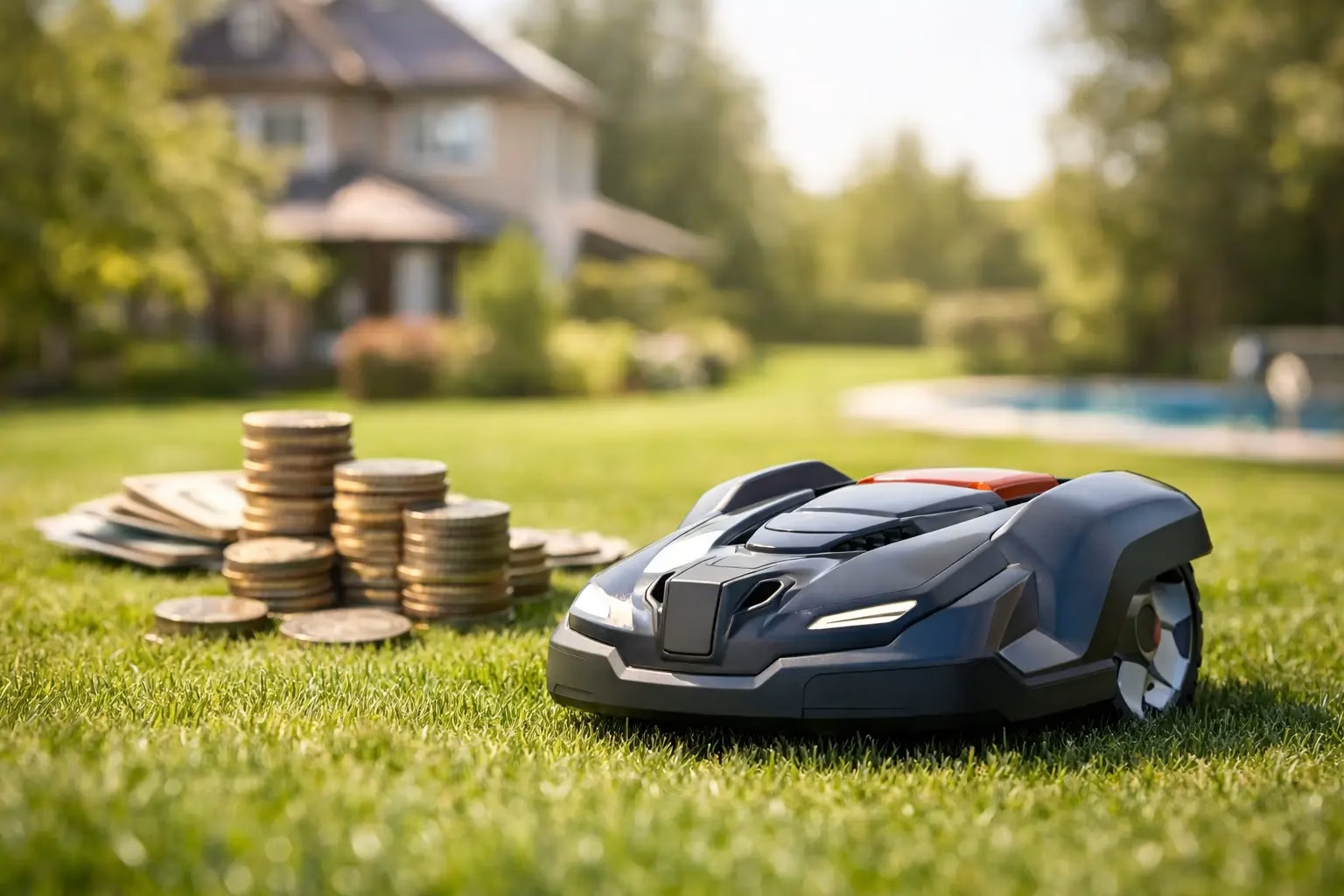
Price only becomes meaningful when it is set against hectares cut, labour hours removed and the standard of finish required. That is the right context for asking how much does a robotic mower cost, particularly in golf, sport and institutional turf where presentation, consistency and operational efficiency all matter.
For a professional buyer, the short answer is that costs vary widely. A robotic mower for managed turf is not a single category with a single price point. The investment depends on whether you need autonomous mowing for greens, fairways, tee boxes, sports pitches, rough, or mixed-use areas, and whether the priority is striping quality, close cylinder presentation, output, or labour reduction across larger estates.
How much does a robotic mower cost in professional turf care?
In commercial and institutional settings, the cost of a robotic mower usually sits well above domestic machines and for good reason. Professional units are designed for larger areas, tighter tolerances, repeatable performance and more demanding operating schedules. They are expected to work reliably across complex sites rather than trim a straightforward back garden.
At the entry end of professional automation, smaller or more targeted systems can represent a lower initial outlay where the application is tightly defined. At the more advanced end, a fleet-based or specialist setup for golf or sports surfaces can become a significant capital investment. The gap between those two positions is driven less by branding and more by the nature of the mowing task.
That distinction matters. A facility manager looking to automate a marked sports surface has a different requirement from a golf operation maintaining multiple areas with distinct cutting regimes. Treating all robotic mowers as comparable leads to poor budgeting and, often, the wrong specification.
What actually drives robotic mower cost?
The biggest factor is site requirement. Surface area is important, but it is only one part of the picture. A large, simple expanse of grass can be easier and cheaper to automate than a smaller site with multiple boundaries, high traffic, steep transitions, isolated zones and demanding presentation standards.
Cutting technology also has a major effect on price. Rotary systems suit many applications where productivity and routine maintenance are priorities. Cylinder-based robotic mowing sits in a different category, particularly where golf greens or other fine turf surfaces demand a cleaner, more refined finish. If the expected quality of cut is close to what an experienced operator would deliver with specialist equipment, the machine and its control systems need to be built accordingly.
Navigation and guidance are another cost driver. Consumer machines often rely on simpler boundary-based approaches. Professional systems increasingly use advanced positioning, intelligent route planning and more structured site management. That improves repeatability, coverage and control, but it also raises the level of engineering and support behind the machine.
Battery capacity, charging strategy and working autonomy influence pricing too. A machine intended to maintain larger areas on a disciplined schedule needs enough endurance to deliver practical output, not just nominal runtime. In a professional environment, the question is not whether it can mow, but whether it can mow enough, often enough, with minimal interruption.
Finally, the level of integration around the machine matters. Commercial buyers are not just purchasing hardware. They are buying a mowing solution that may include site assessment, setup, commissioning, safety planning, training and ongoing support. That is particularly relevant for golf courses, schools, local authorities and sports venues where operational reliability matters as much as the machine itself.
Upfront cost versus total cost of ownership
The wrong way to assess robotic mowing is to compare capital price against a conventional pedestrian or ride-on mower in isolation. The more useful comparison is total cost of ownership over several seasons.
A robotic system changes the cost profile of mowing. It may increase upfront spend while reducing recurring labour demand, fuel use in some cases, routine operator time and the disruption that comes with labour shortages. For many professional sites, that shift is the real commercial case.
If a robotic mower allows a team to redeploy labour from repetitive cutting into presentation work, repairs, bunker maintenance, line marking or general site standards, the value is immediate even before pure wage savings are counted. In a tight labour market, resilience becomes part of the return. A machine that reliably covers planned mowing windows reduces dependence on finding and retaining additional operators for routine work.
There are still running costs, of course. Blades or cutting components, servicing, software support, replacement parts and battery life all need to be considered. Robotic mowing is not maintenance-free. It is better understood as a more controlled, more predictable maintenance model.
Why price varies so much between sites
Two venues with similar acreage can receive very different quotations. That is not unusual. It reflects the fact that professional turf is defined by standard, not just scale.
Take a golf course. If the requirement is autonomous support across fairways or rough management, the machine specification will differ from a setup intended for greens or tightly presented tee surrounds. The latter demands far more from cut quality, route precision and turf interaction. The investment will follow that requirement.
The same is true in sport. A school or training ground may prioritise reliable area maintenance and reduced labour pressure. A stadium-adjacent or elite training venue may need more exact presentation, defined patterns and consistency that aligns with match preparation. Both are robotic mowing use cases, but not remotely the same purchase.
Terrain, access and site segmentation also affect price. Narrow passages, separated zones, public interfaces and areas that require stricter operational controls can all increase setup complexity. That does not make robotics less viable – in many cases it makes them more valuable – but it does influence system design and cost.
When a lower-cost machine is the wrong economy
There is a clear temptation to look for the cheapest route into automation. For professional turf managers, that approach usually creates more problems than it solves.
A lower-cost unit that cannot meet finish requirements, cope with site demands or deliver enough daily output does not save money. It simply shifts the burden back onto the team. Manual intervention rises, quality becomes inconsistent and confidence in the system drops. Very quickly, the site is paying for both the robot and the labour it was meant to reduce.
This is where specification discipline matters. If the objective is to protect greens quality, maintain striped sports surfaces or automate larger acreage to release skilled staff for higher-value tasks, the machine has to be matched to that objective. Professional robotic mowing works best when it is treated as a performance decision, not a gadget purchase.
How to budget for a robotic mower properly
The most reliable budgeting approach starts with the mowing problem, not the machine. Define which areas are candidates for automation, what quality standard they must meet, how many labour hours are currently tied up in those areas and what operational constraints exist across the site.
From there, assess whether you need one machine, multiple machines or a phased rollout. Many operators do not need to automate everything at once. A targeted first phase can deliver measurable productivity gains while building confidence in autonomous maintenance. That might mean starting with a specific fairway programme, selected sports pitches or a set of repeatable areas where labour pressure is highest.
It also helps to be realistic about outcomes. The best robotic mower is not always the one that replaces every conventional process. Often, it is the one that removes enough repetitive work to let a lean team operate to a higher standard overall. That is a more commercial way to look at cost.
For buyers evaluating specialist systems, consultative suppliers such as GrassRobotics can be useful because the conversation starts with site fit, output and turf expectations rather than headline price alone. That tends to produce better decisions and fewer false economies.
How much does a robotic mower cost if ROI is the priority?
If return on investment is the main concern, the answer comes down to how quickly the machine reduces cost or improves productivity in a measurable way. Sites with high routine mowing demand, rising labour pressure and clear standards to maintain often see the strongest case. The more repetitive and predictable the mowing task, the easier it is to quantify value.
ROI is usually strongest where a robotic mower can either replace a significant share of routine operator time or improve consistency in a way that protects the quality of the surface. On golf sites, that may mean dependable, repeatable mowing windows and less variation between operators. On sports sites, it may mean more consistent surface presentation with fewer staffing bottlenecks.
The key point is that price and value are not the same thing. A more expensive machine with the right output and finish can be the cheaper decision over time. A cheaper machine that underperforms rarely stays cheap for long.
The better question is not simply what a robotic mower costs, but what it allows your operation to do with greater precision, fewer labour constraints and more control over turf quality. That is where the investment starts to make sense.