
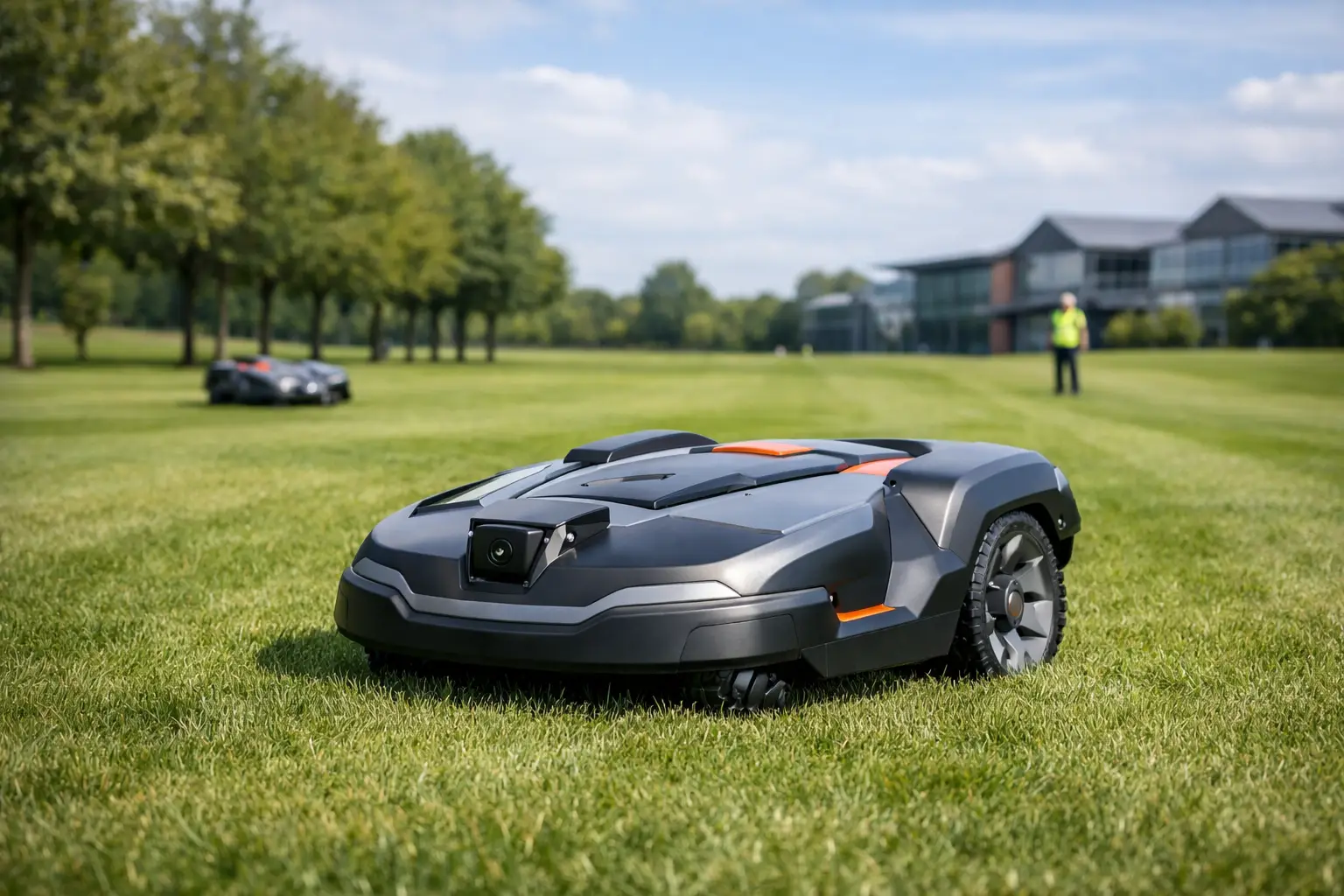
Labour gaps rarely show up on a machinery spec sheet, but every course manager and grounds team feels them. That is why the commercial robotic mower UK market is moving from curiosity to serious consideration across golf, sport and large managed turf sites. For professional operators, the question is no longer whether robotic mowing is viable. It is whether a system can deliver the standard, coverage and control a demanding site actually needs.
Why the commercial robotic mower UK market is growing
The pressure is coming from several directions at once. Skilled labour is harder to recruit and retain, seasonal peaks are more difficult to cover, and expectations around presentation have not softened. At the same time, many facilities are being asked to do more with the same budget, or the same work with fewer people.
A commercial robotic mower changes that equation when it is deployed properly. It does not replace the need for turf expertise. It frees that expertise from repetitive cutting hours and allows teams to focus on presentation detail, agronomy, repairs, set-up and site management. On the right site, the gain is not simply lower labour input. It is more consistent output across the week.
That matters in environments where missed cuts quickly become visible. Fairways, surrounds, training grounds, formal sports surfaces and large amenity areas all benefit from repeatable mowing frequency. Robotic operation keeps surfaces under control with less dependence on staff availability, weather windows or machine scheduling conflicts.
What professional buyers should assess first
The biggest mistake in this category is treating all robotic mowers as broadly comparable. They are not. A professional buyer should start with the turf surface, the expected finish and the operating pattern required.
A golf green has very different demands from a football training area. A fairway approach area has different priorities again. Striping, clipping management, edge definition, turning behaviour, transport demands and obstacle density all affect suitability. The right machine for one task can be the wrong one for another, even on the same site.
This is where many consumer-led discussions become irrelevant to commercial decision-makers. Professional robotic mowing is not about whether a machine can cut grass. It is about whether it can hold a standard over time, across the right acreage, at the right quality level, with manageable oversight.
Cut quality is still the first test
No productivity claim compensates for poor finish. For golf and sport, the mowing result remains the starting point. A robotic solution must produce a clean, even cut at the required frequency and maintain that result in changing conditions.
For some sites, rotary performance is the right fit, especially where coverage efficiency and dependable daily presentation are the main priorities. In other settings, cylinder technology is more appropriate, particularly where finer finish and surface precision are central to the specification. The correct answer depends on the area being maintained, the tolerance for variation and the visual standard expected by members, players or clients.
There is also a practical point here. Frequent autonomous cutting can improve consistency because the plant is being managed in smaller increments rather than through wider peaks and troughs between passes. That can support a neater overall appearance and more stable presentation, provided the machine is matched correctly to the surface.
Labour saving is real, but it needs the right expectations
A commercial robotic mower UK operators choose for labour reduction should be judged realistically. The strongest result is usually not a headcount replacement. It is a redistribution of skilled hours.
That distinction matters. Grounds teams still need to prepare surfaces, carry out line marking, manage inputs, inspect turf health, handle hand mowing where required and respond to wear, weather and event schedules. Robotics removes a large block of repetitive mowing time, especially on areas where high-frequency cutting delivers a clear presentation benefit.
For contractors and multi-site operators, that can improve fleet utilisation and staffing flexibility. For in-house teams, it can reduce pressure at the start of the day and allow better allocation of people to jobs that visibly affect standards. In a market where reliable labour is one of the hardest inputs to secure, that operational breathing space has value.
Site fit matters more than headline capability
The best robotic mower on paper can underperform if the site has not been assessed properly. Terrain, gradients, access routes, isolated sections, crossing points and boundary complexity all affect real-world performance.
Open, repeatable areas are usually the easiest starting point. Fairways, outfield-style spaces, training grounds and larger formal areas often offer a strong case because the machine can work efficiently with fewer interruptions. More intricate zones can also be suitable, but they demand better planning around navigation, exclusion areas and route logic.
UK conditions add another layer. Wet weather, softer ground, leaf fall, shorter winter daylight and varied seasonal growth patterns all influence deployment. A serious commercial system needs to be considered in the context of an annual maintenance programme, not just summer performance. Reliability in shoulder seasons often tells you more than a perfect July demonstration.
Autonomy is only useful if control is practical
Professional users do not need novelty. They need control that supports operations. That means the robotic system must be manageable by a grounds team, not just by a technician during commissioning.
Scheduling, area assignment, machine status, stop-start control and performance visibility all matter. So does the ability to adapt quickly around matches, competitions, maintenance works and changing site priorities. If a system is difficult to adjust, it creates friction rather than savings.
Good autonomous mowing should feel disciplined. It should fit into the site programme, not force the programme to fit around the machine. That is particularly important on sports sites, where training patterns, fixture schedules and protected surfaces can change quickly.
The commercial robotic mower UK buyers choose should match the use case
There is no single best commercial robotic mower UK buyers should expect to use everywhere. Professional sites usually need a use-case-led decision rather than a broad category purchase.
Golf facilities may require different robotic solutions across greens, fairways, tees and rough transitions. Sports venues may need one approach for fine turf and another for larger surrounding areas. Schools, local authorities and institutional estates often prioritise broad productivity and labour reduction, but still need dependable presentation and safe operation around active environments.
That is why consultative specification matters. A machine should be selected around the work, not squeezed into it. Surface type, acreage, quality standard, traffic levels and staffing structure all influence whether a robotic mower will deliver a strong return.
Cost should be measured against output, not sticker price
Commercial buyers are right to scrutinise capital cost. But the more useful calculation is cost against annual output and staffing pressure.
If a robotic mower allows a team to maintain standards with fewer repetitive machine hours, the value shows up across labour allocation, machine utilisation and consistency of presentation. It can also reduce the operational risk that comes from relying too heavily on a shrinking labour pool.
That said, not every site will see the same payback period. A high-specification venue with tight quality demands may judge return differently from a broad-acre operator focused on coverage and labour resilience. This is one of those areas where it depends. The right assessment looks at current mowing hours, staffing challenges, machine overlap, expected finish and the surfaces most suited to autonomy.
Support is part of the product
For professional operators, support should never be treated as an afterthought. Commissioning, training, setup, seasonal adjustment and ongoing technical backup all shape whether the system performs as expected.
A serious supplier should understand managed turf, not just machine features. That means speaking in terms of greens, fairways, pitches, presentation standards and operational workflow. It also means being honest about where robotics will deliver strongly and where conventional equipment should still have a place.
That specialist approach is what separates professional adoption from gadget-led buying. GrassRobotics is positioned around that reality, with robotic mowing solutions selected for commercial turf performance rather than general domestic use.
Where robotic mowing is heading next
The direction of travel is clear. Commercial robotics in turf care is moving towards more defined, task-specific deployment across professional environments. The strongest sites will not necessarily be the ones that automate everything first. They will be the ones that automate the right areas with clear operational intent.
That may mean assigning robotic mowing to fairways and surrounds while keeping other surfaces under conventional control. It may mean using autonomous equipment to protect presentation during labour shortages. Or it may mean building a longer-term model where robotic systems become a permanent part of the maintenance fleet.
The advantage is not simply that the machine can work unattended. It is that the site gains a more consistent, controllable mowing programme without stretching already pressured teams.
If you are assessing a commercial robotic mower for a UK site, the useful question is not whether the technology is advanced enough. It is whether the solution fits your surfaces, your standards and your labour reality well enough to earn a permanent place in the operation.