
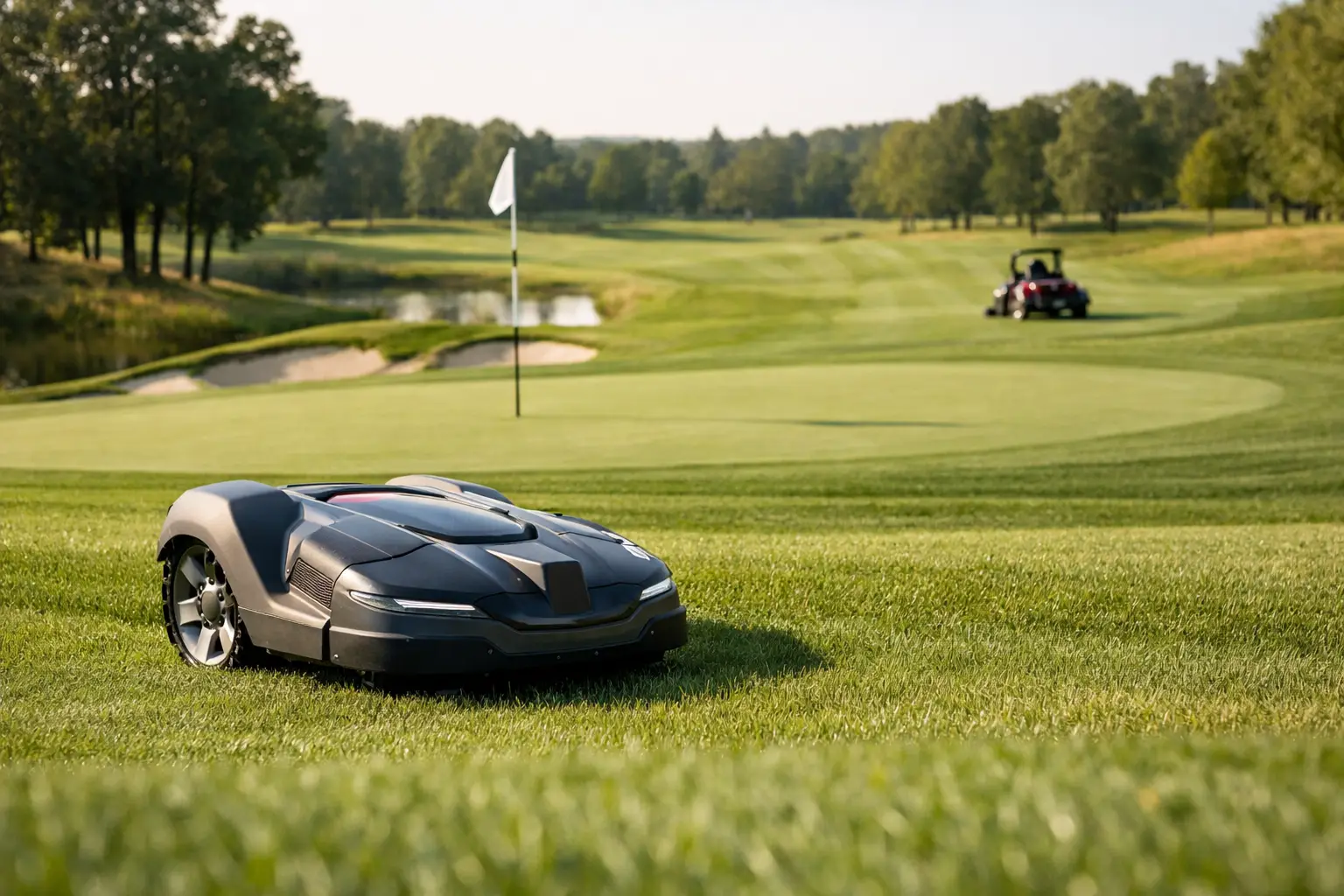
A course can look well presented at 7am and still lose standard quickly when staff are pulled into setup, irrigation checks, bunker work or an unexpected machinery issue. That is where golf club robotic mowing results become commercially meaningful. The value is not simply that a machine cuts grass without an operator. It is that planned cutting continues across defined areas, at consistent intervals, while the greenkeeping team protects playing quality and focuses its skilled time where it has the greatest effect.
For golf operators, the right assessment is not whether a robotic mower can replace every conventional machine. It is whether autonomous mowing can improve the reliability, consistency and cost control of a specific part of the maintenance programme. Greens surrounds, tees, fairways, practice areas and lower-risk presentation zones can all have different requirements. A successful deployment begins by matching the machine, cutting system and working pattern to each one.
What strong golf club robotic mowing results look like
The most visible result is a more consistent surface. Robotic mowers work little and often, maintaining the target height rather than allowing grass to grow on before removing a larger amount in one pass. This can support a more even appearance and reduce the pronounced flushes of growth that can occur between scheduled conventional cuts.
Consistency also applies to timing. An autonomous mower can operate during planned windows, including early morning, overnight or periods when teams are occupied elsewhere, subject to the course’s operating procedures and safety arrangements. For busy venues, that means routine mowing is less exposed to staff absence, tournament preparation or pressure elsewhere on the site.
The operational result is not necessarily fewer people on the payroll. More often, it is better use of the people already employed. Skilled greenkeepers can spend less time on repetitive coverage mowing and more time on tasks that demand judgement: hand mowing high-profile areas, changing holes, monitoring plant health, preparing bunkers, managing moisture, repairing wear and refining presentation ahead of play.
There is also a quieter, lower-interruption benefit in the right location. Reduced engine hours can improve the working environment around the clubhouse, practice ground and residential boundaries. That will not determine every investment decision, but it can be material at sites with early starts, noise sensitivity or dense playing schedules.
Measure performance beyond hours saved
Labour saving is often the first figure considered, but it should not be the only measure. A credible review of robotic mowing results looks at the whole maintenance operation. Before installation, establish a baseline for the area being considered: mowing frequency, operator time, fuel or charging costs, machine maintenance, missed cuts, clipping management and the effect on daily task allocation.
After deployment, assess whether the area is being maintained at the intended standard with fewer manual interventions. Track the conventional mowing passes that have genuinely been removed or reduced, rather than assuming that every autonomous hour is a direct labour-hour saving. A mower may run for several hours while a greenkeeper completes work elsewhere. The practical gain is the capacity released during the working day.
Presentation should be reviewed by area and season. Fine turf around tees and greens may need a different standard from a wide fairway or practice field. Look for evenness of cut, edge definition, visible wheel marks, response during peak growth, and whether the robotic programme supports the club’s preferred playing condition. The results that matter are those seen by members, visitors and the course team over successive weeks, not only on the first day of operation.
Machine availability is equally important. A professional system must return to its charging point reliably, complete its assigned work and fit within the operational windows available. Mapping, boundary definition, charging infrastructure, connectivity and obstacle management all affect this. The best mower on paper will underperform if the working environment has not been properly surveyed and configured.
Quality depends on the cutting application
Not all robotic mowing is the same. A rotary mower can be highly effective for regular maintenance of fairways, rough, surrounds and broader amenity areas. Where the finish, height of cut and plant response demand cylinder technology, a robotic cylinder mower may be the more appropriate route. The decision should follow turf specification, not a desire to automate for its own sake.
Greens and closely managed surfaces require particular care. The required finish is influenced by grass species, season, moisture, clipping volume, rolling programmes and tournament expectations. Autonomous equipment can support the programme, but it does not remove the need for experienced observation or for conventional equipment where that remains the best tool for the standard required.
The same principle applies to striping. Some clubs place high value on a defined visual pattern, especially on approaches, tees and presentation fairways. Depending on the system and mowing plan, robotics may maintain the base cut while conventional machines continue to provide selected finishing passes. That hybrid approach can still create substantial capacity without compromising the club’s visual identity.
Where autonomous mowing delivers the clearest return
The strongest applications tend to be areas with repeatable boundaries, frequent cutting needs and a clear opportunity cost for staff time. Fairways with consistent terrain, practice grounds, tees, greens surrounds and areas around the clubhouse can be suitable candidates, provided access, hazards and golfer interaction are assessed properly.
A large, open area is not automatically the easiest place to start. It may carry long travel distances, complex crossing points or a mowing requirement that does not justify dedicated automation. Conversely, a smaller but regularly maintained zone close to the maintenance facility may deliver a quicker operational win because it is easy to define, easy to supervise and repeatedly draws labour away from higher-value work.
Courses with variable terrain need a more detailed assessment. Slopes, narrow bridges, water margins, tree roots, buggies, pedestrian routes and changing site furniture all affect route planning and machine selection. The aim is not to force an autonomous mower into a difficult task. It is to identify the areas where it can work predictably, safely and productively.
The trade-offs course managers should plan for
Robotic mowing is a system change, not a simple equipment swap. It requires initial site planning, installation, staff familiarisation and a clear process for monitoring performance. Charging locations need to be secure and practical. Boundaries and exclusion zones need to reflect the real course environment, including seasonal changes in traffic and access.
Weather also matters. Wet ground, prolonged growth periods and leaf fall can change the mowing requirement significantly. A programme that performs well in a dry summer may need revised operating times, cleaning routines or supplementary conventional cutting in autumn. Professional results come from adapting the programme to conditions, just as a conventional mowing schedule would be adapted.
There is a maintenance requirement too. Autonomous machines reduce routine operator time, but blades or cylinders still need attention, cutting units need cleaning, and the mower requires inspection. Treating robotic equipment as maintenance-free is one of the quickest ways to dilute its value. The objective is planned, efficient maintenance rather than no maintenance at all.
Finally, communicate the operating plan internally. Greenkeeping staff need confidence in what the mower is responsible for and what remains within the daily team routine. Club managers, professional staff and relevant front-of-house teams should understand where the machines work and when. Clear ownership prevents a robotic mower from becoming an isolated piece of equipment rather than a reliable part of the maintenance fleet.
Build results through a phased deployment
A phased approach gives the course time to validate performance without disrupting the full mowing programme. Begin with a defined area that has a repeatable task and measurable baseline. Set the target height, operating windows, coverage expectations and manual intervention level before the first working period.
Review the surface after the initial weeks, then through changes in growth and play volume. If the cut quality, availability and staff capacity gains meet expectations, expand to additional zones or refine the programme. This gives managers evidence for further investment based on their own site data, not generic claims.
GrassRobotics works with professional turf teams because the value lies in this application-led approach. The right autonomous solution is the one that fits the course’s grass standards, terrain, workload and labour priorities.
The most useful question is not whether robotics will transform every mowing task. It is which repeated task is currently consuming skilled time without improving the course once it is completed. Start there, measure the change carefully, and let consistent turf quality make the case for the next area.