
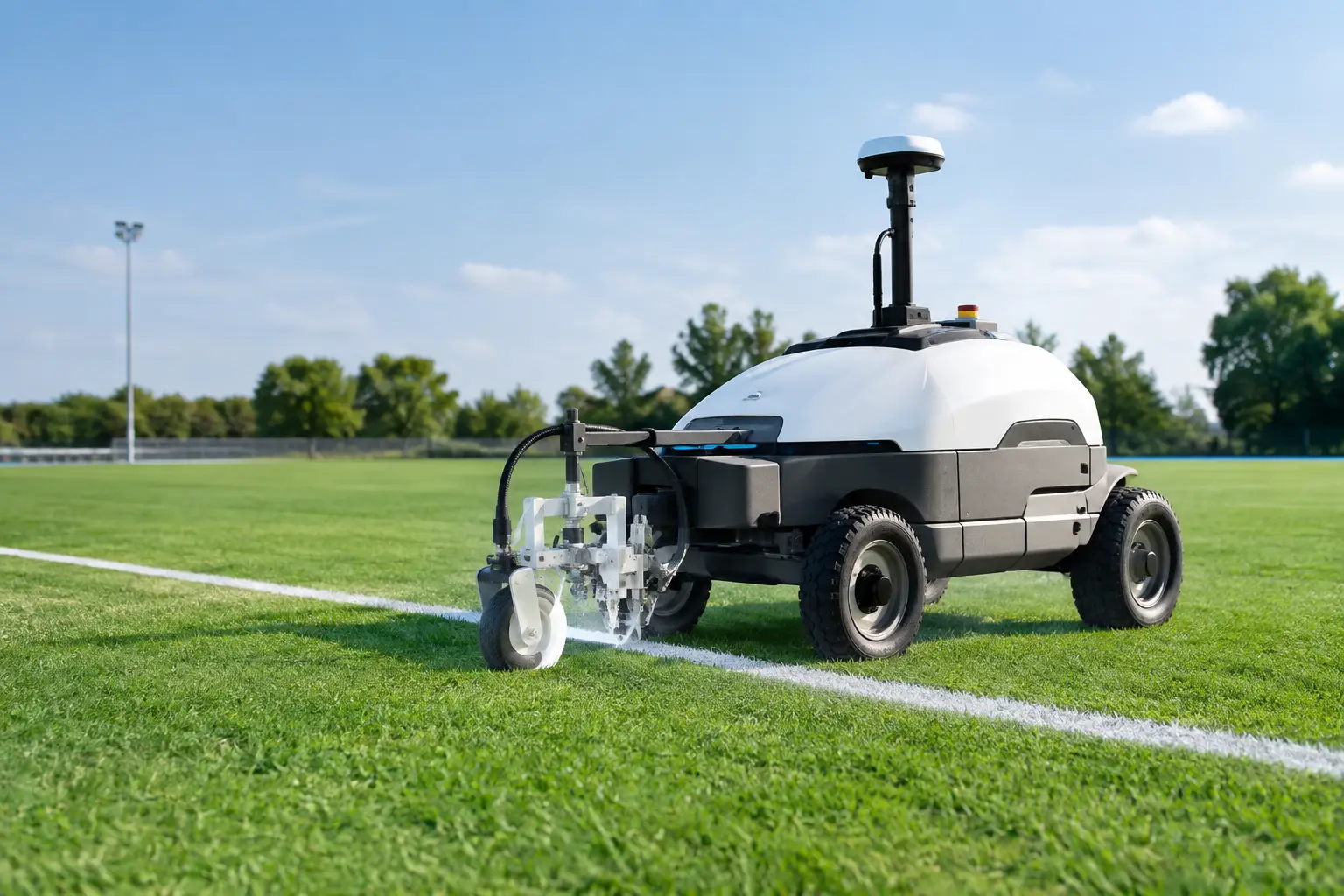
A pitch can be cut perfectly and still look below standard if its lines are inconsistent. Faded touchlines, uneven arcs and repeated set-out work consume valuable hours at the point when grounds teams are under the greatest pressure. Knowing how to deploy robotic line marking properly gives professional operators a repeatable way to set out pitches accurately, reduce manual handling and maintain presentation standards across a busy fixture programme.
Robotic line marking is not simply a case of loading paint and pressing start. The quality of the result depends on sound pitch data, a suitable site, the right paint settings and a workflow that allows the machine to work without disrupting other maintenance activity. Get those foundations right and autonomous marking becomes a dependable part of the weekly turf-care programme.
Start with the pitch, not the robot
Before a robotic line marker is introduced, establish exactly what needs to be marked and how often. A full-size football pitch, training grid, rugby layout and multi-use school surface all place different demands on mapping, paint volume and scheduling. The first deployment should reflect the real operating conditions of the site rather than an idealised empty field.
Measure the playing area carefully and confirm the governing dimensions for the sport and competition level. This is especially relevant where a ground hosts several teams, has non-standard run-offs or uses temporary markings. A robotic system will reproduce the layout it is given with high consistency, so inaccuracies in the initial set-out can be repeated just as consistently.
Review the surface condition at the same time. Severe undulations, standing water, loose debris, damaged turf or recently top-dressed areas can affect traction and line definition. Autonomous equipment can work on professional natural turf, but it should be deployed into a prepared operating environment. Clear the route, assess access points and identify any features that must remain outside the working area.
Build an accurate digital pitch layout
The layout is the operational foundation of robotic line marking. Most professional systems use position data to follow planned line paths, often supported by high-accuracy satellite positioning and a local correction signal. The objective is simple: the robot must know where the pitch sits on the ground and where every line begins, turns and finishes.
Initial mapping is normally completed by surveying or teaching the machine the pitch boundaries and reference points. Work methodically. Confirm the orientation of the pitch, the location of the centre spot, goal areas, penalty areas, technical zones and any sport-specific markings before saving the plan.
For facilities with several pitches, name layouts clearly by sport, size and location. “Football Pitch 1” is less useful than “Senior Football – North Pitch – Saturday Layout”. Clear naming prevents the wrong programme being selected during a busy changeover and makes it easier for different members of the team to use the system with confidence.
Treat the first map as a controlled commissioning task
Do not judge the system solely on the first autonomous run. Mark a test layout, inspect it against fixed site references and make measured adjustments where required. Pay particular attention to right angles, line-to-line spacing, circles, arcs and the relationship between markings and permanent goal sockets or boundary features.
Once approved, protect that layout as the master file. It should only be amended through a controlled process, particularly at sites where pitch dimensions are linked to league, school or governing-body requirements. This discipline is what turns automation into consistency rather than simply a faster way of applying paint.
Prepare the robot and marking materials
Line quality is influenced as much by paint preparation as navigation accuracy. Use a professional line-marking paint compatible with the machine and dilute it to the manufacturer’s recommended ratio for the prevailing conditions. Paint that is too thin can look weak and require additional passes. Paint that is too concentrated may reduce flow performance, increase waste and leave an unnecessarily heavy line.
Water quality matters where dilution is required. Sediment or contamination can block filters and nozzles, while poorly mixed paint can produce variations in brightness across the pitch. Mix thoroughly, fill the tank within its stated capacity and check that lids, hoses, filters and spray components are secure.
Before each deployment, carry out a short pre-start inspection. Check battery charge, wheel condition, sensor cleanliness, paint level, nozzle condition and positioning status. Confirm that the planned route is loaded and that the robot has a reliable connection to its positioning infrastructure where applicable. A five-minute check before deployment is preferable to finding a blocked nozzle halfway through a penalty arc.
Set safe working conditions
Autonomous operation does not remove the need for active site management. Establish a clear working zone and keep players, staff, spectators and vehicles away from the robot while it is marking. At schools, public parks and multi-use venues, this may mean scheduling work outside peak access periods or using temporary barriers and clear signage.
The operator should understand the stop procedure and remain available to intervene if site conditions change. Marking around moving goalposts, maintenance vehicles or public access routes introduces avoidable risk and can compromise the result. In most cases, the best deployment window is after mowing and surface preparation, when the pitch is clear and before training or fixtures begin.
Weather also affects the decision. Light wind may have little impact, but strong gusts can influence spray placement. Persistent rain can dilute fresh paint and saturated ground may affect machine movement. Frost, heavy dew and very dry surfaces can each alter how paint sits on the leaf. The right response is not always to cancel the programme, but to adjust the schedule, paint mix or pass strategy to suit the conditions.
Run a controlled first marking pass
For the initial operational runs, supervise the machine closely from start to finish. Watch for consistent paint flow, clean turns, accurate line tracking and appropriate clearance from goals, posts and pitch furniture. If a line begins to feather, fade or drift, stop and identify the cause rather than allowing the entire layout to be completed below standard.
Speed, nozzle configuration and paint flow must be balanced. A slower route may improve definition where a bright, highly visible line is required, but it can reduce daily capacity. A faster route can suit routine refresh work if paint coverage remains acceptable. The right setting depends on turf density, surface moisture, paint formulation, competition expectations and whether the line is a first application or a re-mark.
This is where robotic line marking offers a practical operational advantage. Once the correct settings are established, they can be repeated across pitches and throughout the season. That reduces variation between operators and helps grounds teams plan labour around other essential work such as mowing, aeration, repairs and match preparation.
Integrate robotic line marking into the maintenance plan
The strongest results come when marking is scheduled as part of a complete turf-care workflow. Coordinate it with cutting height, mowing direction, irrigation and fixture timings. On a striped presentation pitch, for example, the sequence of mowing and marking affects the finished appearance. Mark too early and later operations may scuff fresh lines; mark too late and the team may be working against an immovable kick-off deadline.
For high-use sites, create programmes for full marks, partial refreshes and training configurations. A full layout may be needed before a weekend fixture, while a midweek touch-up may only require high-wear areas such as touchlines, goalmouth boundaries and centre markings. Saved digital layouts make these variations easier to deliver without returning to tape measures and string lines.
At larger facilities, the productivity benefit is often found in parallel working. While the robot applies a planned layout, skilled staff can focus on inspections, repairs, presentation details or another pitch. The aim is not to remove professional judgement from grounds maintenance. It is to apply that judgement where it adds the most value.
Inspect, record and improve
Every marked pitch should be inspected before handover. Walk the surface from the spectator viewpoint as well as from pitch level. Check brightness, width, straightness, intersections and the visibility of key markings. Record paint usage, run time, weather conditions and any changes made to the programme.
These records help identify patterns. If one pitch consistently needs a different dilution ratio, has weaker coverage after irrigation or causes more wheel slip in winter, the operating plan can be adjusted before it becomes a fixture-day problem. Professional deployment is built on this feedback loop, not on assuming one setting will suit every surface and season.
GrassRobotics approaches autonomous turf equipment as a working solution for professional sites, where accuracy must be matched by dependable daily operation. Robotic line marking is most effective when it is commissioned carefully, supervised intelligently and incorporated into the wider maintenance routine.
The practical opportunity is clear: set the pitch once with precision, repeat it when required, and give your grounds team more time to protect the surface and prepare it to the standard players and spectators expect.