
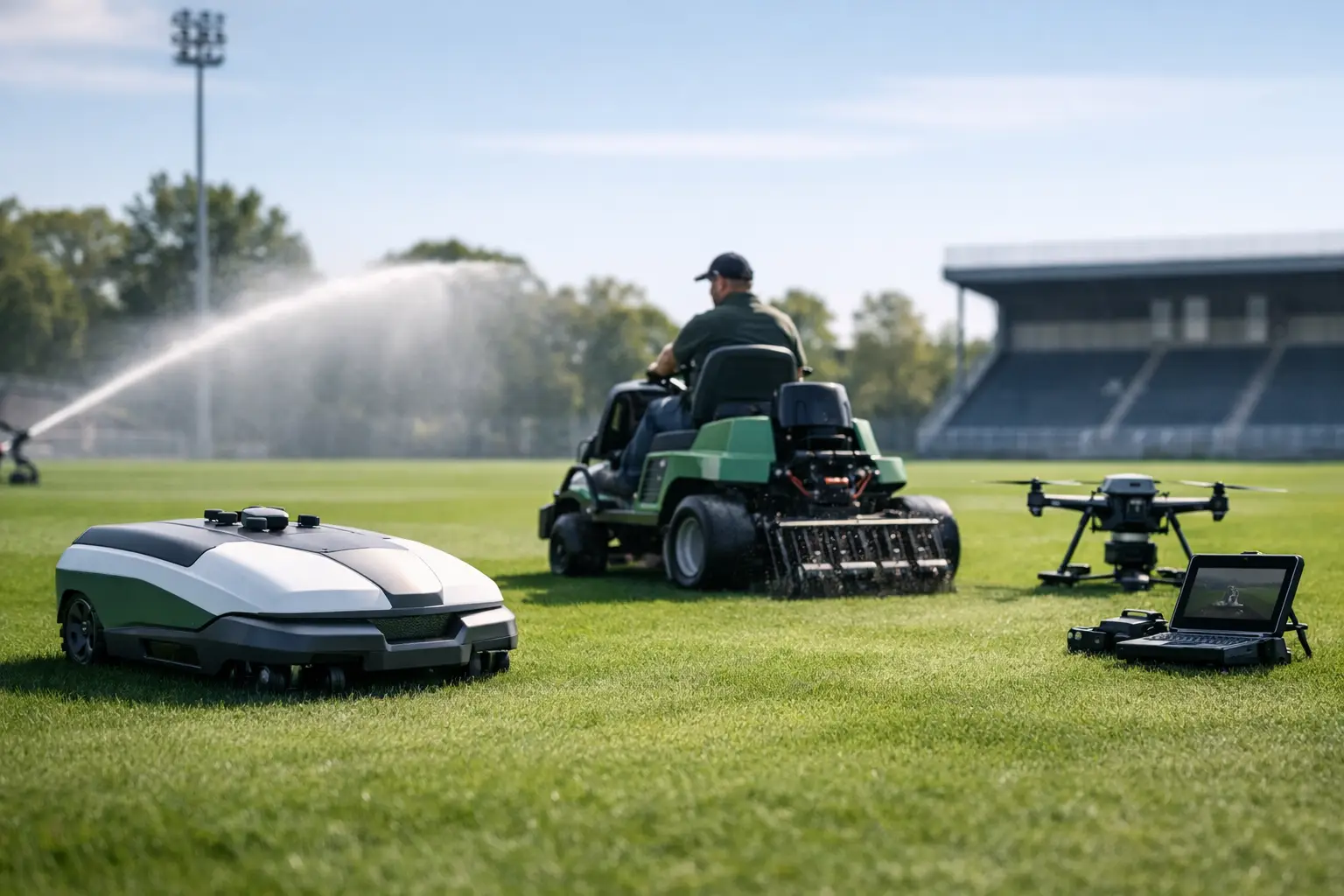
A marked pitch does not have the luxury of an inconsistent cut. Whether the surface is used for football, rugby, hockey or training, presentation, plant health and playability are judged every day – often under tight staffing, fixture and weather pressure. The best sports pitch maintenance technology is therefore not simply the newest machine on the market. It is technology that protects the mowing standard, releases skilled staff for higher-value turf work and fits reliably around a demanding site programme.
For professional grounds teams, autonomous mowing has become one of the most practical advances available. Its value is not that it replaces sound agronomy or experienced judgement. Its value is that it delivers repeatable daily cutting, allowing the team to focus on renovation, nutrition, irrigation, line marking, repairs and match preparation.
What makes sports pitch technology worth the investment?
A useful investment begins with the operational problem, not the product specification. If the challenge is labour availability, a machine that can maintain frequent mowing without an operator on the seat may have the strongest case. If presentation suffers between matches because mowing windows are limited, consistency and scheduling flexibility matter more than headline capacity alone.
The right technology should improve one or more of three outcomes: turf quality, team productivity and operational certainty. A system that produces an excellent finish but requires constant intervention will not solve a labour constraint. Equally, automation that cannot cope with the site layout, gradients, access routes or protected areas can create more work than it removes.
For most sports facilities, the strongest return comes from placing autonomous equipment into a defined maintenance system. The mower handles routine, frequent cutting within a mapped working area. The grounds team sets the standard, monitors turf conditions and deploys specialist equipment where a particular finish, cut height or task demands it.
Autonomous mowing for consistent presentation
Robotic mowing is the leading candidate when assessing the best sports pitch maintenance technology for daily operational impact. Regular light trimming supports a clean, uniform appearance without waiting for a conventional mowing round. Because the machine can work to a planned schedule, the pitch can receive attention consistently across the week rather than only when labour and weather windows align.
Frequent mowing also changes the nature of the workload. Small clippings are returned to the surface, reducing collection requirements in suitable conditions and avoiding the disruption of less frequent, heavier cuts. The result can be a more even visual finish and a more predictable routine for the team.
This does not mean every pitch should be managed identically. Stadium surfaces, heavily used community grounds and training areas have different wear patterns, recovery demands and expectations. A premium striped finish before a televised fixture may still require a cylinder mower and an experienced operator. The autonomous unit is most valuable where it protects the baseline standard every day, before specialist finishing work is required.
Precision around marked playing surfaces
Modern professional systems are designed to operate within defined work zones and can be configured around pitch boundaries, exclusion areas and site features. That precision is central to their value. A football training complex may need several closely managed areas with paths, goals, fencing and changing access requirements. A rugby ground may have a larger playing footprint and a different tolerance for edge management.
The planning stage matters. Boundary design, docking location, charging access, route between areas and safe separation from public use all influence performance. A proper site assessment should consider these details before selecting a machine. Buying on cutting width alone overlooks the factors that determine whether autonomy will work day after day.
Cylinder mowing still has a defined role
Autonomy is not a reason to retire every conventional mower. Cylinder mowing remains important where a close, highly refined cut and formal presentation are required. On elite surfaces, it can provide the finish expected for matchday, particularly where striping and exact visual standards are part of the venue offer.
The operational opportunity is to use each machine where it performs best. An autonomous mower can maintain frequency across training pitches, outfields and wider managed turf. A robotic cylinder mower may suit surfaces requiring a tighter standard of cut. Conventional equipment and skilled operators can then be deployed strategically for match preparation, clean-up work, renovation and periods of exceptional growth.
This mixed fleet approach is often more realistic than a single-technology answer. It reduces dependence on routine manual mowing without compromising the ability to respond to seasonal change or premium presentation requirements.
Data and remote control improve decision-making
The best equipment provides visibility as well as cutting capacity. Remote status monitoring, planned schedules and alerts help grounds managers understand whether a unit has completed its programme, needs attention or has been interrupted. That is especially valuable across multi-pitch estates, school campuses and local authority facilities where teams may be responsible for several locations.
Operational data should support judgement rather than overwhelm it. The useful questions are straightforward: how many hours has the machine worked, which areas receive the most activity, where have interruptions occurred, and does the schedule reflect actual turf growth and fixture use? Armed with this information, a manager can adjust mowing patterns before a presentation issue develops.
Connectivity also supports accountability. Instead of discovering an unfinished area during a pre-match walkover, teams can check progress and intervene early. For contractors managing service-level agreements, that greater visibility can improve reporting and protect consistency across a portfolio of sites.
Technology cannot override turf conditions
No mower, autonomous or otherwise, can compensate for poor drainage, compacted soil, disease pressure or an unsuitable cutting regime. The technology must sit within sound sports turf management. Cut height, mowing frequency, blade condition, soil moisture and seasonal growth all remain professional decisions.
Wet weather is a clear example of the trade-off. Frequent mowing can be beneficial, but traffic on saturated or vulnerable areas must be managed carefully. Similarly, a pitch carrying intense winter fixtures may require a revised operating schedule to avoid compounding wear in goalmouths, touchlines or access routes. Autonomy gives managers more control over timing, but it does not remove the need to adapt.
Safety and site management also remain essential. Machines should operate only in properly defined areas, with clear procedures for public access, maintenance staff, players and contractors. The strongest deployments are not treated as a standalone purchase. They are introduced with training, mapped workflows and a named person responsible for reviewing performance.
Choosing the right system for your site
When comparing robotic sports pitch equipment, start with the surfaces you need to maintain and the standard expected on each. Consider total workable area, terrain, cut-height requirement, daily operating windows, obstacles, charging arrangements and the availability of staff for routine checks. A large, open training area presents a different case from a compact independent school site with frequent pedestrian movement.
It is also worth assessing the labour task being displaced. If an experienced grounds operative spends several hours each week on repetitive mowing, autonomous equipment can reallocate that time to work that directly influences pitch resilience and match readiness. That is a stronger business case than measuring the purchase only against fuel or mowing hours.
At GrassRobotics, the focus is on purpose-built professional equipment rather than domestic lawn automation. That distinction matters when reliability, cutting quality and repeatable operation affect a venue’s reputation and its ability to host fixtures.
Build automation into the maintenance plan
The most successful installations begin with a clear outcome: maintain training pitches to a daily standard, protect labour capacity during peak growth, or improve consistency across several playing areas. From there, the mowing schedule, site boundaries and manual finishing work can be organised around the machine.
The technology earns its place when it gives the grounds team more time to apply its expertise where it matters most: producing healthier, more playable and better-presented surfaces when players arrive.