
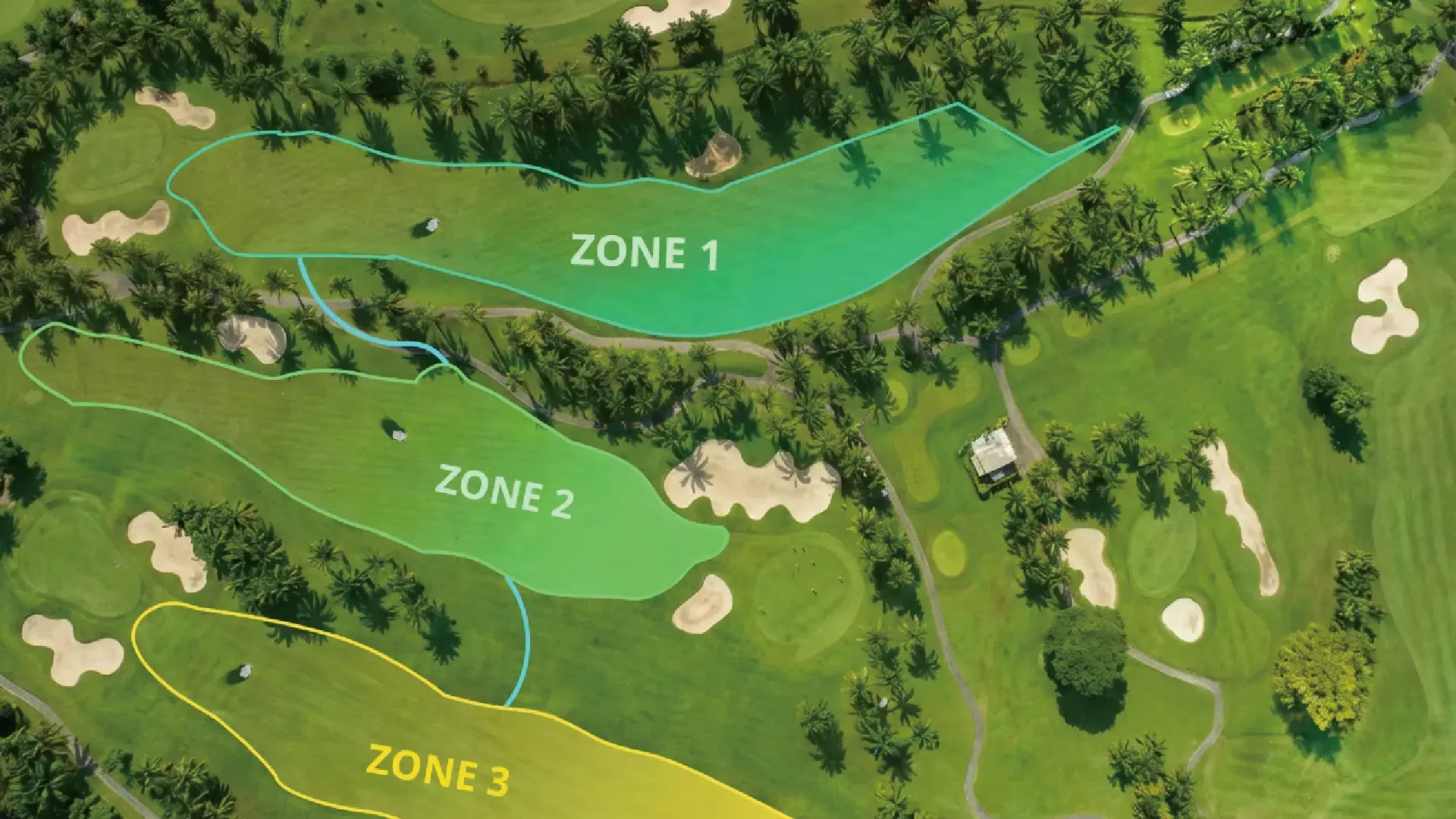
At 6.00am, the priority is not simply to cut grass. It is to present greens, tees and approaches to the required standard before the first players arrive, without consuming the whole morning’s labour resource. This golf course mower deployment example shows how an 18-hole facility can introduce autonomous mowing as a planned operating system rather than an isolated equipment purchase.
The example assumes a busy members’ course with a mixture of greens, tee complexes, fairways, semi-rough and practice areas. The principle applies equally to resort, municipal and private facilities, but the area allocation, work windows and number of machines must follow the course’s own presentation standard and playing pattern.
The operating brief
Consider an 18-hole course with approximately 1.1 hectares of greens and collars, 1.8 hectares of tees and surrounds, 22 hectares of fairways, and several hectares of practice ground and managed rough. The greenkeeping team is experienced but under pressure: vacancies are difficult to fill, early-morning work is concentrated, and manual mowing leaves less time for detail work, agronomy and course set-up.
The objective is not to remove the team from the course. It is to move repetitive, predictable cutting into an autonomous programme so skilled staff can focus on surfaces that need judgement. That includes hole changes, moisture management, bunker presentation, disease monitoring, hand finishing and preparing for competitions.
A practical fleet in this scenario might use dedicated robotic units for greens and selected surrounds, larger autonomous rotary machines for fairways and practice areas, and existing ride-on or pedestrian equipment for areas where a specific finish, collection requirement or rapid response is needed. The right mix depends on cut specification, gradients, access routes, daily traffic and the standard expected by members and visitors.
Golf course mower deployment example: area by area
Greens, collars and green surrounds
Greens are the least forgiving part of the deployment. Autonomous cylinder mowing can be scheduled during defined early-morning windows, with each machine assigned to a group of nearby greens and a clearly managed access route. The target is consistent frequency and reliable height of cut, not simply maximum coverage.
For example, two robotic cylinder mowers could each work a nine-hole loop across the week, with their programmes adjusted around competition days. A third unit may be assigned to high-use practice greens, putting surfaces and selected collars. This gives the head greenkeeper flexibility to protect the main-course schedule when a machine requires cleaning, service or redeployment.
The team should retain the ability to hand-finish or use conventional equipment where surface conditions demand it. During periods of disease pressure, heavy dew, renovation, topdressing or exceptional growth, autonomy supports the operation but does not replace agronomic judgement.
Tees and high-visibility surrounds
Teeing grounds are well suited to scheduled autonomous work because their boundaries are known, their presentation matters, and their cutting demand is recurring. Small, dedicated zones reduce unnecessary travel and make it easier to set different schedules for championship tees, daily tees and academy areas.
In this example, a robotic mower covers the main tee complexes outside the busiest player movement periods, while a second programme manages practice tees and selected approach surrounds. The frequency can be increased before weekends and member events, then reduced where growth slows. That control helps maintain a consistent visual finish without allocating a team member to the same repetitive route every morning.
Fairways and practice areas
Fairways usually offer the largest labour saving, but they also require the most disciplined deployment plan. An autonomous machine should be assigned by playing zone rather than given an unrealistic expectation to cover the entire course in one shift. Divide fairways into workable sectors based on hectare count, travel distance, crossing points and likely player traffic.
A larger autonomous mower might cover holes 1 to 6 on Monday and Thursday, holes 7 to 12 on Tuesday and Friday, and holes 13 to 18 on Wednesday and Saturday. Practice fairways can run in lower-traffic afternoon or overnight windows where site conditions permit. The conventional fleet remains available for tournament preparation, recovery following weather disruption and occasions when a particular stripe or finish is required.
This approach also prevents the common mistake of judging a robotic deployment only by hectares per hour. A machine that delivers regular, controlled cutting across a defined zone can improve surface consistency even if it does not replicate the route of a ride-on fairway mower.
Build the schedule around play, not around machinery
The best programme begins with the tee sheet. Identify the protected periods first: early starts, societies, coaching blocks, competitions, maintenance closures and busy practice times. Then allocate autonomous mowing windows around them.
For a typical members’ club, greens and priority tees may be completed before the first booked times. Fairways can be programmed in staggered sections through quieter periods, while practice areas run later in the day. Where the course has long operating hours or a resort pattern, overnight working may be viable, subject to site policy, lighting, noise expectations, security and wildlife considerations.
Each machine needs a route plan that accounts for narrow bridges, paths, ramps, underpasses, slopes, water hazards and public interfaces. The most efficient route on a map is not always the safest or most reliable route in operation. Establish service access, charging locations and approved transfer corridors before committing to daily schedules.
Labour gains come from redeployment, not an empty workshop
A credible business case measures what the team can now do with recovered hours. If two staff previously spent several hours each morning on repeat mowing routes, the value is not limited to fewer labour hours on a spreadsheet. Those people can inspect surfaces earlier, complete hand work before play, manage irrigation, prepare bunkers or progress planned improvement work.
Autonomy can also reduce dependence on a small number of operators who are qualified or confident on particular machines. That matters when holidays, sickness or recruitment gaps affect the rota. The course still needs trained people who understand mowing quality and can intervene when conditions change, but the daily operation becomes less vulnerable to one missing person.
There is a trade-off. Robotic mowing introduces its own management tasks: cleaning, blade or cylinder checks, charging infrastructure, mapping, software oversight and periodic route review. These tasks are generally predictable and can be incorporated into the workshop routine, but they should be included in the deployment plan from day one.
Set performance measures before the trial begins
A deployment should be assessed against operational outcomes, not enthusiasm for new technology. For the first eight to twelve weeks, record the time spent mowing by area, the number of completed autonomous cycles, missed or delayed cuts, intervention time, surface feedback and fuel or energy use.
Also track the quality indicators that matter to the course. On greens, that may include consistency of cut, clipping management and visual uniformity. On fairways, the focus may be evenness, presentation, frequency and the ability to maintain standards through peak growth. Compare results against the previous routine and against the labour released for other essential tasks.
Brief the whole team before launch. Greenkeepers need to know why each zone has been selected, who checks machine status, how exceptions are reported and when conventional mowing takes priority. Clear ownership is more valuable than a complicated operating manual.
Start with the zones that create immediate control
For many clubs, the right first phase is not every hectare of the course. Begin with one category of high-frequency work, such as practice areas, selected fairways, tees or a defined group of greens. Prove reliability, establish the daily checks and refine the programme around player movement. Expansion is then based on measured capacity rather than assumptions.
GrassRobotics approaches this as a turf-management decision: match the machine and deployment method to the playing surface, the work window and the standard required. The strongest result is a quieter, more predictable mowing operation that gives the greenkeeping team more time where their expertise has the greatest effect – on the course the golfer sees and plays.