
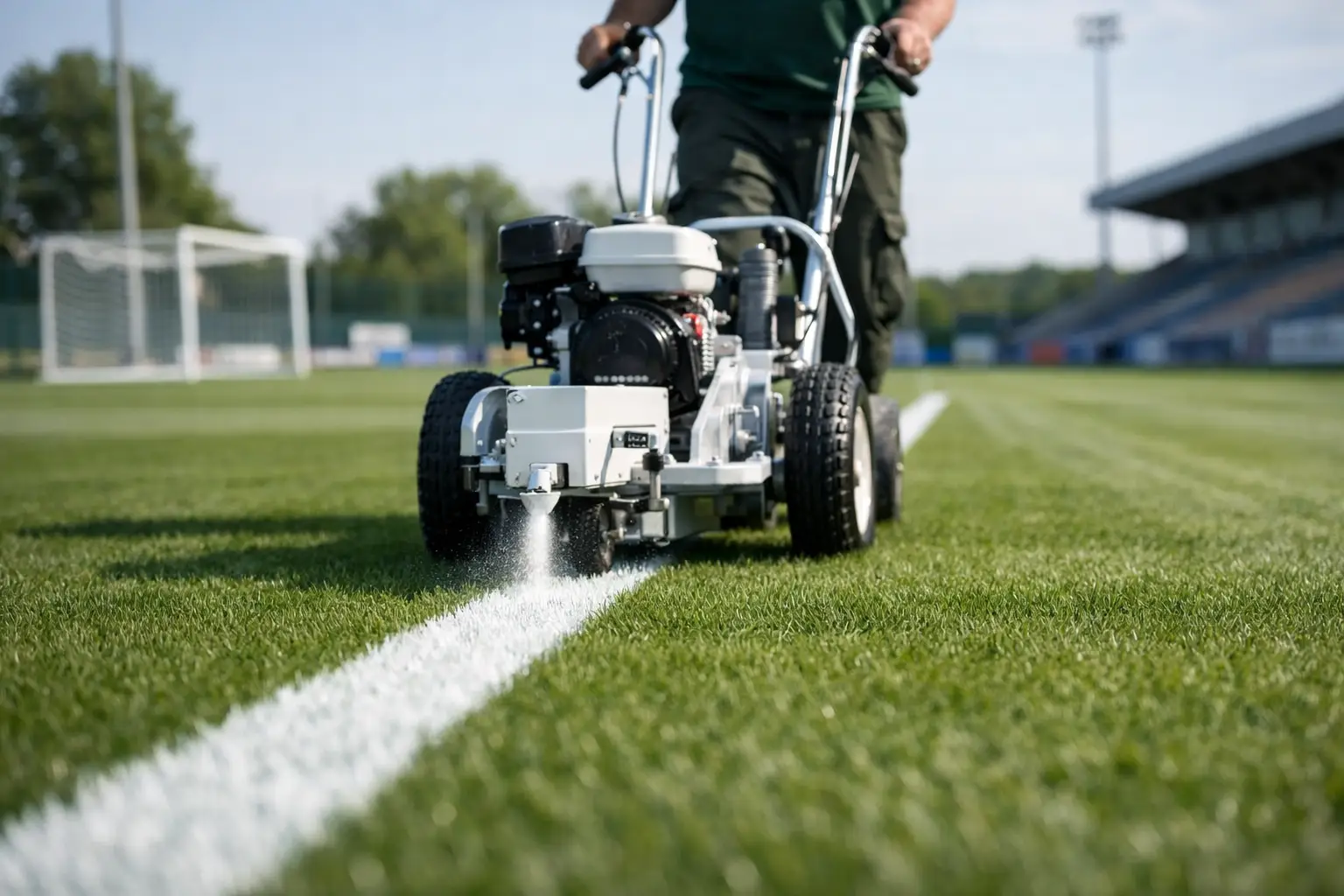
A poorly marked pitch is noticed before the first whistle. Uneven widths, faded touchlines and inaccurate corners undermine presentation standards and create avoidable work for the grounds team. The right pitch striping equipment gives operators control over accuracy, output and finish, even when fixture schedules leave little room for rework.
For professional sports grounds, the decision is not simply between a line marker and a can of paint. Equipment needs to suit the surface, the number of pitches, line-marking frequency, staff availability and the level of presentation expected by players, officials and spectators. A school field, community sports hub and elite stadium may all require white lines, but their operational needs are very different.
What Professional Pitch Striping Equipment Must Deliver
The core requirement is consistent line quality. That means clean edges, dependable coverage and a uniform width from the first metre to the final corner. Equipment that is difficult to calibrate or prone to inconsistent flow creates waste, slows the operator down and makes a precise layout harder to achieve.
Accuracy matters just as much. A marker can apply bright paint, but it still needs to follow correct dimensions and produce straight lines across the full field. Well-maintained measuring points, string lines or laser-guided set-out methods remain essential, particularly for first markings and multi-sport sites. The equipment should then make repeat applications straightforward rather than introducing fresh variation every week.
Professional operators should also assess capacity. Small manual applicators have a place for isolated repairs, training areas and low-use grounds. They become restrictive when a team is responsible for several full-size football, rugby, hockey or cricket outfields. Larger transfer-wheel, spray and battery-powered systems can reduce time on the pitch, although they require a more considered cleaning, storage and charging routine.
Match the Marking Method to the Surface
There is no single marking system that is best for every site. The right choice depends on turf condition, pitch use, local weather and the standard of finish required.
Transfer-wheel marking
Transfer-wheel machines apply paint through a rotating wheel that contacts the surface. They are valued for clear, defined edges and controlled application, especially on closely mown natural turf. With correct dilution and a clean wheel, they can produce an excellent professional finish.
Their limitation is that the wheel must stay in consistent contact with the ground. Deep divots, uneven ground and wet or soft surfaces can affect the result. Operators also need to keep the wheel, tank and feed system clean. Dried marking compound soon becomes a reliability problem.
Spray marking
Spray systems apply marking fluid through nozzles and can cover ground quickly. They are often well suited to larger facilities, regular over-marking and situations where productivity is a priority. Adjustable pressure and nozzle selection can help operators match the application to the grass cover and required visibility.
The trade-off is that spray application demands good discipline. Wind can affect accuracy, while blocked nozzles or incorrect settings can create patchy coverage. Operators need a consistent travel speed and suitable pressure to avoid lines that look heavy in one section and weak in another.
Aerosol and hand-held tools
Hand-held applicators are practical for goalmouth repairs, small training grids, temporary markings and detail work around existing lines. They are not an efficient primary system for a full programme of pitch preparation. Relying on hand application for large areas usually increases labour time and reduces repeatability.
For high-use sites, the strongest approach is often a main machine for full-pitch marking supported by compact tools for quick corrective work. This keeps staff from bringing a large machine onto a surface simply to repair a short section of line.
Build Accuracy Into the Workflow
The machine is only one part of the result. Consistent presentation comes from a repeatable process that begins before paint reaches the grass.
Start with permanent reference points where appropriate and confirm the governing dimensions for each sport and competition. A pitch used for multiple formats should have a clear marking plan, including which colours apply to which activity and how line clutter will be managed. Conflicting or poorly removed lines quickly make a surface look unmanaged.
Before each application, check paint dilution, battery charge or fuel level, tyre condition, wheel cleanliness and nozzle output. A short test pass on an unobtrusive area can identify flow issues before they become visible across a main pitch. It is faster to correct a setting at the start than to repaint an entire touchline.
Travelling speed should be controlled rather than rushed. Faster is not always more productive if it leaves a weak line that requires a second pass. Equally, excessive application wastes marking material, can stain footwear and produces an unnecessarily harsh appearance. The objective is clean, visible definition using the minimum reliable quantity of product.
Consider Labour Alongside Equipment Cost
Purchase price matters, but it is rarely the full cost of a line-marking operation. Grounds managers should consider the time required to set out, fill, apply, clean and store the system, as well as the cost of marking fluid and replacement parts.
A lower-cost machine may be sensible for a single low-use pitch, particularly where the surface is simple and marking dates are flexible. At a busy school, academy, local authority site or club with several fixtures each week, labour often becomes the larger cost. A higher-capacity or powered system can be the more economical choice if it cuts repeated manual work and helps a small team keep to schedule.
Reliability also carries value. Equipment that is straightforward to maintain and ready when required protects match-day preparation. Keeping a basic stock of consumables, cleaning equipment and suitable spare nozzles or wheels can prevent minor issues from becoming a cancelled marking session.
Pitch Striping Equipment and Mowing Presentation
Line marking and mowing should be planned together. Freshly cut turf provides a cleaner surface for visible lines, while a well-designed mowing pattern adds the striped presentation that frames the marked playing area. These are separate tasks, but the finished pitch is judged as one surface.
For facilities managing extensive turf, autonomous mowing can create a more reliable base standard between pitch preparations. Consistent cutting height, regular mowing cycles and reduced dependence on available manual labour help keep grass coverage even. That supports sharper marking and reduces the visual contrast caused by uneven growth.
Robotic mowing does not replace pitch striping equipment. It gives the grounds team more time to focus on the skilled work that still needs human judgement: setting out, fixture-specific marking, repairs, inspections and final presentation. For operators balancing several sports areas, that shift in labour can be significant.
GrassRobotics works with professional turf teams looking to increase mowing consistency across demanding sports and institutional environments. When autonomous cutting is planned around marking schedules, teams can maintain a more predictable surface without compromising access for pitch preparation.
Maintenance Protects the Finish
Pitch marking equipment should be cleaned immediately after use, not left until the next fixture. Flush tanks, hoses and spray components with the recommended cleaning method, remove residue from wheels and inspect filters before storing the machine. Paint compounds are designed to remain visible on turf, so they can be equally effective at creating blockages if allowed to dry inside equipment.
Keep a simple record of line-marking dates, dilution rates, weather conditions and any adjustments that improved results. Over time, this gives the team a practical reference for different surfaces and seasons. A setting that works on dense summer growth may not be right for a thinner winter pitch.
The best investment is equipment that fits the site, is simple enough to be used correctly every time and supports the standard your facility promises. When marking, mowing and maintenance are planned as one operation, the pitch is ready to perform long before the teams arrive.