
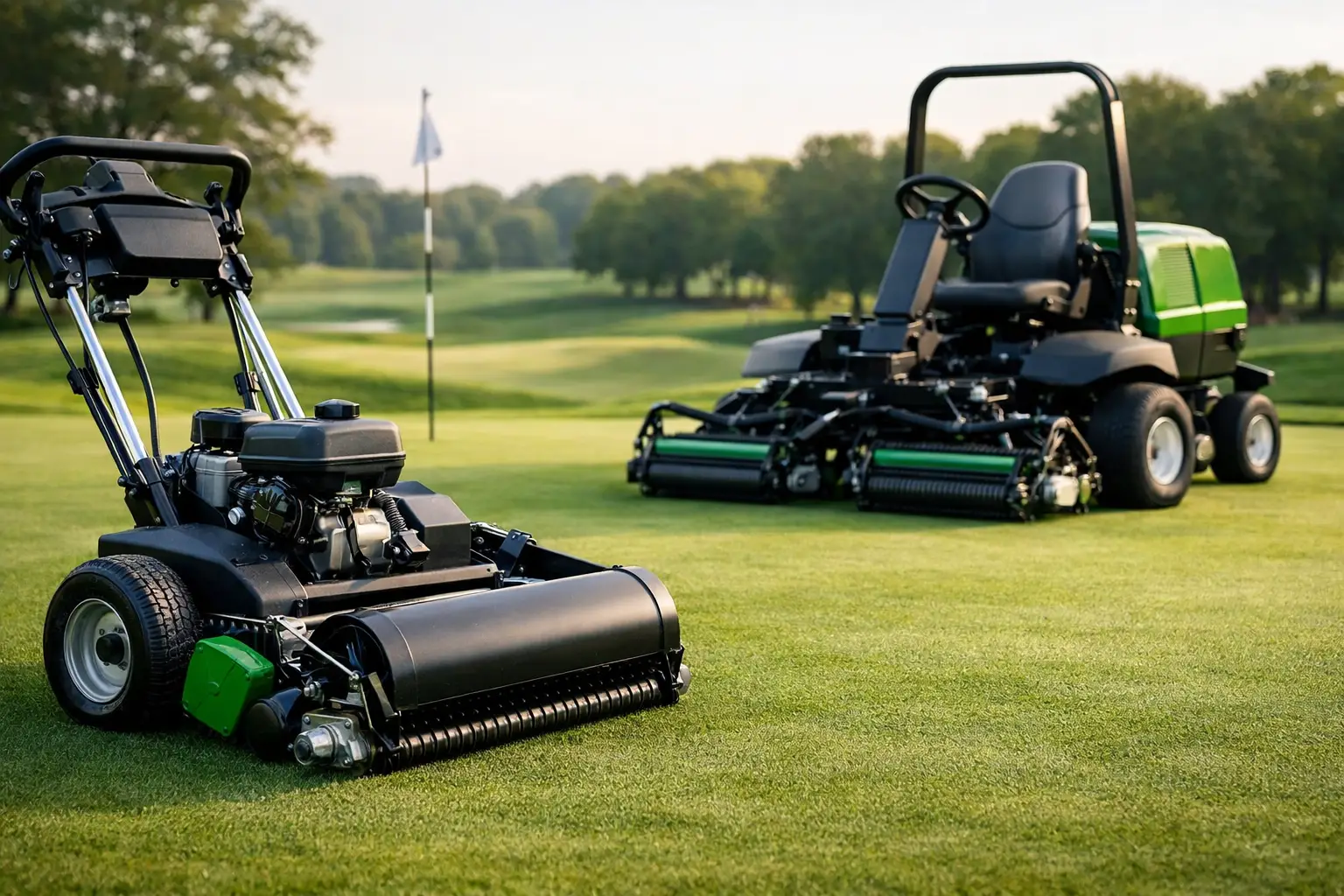
A green can look acceptable at first light and still fail the test once the first putt rolls across it. The best mower for golf greens is therefore not simply the machine that cuts lowest. It is the one that repeatedly delivers a clean, consistent finish at the required height of cut, without disrupting play or stretching an already pressured labour resource.
For course managers and head greenkeepers, the decision should begin with surface standards and operating conditions, not a headline specification. Green size, contour, grass species, mowing frequency, access routes, morning play, staffing levels and workshop capacity all affect what the right mowing system looks like.
What makes the best mower for golf greens?
Greens demand a different standard from fairways, semi-rough or general amenity areas. The cutting unit must produce a precise, scissor-like cut that supports ball roll and plant health. For that reason, a professional cylinder mower remains the reference point for close-cut greens work. The reel and bedknife need to be correctly set, sharp and maintained so the machine cuts rather than tears the leaf.
The quality of cut is only one part of the equation. A greens mower must also follow undulations without scalping high points, maintain a stable height of cut across the surface, and avoid marking or bruising the turf during turns. On tightly managed greens, small inconsistencies quickly become visible in presentation and measurable in putting performance.
The best choice will also fit the course’s maintenance programme. If daily cutting is needed during peak season, reliability, repeatability and deployment time can matter as much as outright mowing speed. A machine that consistently completes a shift with minimal intervention may offer greater value than one that looks more capable on paper but adds set-up, transport or operator time.
Cylinder mowing is the starting point
For greens maintained at close heights, cylinder technology is normally non-negotiable. Rotary mowing has a place elsewhere on the course, but it does not provide the finish expected on a putting surface. A properly configured cylinder mower delivers a fine, even cut and can be selected around the course’s target height of cut, turf species and desired clip rate.
Clip rate deserves particular attention. It is the distance travelled between successive cuts from the reel, and it influences the texture and uniformity of the finished surface. A tighter clip can improve presentation, but the right setting depends on growth, mowing frequency and how aggressively the turf is being managed. There is no value in chasing a single number if it creates unnecessary stress or slows operations beyond what the maintenance team can support.
Equally, do not treat the stated cutting width as a simple productivity figure. Wider is not always better on small, shaped greens with narrow entrances, steep banks and frequent obstacles. Manoeuvrability, weight distribution and the mower’s ability to follow contours can be more valuable than extra width. The machine should work with the architecture of the green rather than force the team into awkward passes or compromised clean-up.
Autonomous mowing changes the labour calculation
Robotic mowing is particularly relevant where labour availability is limiting routine maintenance capacity. It moves repetitive cutting from a manually staffed task to a planned, repeatable operation, allowing skilled greenkeeping staff to focus on agronomy, detail work, course set-up and player-facing priorities.
That does not mean autonomy removes the need for professional judgement. Greens still require inspection. Moisture, disease pressure, debris, worm casts, seasonal growth and temporary course activity all influence whether a scheduled cut should proceed. The strongest autonomous programmes build mower operation into the greenkeeping routine, with clear oversight and defined intervention points.
A purpose-built robotic cylinder mower can be a strong option for courses seeking close-cut precision with lower daily labour dependence. Systems such as the GM22S Greens Mower are designed around the requirements of professional turf operations, where consistent coverage and controlled cutting are more relevant than consumer-style convenience features.
The practical question is whether the autonomous platform can operate reliably within the site. Consider the route between storage, charging and greens; gradients; bridges; narrow paths; public access; and the way the machine will be managed during competitions. The best autonomous solution is one that fits the working course, not an idealised map of it.
Assess your greens before selecting a mower
A site assessment should identify where mowing quality or efficiency is currently being lost. Are greens being cut late because staff are diverted to other tasks? Are operators spending significant time moving machines between surfaces? Is there inconsistency between shifts or personnel? Are contouring and tight surrounds creating scalping risk? These are equipment-selection questions as much as management questions.
Start with the number and average size of greens, then look at their variation. A course with relatively open, modern greens has different requirements from one with small, heavily contoured surfaces, tight approaches and mature tree cover. Include satellite practice greens, putting greens and short-game areas in the assessment. They often carry high presentation expectations while receiving less consistent attention during busy periods.
Also examine the intended mowing window. Early-morning manual mowing can compete directly with course preparation and first-tee demand. Autonomous operation may create flexibility, but it still needs scheduling around golfers, staff movements, irrigation, frost delays and event set-up. A mower is only productive when its working hours suit the venue.
The trade-offs that matter most
There is no single best mower for every golf green because every course balances quality, capacity and budget differently. The correct decision usually sits between several trade-offs.
A highly specialised greens mower can deliver exceptional close-cut performance, yet it may be less useful outside that defined role. That is often the right compromise. Using a dedicated machine for the surfaces that set the course’s visual and playing standard protects quality where it matters most.
Autonomy can reduce routine labour demand, but it requires sound implementation. Mapping, operating boundaries, charging arrangements, daily checks and staff training need to be planned from the outset. Treating robotics as a standalone purchase rather than part of a maintenance workflow risks underusing the equipment.
Lower height of cut can improve pace and presentation in the right conditions, but it increases agronomic pressure. Mower selection must support the maintenance plan, not dictate it. Reel condition, bedknife adjustment and the discipline of regular backlapping or grinding remain central to plant health and finish, regardless of how the mower is powered or controlled.
Cost should be assessed over the operating life of the machine. Purchase price is relevant, but so are labour hours, fuel or energy use, maintenance intervals, consumables, downtime risk and the value of releasing experienced staff for higher-value work. For many facilities, the commercial case for automation is strongest when it protects standards during periods of recruitment difficulty or peak workload.
Questions to ask before committing
Ask suppliers to demonstrate the machine on representative greens, not only on a flat demonstration area. Observe the finish in different directions, the behaviour around contours, the cleanliness of turns and the time required for set-up and daily care. A practical demonstration should show how the mower handles the surfaces that cause problems on your course.
Clarify the expected maintenance regime for cutting units, batteries, sensors and drive components. Professional equipment should have a clear service pathway and parts support suitable for a working golf operation. The operational benefit of an advanced mower is quickly reduced if the team cannot keep it accurately adjusted or return it to service promptly.
Finally, decide what success looks like. It may be a more consistent daily finish, fewer operator hours on routine cuts, greater resilience during staff shortages, or more time for hand work and agronomic tasks. Defining that outcome makes it easier to select a mower system on evidence rather than assumptions.
The right greens mower should make excellent surfaces more repeatable, not merely more mechanised. When cylinder precision, autonomous capability and the realities of the course are aligned, the maintenance team gains time without giving away the standard players see and feel on every putt.