
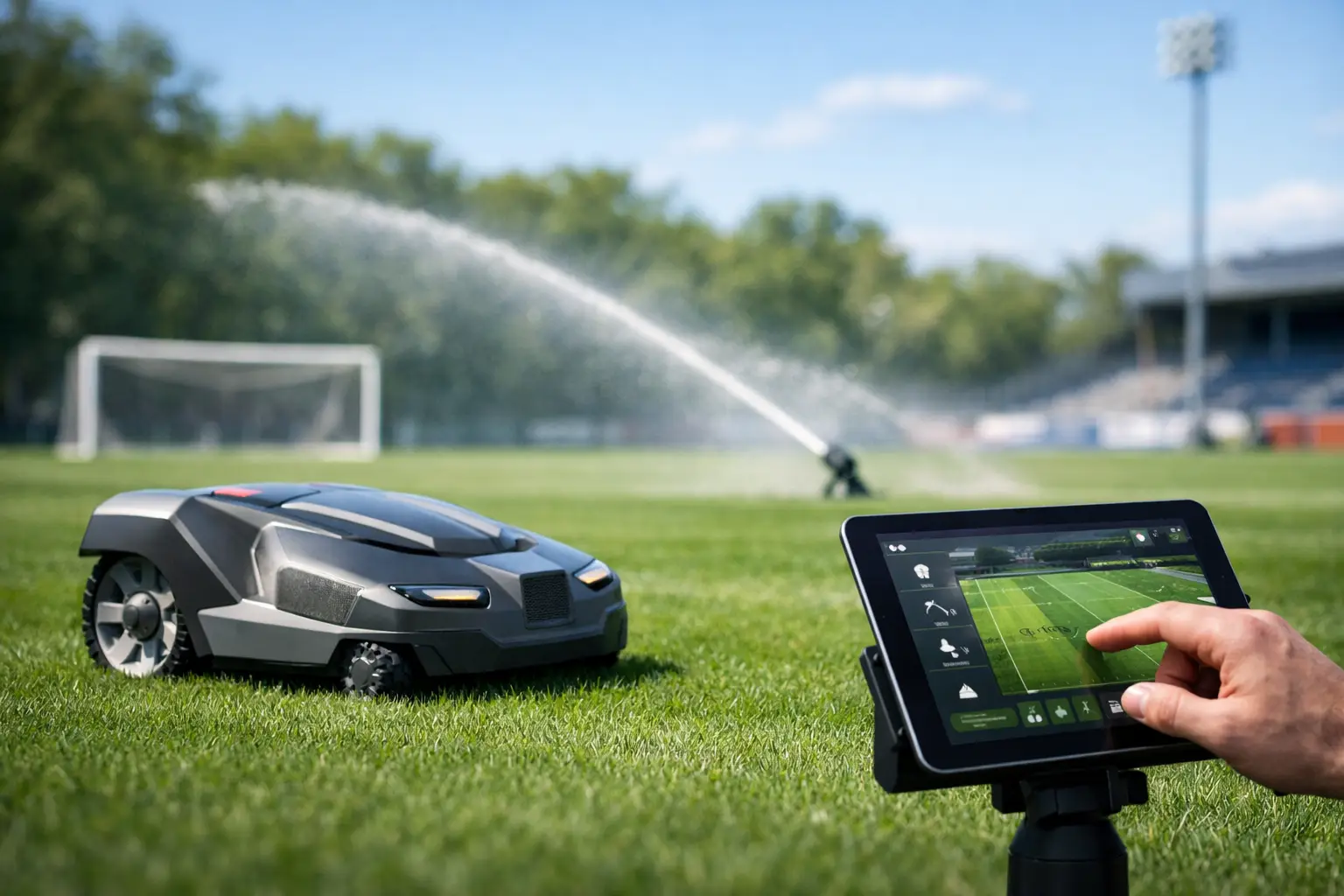
A guide to sports turf automation starts with a practical question: which parts of your cutting programme need repeatable output without tying up skilled people? For most sports facilities, the answer is not every task. It is the predictable, high-frequency mowing work that has to be completed regardless of staffing gaps, fixture pressure or changing weather.
Autonomous mowing gives grounds teams a way to protect presentation standards while moving labour towards line marking, repairs, irrigation, disease monitoring and match preparation. The value is not simply that a machine can mow unattended. It is that cutting can become more consistent, more frequent and easier to plan across the whole site.
Where sports turf automation delivers most value
Sports pitches demand a different approach from amenity grass. Surface appearance matters, but so do plant health, ball roll, traction, recovery and safe access for players and staff. Automation should therefore be assessed as part of the maintenance system, not as a replacement for a single ride-on mower.
The strongest applications are repeatable areas with defined boundaries and regular cutting requirements. Training pitches, school and university grounds, football and rugby facilities, cricket outfields, tennis surrounds and multi-pitch estates can all benefit where mowing is a substantial weekly labour commitment.
A robotic mower can work outside the busiest periods of the day, maintaining a frequent light cut while the grounds team focuses on specialist interventions. This is particularly useful where a small team is responsible for several pitches or when contractors need to maintain a reliable service across multiple locations.
That said, automation is not automatically right for every area. Steep banks, heavily obstructed spaces, irregular temporary layouts and surfaces with frequent public access may need a different machine, additional site controls or conventional mowing. The right decision follows a site assessment, not a headline claim about labour saving.
Start with the mowing programme, not the machine
Before selecting equipment, map the current programme in detail. Identify each area, the required height of cut, the target mowing frequency, access routes, obstacles, fixture windows and the time currently spent mowing. This provides a baseline for deciding where automation will make a measurable difference.
Separate areas according to their maintenance standard. A first-team stadium pitch, an academy training grid and a grass perimeter may all sit within one facility, but they will not necessarily require the same cut, machine or operating schedule. Autonomous equipment is most effective when deployed against a clear specification rather than asked to do every job.
For marked playing surfaces, consider how mowing direction, striping expectations and line-marking schedules fit together. Some facilities will prioritise a highly consistent daily cut, while others will use automation to keep areas tidy between scheduled presentation cuts. Both models can work, provided the outcome is defined in advance.
A good assessment should also examine practical constraints: charging location, power availability, storage, mobile connectivity where relevant, public separation, gates, bridges, drainage channels and routes between work areas. These details decide whether a proposed system will operate reliably through a full season.
Match the cutting system to the surface standard
The cutting unit matters as much as the autonomous platform. Rotary systems can be highly productive on larger sports surfaces where regular maintenance and efficient coverage are the priority. Cylinder mowing may be better suited to finer presentation standards and closely managed turf, depending on the surface, height of cut and finish required.
For a sports manager, the useful question is not whether one system is universally better. It is whether the mower produces the required quality at the required frequency without creating extra remedial work. A machine that saves mowing hours but leaves unacceptable clippings, inconsistent edges or poor results in damp conditions is not delivering real productivity.
Grass condition should shape the operating plan. During periods of rapid growth, a frequent light cut usually supports a cleaner finish than infrequent removal of heavier material. In slower growth or drought stress, schedules may need to be reduced. Automation provides capacity, but it does not remove the need for professional judgement on clipping volume, plant response and soil conditions.
Design an operating plan around fixtures and people
Autonomous mowing must fit the rhythm of the venue. Build operating windows around training, matches, school use, maintenance access and public activity. Many sites gain the most from early morning, evening or overnight mowing, but the appropriate window depends on local noise considerations, security arrangements and how the facility is used.
Set clear rules for weather interruptions. Heavy rain, saturated ground, frost and periods of disease risk may require the mower to pause. This is not a weakness of automation. It is the same agronomic discipline an experienced operator would apply, now built into a controlled operating process.
Human oversight remains essential. Teams should inspect the surface, check the machine’s work, clear hazards and review exceptions. Automation reduces routine driving time; it does not remove accountability for the playing surface. A head groundskeeper or turf manager still sets the standard and decides when conditions call for a change.
Plan the site set-up carefully
The quality of the installation has a direct effect on daily performance. Boundaries, work zones, exclusion areas and return routes must reflect the real site rather than an idealised plan. Goalposts, benches, portable equipment, temporary fencing and seasonal changes all need to be considered.
A proper commissioning process should include supervised runs in normal operating conditions. Observe turning behaviour, edge coverage, access through gates, charging cycles and performance around drainage features or irrigation hardware. Adjustments made at this stage are far less disruptive than dealing with repeated stoppages once the system is expected to run independently.
Safety procedures should be clear for every user of the grounds. Staff need to know how to stop the machine, where it is permitted to work and how to report an issue. If contractors, coaches or caretakers share the site, communicate the operating windows and responsibilities from the outset.
Measure the return in operational terms
Labour saving is often the starting point, but it should not be the only measure. Track mowing hours released, frequency achieved, fuel or transport use avoided, missed cuts prevented and the time redirected towards higher-value turf work. These figures make the business case clearer than a general claim that the site is more efficient.
Quality indicators matter too. Record visual consistency, clipping control, pitch availability, complaints, turf recovery and the number of manual interventions required. A successful installation should improve predictability. If the team is still repeatedly stepping in to correct coverage or deal with access issues, the operating plan needs refinement.
The financial case will vary. A high-use facility with several pitches and persistent recruitment pressure may see a faster return than a single, lightly used field. Equally, a site may justify automation because it increases reliability during staff absence, even where the direct labour saving is modest. Assess the investment against your own workload, standards and risk profile.
Keep skilled people focused on skilled work
The most effective automated sites do not treat robotics as a way to remove expertise from turf care. They use it to make expertise more available. Instead of spending hours completing repetitive cuts, experienced staff can inspect high-wear areas, respond to changing conditions, prepare surfaces for fixtures and improve the details that players and clients notice.
That shift is especially relevant when recruiting and retaining capable grounds staff is difficult. A well-planned robotic mowing programme can make the working day more productive and less dependent on finding an operator for every routine pass. It also creates a more consistent baseline across the estate, even when the calendar is crowded.
For facilities considering professional autonomous equipment, GrassRobotics approaches the decision as a turf-management solution: matching machinery, surface requirements and operating conditions rather than treating every pitch as the same.
The best first step is to choose one defined area with a clear mowing burden and a measurable standard. Prove the operating model there, refine it with the team, then expand automation where it gives the grounds operation more control over time, quality and available labour.