
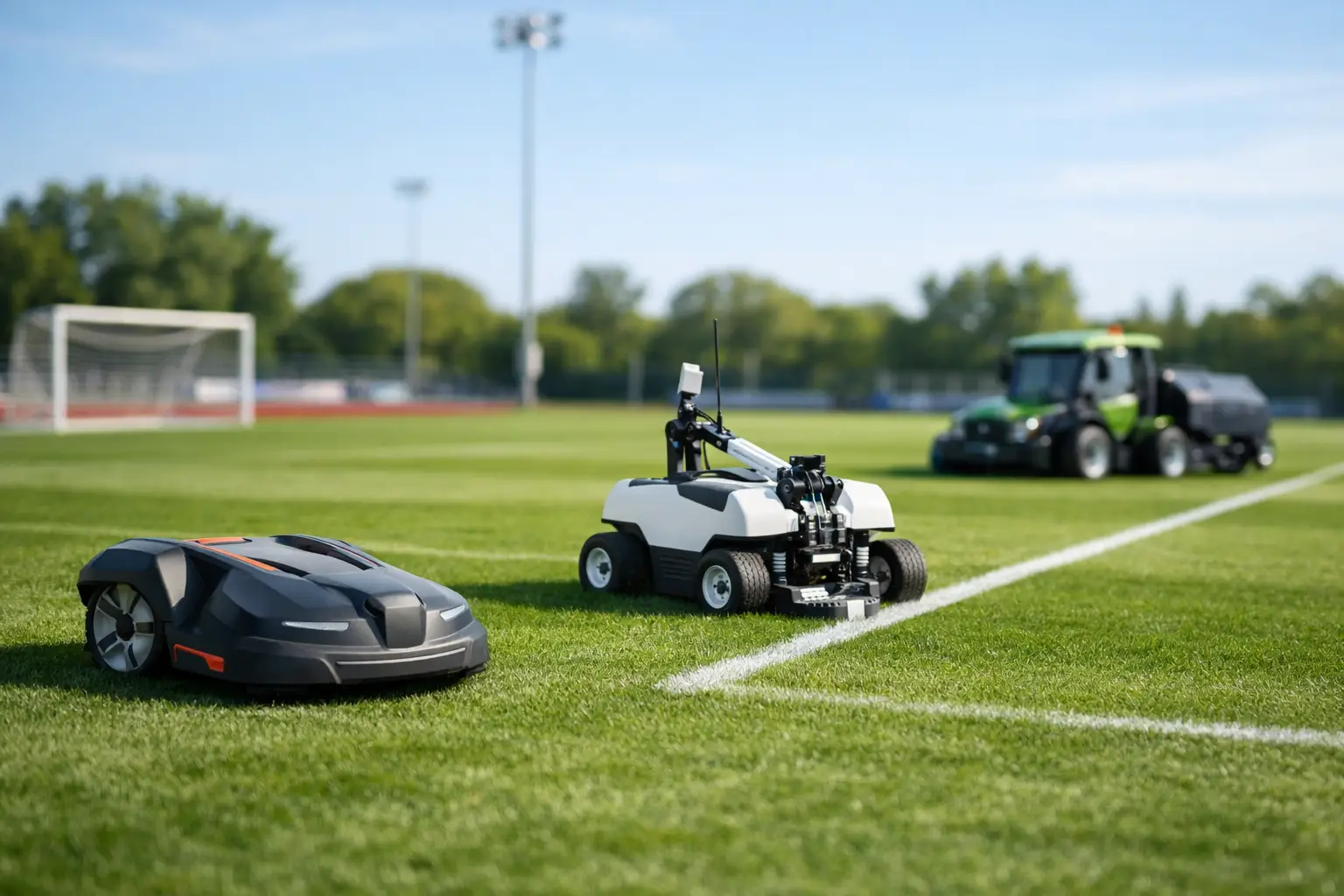
A pitch does not care that you are short-staffed. It still needs a clean, even cut, reliable presentation, and surfaces that perform day after day. That is exactly why top robotic solutions for sports turf are moving from trial projects into mainstream operational planning for schools, clubs, stadiums and local authority sites across the UK.
For professional operators, the case for automation is no longer about novelty. It is about maintaining standards when labour is harder to recruit, fuel and input costs remain under pressure, and expectations around consistency have not dropped. The real question is not whether robotics can work on sports turf. It is which solutions make commercial and practical sense for your site.
What counts as top robotic solutions for sports turf?
In a professional setting, robotic turf care goes well beyond a small autonomous mower trundling around a domestic lawn. The top robotic solutions for sports turf are purpose-built systems designed for managed playing surfaces, repeatable work patterns and measurable labour savings.
That usually means autonomous mowing platforms for football, rugby, cricket outfields, training grounds and wider amenity sports areas. In some cases, it also includes robotic cylinder mowing for finer presentation, autonomous collection or transport functions, and line-marking systems that reduce manual set-up time and improve repeatability.
The right solution depends on the surface standard you need to achieve. A training pitch with heavy weekly usage has different priorities from a show pitch, and both differ again from a golf practice area or multi-pitch education site. Automation works best when matched to the actual maintenance objective rather than bought as a broad technology upgrade.
The main robotic categories that matter
Autonomous rotary mowing
For many sports sites, autonomous rotary mowing is the fastest route to labour reduction. These machines are suited to regular maintenance cutting across larger areas where consistency, frequency and dependable output matter more than one-off high-volume mowing.
Their value comes from continuous operation. Instead of sending a member of staff out for several hours on repeat mowing passes, the machine handles routine cutting little and often. That supports a more consistent surface, steadier presentation and lower pressure on the team.
Rotary systems are especially useful on football and rugby pitches, training facilities and wider grounds where maintaining a tidy, even finish every day would otherwise be labour intensive. They can also help keep growth under control between higher-input maintenance operations.
Robotic cylinder mowing
Where striping quality, clipping control and a tighter finish are central to standards, robotic cylinder mowing becomes more relevant. This is particularly important for finer turf environments and sites where presentation is part of the user experience, not just a background expectation.
Cylinder robotics are not the answer for every venue. They tend to make most sense where the finish quality must sit closer to what operators expect from a skilled grounds team using conventional professional equipment. The trade-off is that these systems require a tighter specification around site suitability, operating plan and expected finish.
Robotic line marking and complementary automation
For marked playing surfaces, mowing is only part of the workload. Robotic line marking can bring similar advantages in accuracy and repeatability, especially on sites with multiple pitches or frequent layout changes.
This type of automation is often overlooked because mowing feels like the larger cost. In practice, line marking can absorb significant staff time and can vary too much when completed under pressure. Autonomous or semi-autonomous marking systems help standardise outcomes, though they still rely on good initial site mapping and disciplined operational processes.
Where robotics delivers the strongest return
The best return usually appears where repetitive labour is high and standards need to stay consistent across the week. Schools with multiple winter sports pitches, local authorities with broad grass estates, training grounds, academies and contractor-managed sites are often strong candidates.
High-profile venues can benefit too, but for slightly different reasons. At that level, robotics supports precision and consistency while freeing skilled staff to focus on renovation work, disease monitoring, irrigation, presentation details and fixture preparation. The machine takes over routine passes so the team can concentrate on the tasks that still need judgement.
That distinction matters. Automation does not remove the need for qualified turf professionals. It changes where their time is best spent.
What to assess before choosing a system
Surface type and quality target
Start with the required finish, not the machine brochure. If your priority is dependable maintenance across training and community pitches, autonomous rotary solutions may be the most practical fit. If your target is a finer cut on premium surfaces, a cylinder-based platform may deserve closer attention.
The mistake is assuming all robotic mowing produces the same result. It does not. Cut quality, stripe definition, clipping behaviour and recovery under heavy growth all vary by machine type and operating method.
Site layout and access
Complex sports sites can either suit robotics very well or become frustrating quickly. Separate pitches, narrow access points, changing boundary layouts and shared public space all affect deployment.
A simple, contained training ground is generally easier to automate than a busy municipal site with open pedestrian traffic and mixed-use areas. That does not rule robotics out, but it changes the level of planning required. Boundary management, docking locations, transport between zones and safe working windows all need proper consideration.
Labour profile
If your team is stable, experienced and fully resourced, the main value of robotics may be productivity and consistency. If you are struggling to recruit, dealing with seasonal gaps or relying heavily on overtime, the value becomes more immediate.
This is where many buying decisions are really made. A robotic system that saves a few hours on paper can be transformational if those hours are currently difficult or expensive to cover.
Growth conditions and maintenance regime
Robotics performs best within a planned maintenance system. If surfaces are routinely left too long between cuts, or if growth surges are extreme, machine selection and scheduling become more important.
Frequent autonomous mowing can improve consistency significantly, but it is not a cure for weak agronomy or poor planning. The strongest results come when robotics is integrated into a wider programme that includes nutrition, irrigation, aeration and seasonal renovation.
Common concerns from professional buyers
The first concern is usually reliability. Professional operators want to know whether autonomous equipment can cope with real sites rather than showroom conditions. That is a fair challenge, and the answer depends on buying equipment designed for commercial turf rather than consumer-grade machines dressed up for larger areas.
The second concern is finish quality. Again, it depends. Some surfaces will benefit immediately from continuous autonomous mowing. Others will still require conventional equipment for match prep, presentation detailing or periods of peak growth. Robotics often works best as part of a mixed fleet rather than a total replacement from day one.
The third concern is safety and control. On active sports sites, that matters. Professional systems need structured operating parameters, dependable navigation and practical oversight. Good implementation is as important as the hardware itself.
Why the best solution is rarely the cheapest unit
Price matters, particularly for schools, local authorities and contractors working to fixed budgets. But the lowest-cost machine is not automatically the best-value option.
Professional buyers should look at usable output, cut quality, supportability, suitability for the site and how quickly the machine removes pressure from the team. A cheaper unit that cannot deliver reliable performance on marked sports turf is not a saving. It is a delay before buying the right machine.
That is why a consultative approach matters. Suppliers that understand pitch standards, operational constraints and sector-specific needs are more likely to recommend a system that genuinely fits the environment. For buyers comparing options, that practical alignment is often more valuable than a long feature list.
A realistic view of the next few years
Robotics will not replace every machine shed overnight. There will still be surfaces, conditions and preparation windows where skilled operators and conventional equipment remain essential. But the direction is clear. Routine mowing on professional sports turf is increasingly an automation task, especially where consistency and labour efficiency sit side by side.
For many sites, the smartest move is not a complete fleet change. It is introducing one autonomous system where the hours are repetitive, the savings are visible and the quality gain can be measured. From there, the case for expansion becomes much easier to prove.
At GrassRobotics, that is how automation should be judged – not by novelty, but by whether it gives your operation more control, better consistency and more time for the work that actually needs your expertise.
If you are planning machinery investment for the next season, look closely at where your team is spending time on repeat cutting. That is usually where robotics starts paying for itself long before the surface tells you it has changed.