
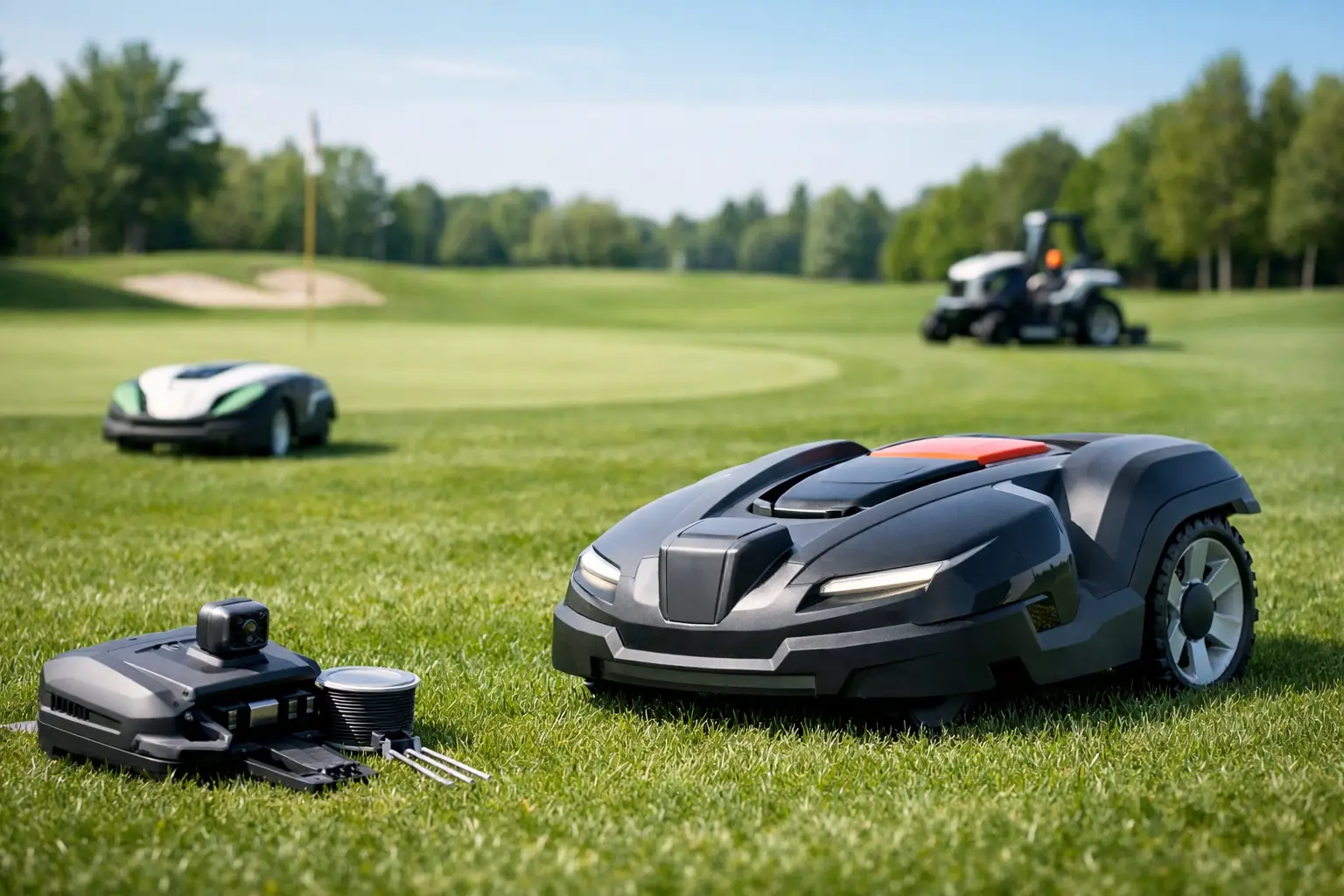
If your team is spending too many hours simply keeping surfaces presentable, a guide to robotic turf maintenance starts with a hard question: where is skilled labour adding the most value, and where is it tied up in repeat cutting? For golf courses, sports venues and larger managed estates, that distinction matters. Robotic mowing is not a gadget layer on top of conventional maintenance. Used properly, it is an operational shift that releases labour, tightens consistency and improves presentation across demanding turf areas.
What robotic turf maintenance changes
The biggest misunderstanding is that robotic mowing replaces turf management judgement. It does not. Agronomy, surface preparation, line marking, presentation planning, disease response and seasonal adjustment still depend on experienced professionals. What changes is the delivery of repetitive cutting tasks that benefit from frequency, consistency and predictable output.
That matters because high-quality turf is rarely about one excellent cut. It is about maintaining a stable surface over time. Frequent autonomous mowing supports cleaner presentation, tighter visual consistency and reduced peaks and troughs between cuts. On fairways, surrounds, sports outfields and selected pitch environments, that consistency often delivers more practical value than relying on labour availability and machine scheduling alone.
There is also a commercial point that cannot be ignored. Most professional sites are managing labour pressure, rising operating costs and increasing expectations from players, members, schools, clubs or clients. Robotic systems address all three, but only when they are matched properly to the site.
A practical guide to robotic turf maintenance planning
A successful robotic setup starts well before the first machine is deployed. The right question is not whether the site can use robotics. It is which areas are most suitable, what standard is required, and how autonomous equipment will fit around the rest of the maintenance programme.
Start with the surfaces where repeatable cutting quality and labour savings are easiest to realise. Fairways, tee approaches, selected rough areas, training grounds, sports pitches, outfields and formal managed turf are common starting points. Greens and stadium-grade surfaces can also be suitable, but expectations are higher and machine choice becomes more specific.
Site layout is the next factor. Open, repeatable areas with clear operating boundaries are straightforward. Complex spaces with steep banks, frequent public interface, narrow transfer routes or multiple isolated sections need more planning. That does not rule robotics out, but it affects machine specification, route planning and the level of supervision required.
The third consideration is output. Not every site needs the same result. A golf course may want autonomous precision on fairways while keeping greens under a separate programme. A school or sports venue may prioritise reliable presentation of marked playing surfaces and predictable weekly labour reduction. A contractor may be looking for scalable coverage across several commercial locations. The correct setup depends on the operational objective, not just the acreage.
Choosing the right robotic system
Professional robotic turf maintenance is not one category. Machine selection should reflect grass type, cutting method, finish requirement and working area.
Rotary robotic mowers are often a strong fit for broad-area maintenance where coverage, frequent cutting and efficiency are the priority. They can maintain a very consistent appearance across fairways, outfields and larger managed turf spaces, especially when the goal is to hold the sward in a stable condition with minimal interruption.
Cylinder-based robotic systems come into the conversation when stripe definition, clip quality and a more traditional fine-turf finish are central to the brief. On some sports surfaces and high-expectation areas, that distinction matters. The wrong choice is not always obvious on paper, but it becomes obvious in the finish.
Battery capacity, charging logic, terrain capability, obstacle handling and fleet management also affect real-world performance. A machine that looks efficient in specification sheets may be less suitable if the site has fragmented mowing zones or extended travel between work areas. In practice, the best system is often the one that fits the site cleanly rather than the one with the most aggressive headline numbers.
Setup, boundaries and workflow integration
This is where projects succeed or struggle. Robotic mowing should be integrated into the maintenance operation, not treated as a standalone experiment.
Boundary definition is critical. Whether the system uses perimeter guidance, satellite-supported positioning or another control method, accuracy at the setup stage directly affects cut quality, reliability and safety. Professional sites should expect a commissioning process that reflects the importance of the environment. A golf hole, a training complex and a school playing field all require different thinking around access, operating windows and interaction with users.
Workflow integration matters just as much. If a robot is mowing a fairway every day, how does that alter hand mowing schedules, debris clearance, presentation routines or staff deployment? If a sports pitch is being maintained autonomously, when are goal mouths, edges and line marking handled? The machine should remove time from repetitive mowing, but the team still needs a clear operating rhythm.
Communication on site is part of the setup too. Staff need to know where machines are working, when interventions are needed and who is responsible for oversight. On public-facing or multi-user sites, simple internal discipline avoids most operational friction.
The labour question – where the gain actually comes from
The labour case for robotics is strong, but it should be framed accurately. Robotic turf maintenance does not usually mean fewer standards. It means fewer hours spent achieving the same standard through repetitive manual mowing.
For many venues, the most immediate benefit is not headcount reduction. It is labour reallocation. Skilled staff can move from routine cutting into detail work, presentation improvements, bunker maintenance, surface repairs, irrigation checks and seasonal renovation support. That is a better use of experienced people, particularly when recruitment is difficult and retention matters.
There is also less dependence on narrow weather windows and daily machine availability. Autonomous mowing can keep surfaces under control with a level of consistency that manual schedules often struggle to match during busy periods. That consistency is one of the reasons robotic systems are gaining ground in professional environments rather than being confined to domestic use.
Performance, quality and the trade-offs to understand
Robotic mowing is not a universal answer for every surface on every site. The professional value comes from understanding where it performs best and where conventional methods still earn their place.
Frequent cutting supports a cleaner and more even presentation, but it depends on the area being suitable for that pattern of maintenance. Heavy leaf fall, regular debris, poor surface definition or constant event disruption can reduce efficiency. Steep changes in topography or heavily segmented sites may also require more complex planning.
There are weather considerations as well. UK conditions are variable, and any maintenance system has to deal with wet periods, flush growth and seasonal slowdown. Good robotic deployment accounts for that with appropriate mowing schedules, realistic area allocation and a clear plan for periods when conventional support is still the better option.
That is the right way to view robotics in professional turf care: not as an all-or-nothing switch, but as a serious working part of a broader maintenance model.
Managing expectations in golf and sport
Golf and sport are similar in one respect and very different in another. Both demand presentation, consistency and dependable surfaces. But the tolerance for variation changes by area.
On golf courses, fairways, semi-rough, approaches and selected surrounds are often strong candidates for autonomous mowing. Greens require a more exact conversation around finish, clipping, speed expectations and daily set-up standards. On sports sites, outfields and training areas can be highly suitable, while match pitches may need a more selective approach depending on level, usage and presentation demands.
The key point is that robotic deployment should follow the maintenance priority of the venue. Start where the system can create immediate operational value without compromising standards. Expand from there once the workflow is proven.
Measuring success after deployment
The first measure is reliability. Machines need to operate consistently within the planned window and deliver repeatable cut quality. The second is labour impact. If the site has not released meaningful staff time, the setup needs review. The third is turf outcome. Presentation should improve or at minimum remain stable while efficiency increases.
It is also worth tracking less obvious gains. Reduced pressure on staff, better consistency between cuts and improved ability to maintain standards during peak periods all have operational value. On many sites, these are the factors that justify wider adoption.
For professional operators, the strongest case for robotics is straightforward. Better consistency, lower dependence on repetitive labour and a maintenance model built for modern pressure on time and staffing. When machine choice, site planning and workflow integration are handled properly, robotic mowing becomes less about technology and more about control. That is usually where the real improvement starts.