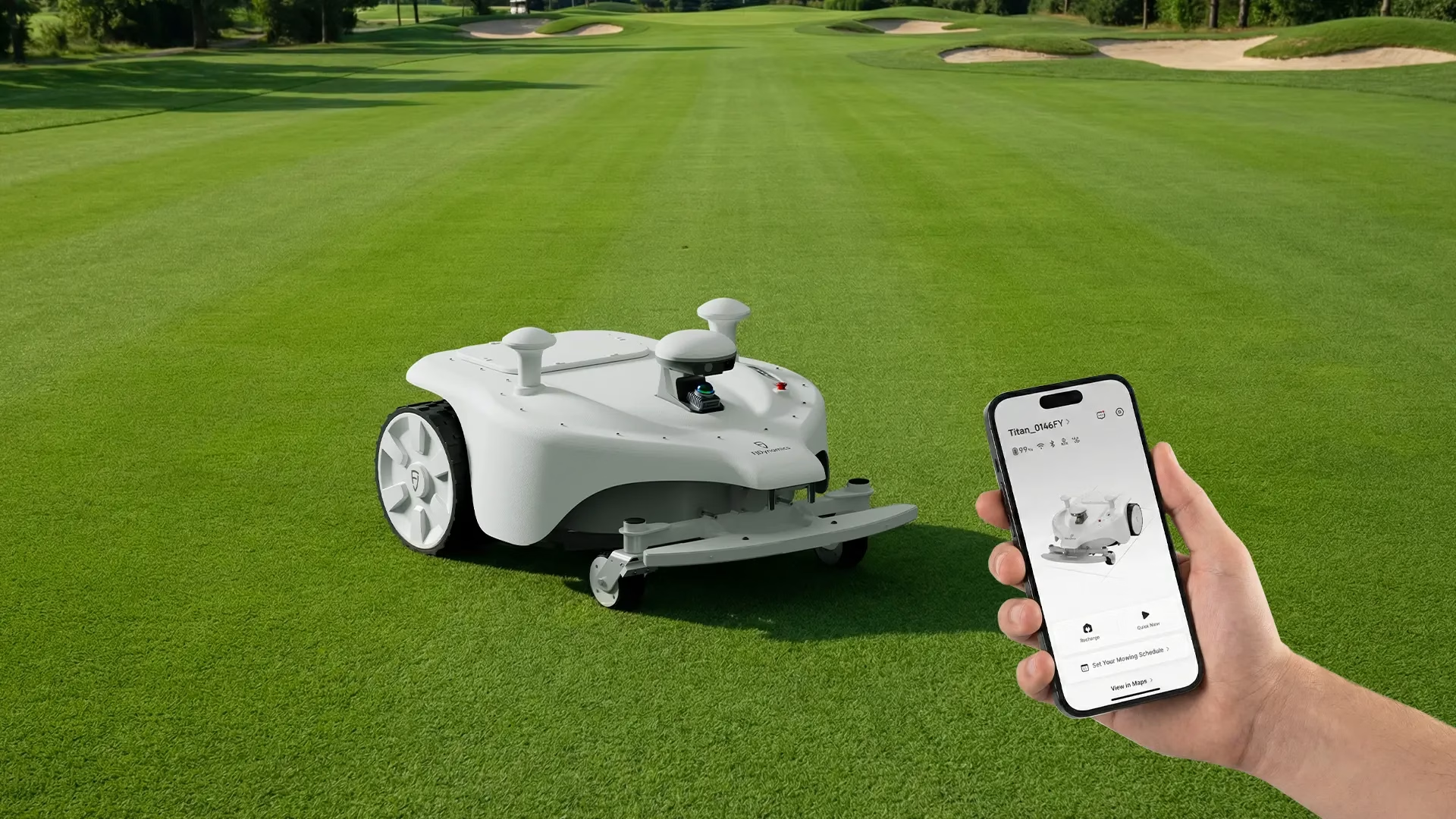
The FJD Titan is aimed at professional turf operations that need high-capacity autonomous mowing across substantial maintained areas. This guide focuses on where Titan fits, how to assess a deployment and when another FJD mower may be more appropriate.
What is the FJD Titan?
Titan is a professional autonomous mower from FJ Dynamics for large-scale turf maintenance. Grass Robotics positions it for applications including sports complexes, golf and extensive commercial grounds where capacity and repeatable autonomous operation are important.
For the latest product information and available configuration, see the FJD Titan product page.
Where does Titan fit best?
Titan is most relevant where a site has large, clearly defined mowing areas and a substantial recurring workload. Rather than viewing autonomous mowing as a replacement for every conventional machine, professional operators can allocate suitable routine areas to robotics while retaining specialist equipment for fine turf, detail work and unusual conditions.
Sports facilities can also explore our sports-pitch automation guide, while estates and commercial operators can see robotic mowing for estates and large grounds.
Navigation and autonomous workflow
The current Titan product information describes a navigation system combining RTK, LiDAR and Vision. In practice, machine capability is only one part of a successful deployment. Working zones, exclusions, charging, travel routes, operating times and interaction with other site users all need to be planned around the individual property.
Capacity versus finish
High-capacity autonomous mowing is valuable when it is matched to the right surface. Golf greens, specialist cylinder-cut areas and presentation-critical fine turf may require another machine. The FJD range allows sites to consider a mixed fleet rather than forcing one platform into every role.
Use our Compare FJD Robotic Mowers page to compare Titan with the RM21, RCM01, FRX and GM22S.
Building the business case
The appropriate business case should use your own current mowing hours, staffing costs, fuel or electricity, machinery maintenance, replacement plans and required cutting frequency. Avoid relying on a generic percentage saving: the result depends on how much of the existing workload can realistically be transferred to autonomous operation.
Grass Robotics can use a site assessment to identify candidate mowing areas and develop a mower or fleet configuration around the actual workload.
Arrange a Titan demonstration
A demonstration is the best way to assess autonomous operation against your terrain, workflow and presentation requirements.