
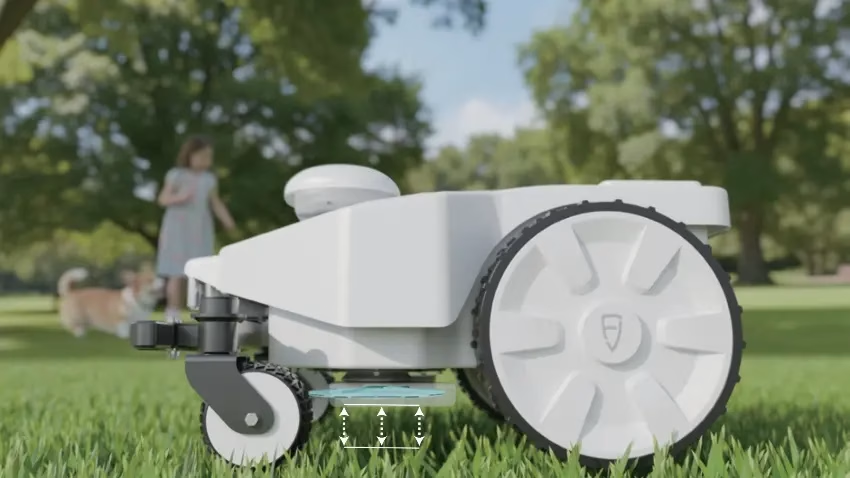
Tee boxes expose every weakness in a mowing programme. They sit in full view, carry concentrated traffic, and need a finish that looks deliberate rather than merely tidy. That is why interest in the robotic tee box mower has moved beyond curiosity. For many golf operations, it now sits in the same conversation as labour planning, presentation standards and long-term cost control.
A teeing ground is a small area, but it creates disproportionate pressure. If cut quality drifts, if the perimeter loses definition, or if mowing frequency becomes inconsistent during busy periods, players notice immediately. The appeal of autonomy is straightforward: repeatable cutting, scheduled operation and less dependence on a shrinking labour pool. The harder question is whether a robotic system genuinely fits the way your course operates.
Where a robotic tee box mower makes sense
The strongest case for automation is not simply replacing a walk-behind or ride-on pass. It is removing repeated, low-variation work from the daily routine so skilled staff can focus on presentation detail, setup and recovery tasks. Tee boxes are well suited to that model because the mowing objective is clear, the area is defined, and the expectation is consistency rather than one-off intervention.
On a course with multiple tees spread across the site, those small mowing jobs add up. Travel time, machine handling, staff allocation and scheduling friction can consume more resource than the square metre total suggests. A robotic tee box mower addresses that inefficiency by maintaining cut frequency without requiring an operator to be present at each cycle.
That does not mean every teeing ground is automatically a good candidate. Site layout matters. Access routes, transitions between tees, localised slopes, tree cover, irrigation hardware and the relationship between tees and buggy routes all affect whether deployment is straightforward or needlessly complex. A compact, clearly defined set of tees may be ideal. A fragmented setup with awkward edges and frequent congestion may require a more selective rollout.
The operational value is in consistency, not novelty
The real gain from robotic mowing is repeatability. Tee boxes benefit from frequent, controlled cutting because presentation depends on a uniform surface and sharp visual definition. When mowing is delayed by staff shortages, weather interruptions or competing priorities, standards tend to fall gradually and then all at once.
Automation changes that pattern. Instead of fitting tee mowing around bunker work, divoting, course setup and reactive jobs, the task is handled to schedule. That helps maintain a more stable sward appearance, reduces visible surges in growth between cuts and supports a cleaner overall look across the course.
For golf managers, the commercial value is just as practical. Consistency protects golfer perception. It also reduces the operational risk that a high-visibility area slips because the team is stretched elsewhere. A machine that delivers dependable daily or near-daily attention to teeing grounds can relieve pressure without lowering expectations.
What to assess before choosing a robotic tee box mower
A robotic tee box mower should be evaluated as part of a mowing system, not as a standalone gadget. The first question is surface requirement. Teeing grounds vary by course standard, grass type, clipping expectation and desired finish. If the visual target is extremely high and tightly linked to a specific cut presentation, mower type and cutting system need close attention.
The second question is work pattern. Some courses will want dedicated robotic coverage on selected tees only, especially those nearest the clubhouse or those with the highest play volume. Others will look at wider deployment where robots maintain a broad group of tee boxes continuously. Both approaches can work, but the best choice depends on budget, routing logic and how much labour release the site actually needs.
Boundary management is another practical factor. Tee boxes often include sharp edges, marker positions, ornamental surrounds or nearby hazards that require a mower to hold a precise working area. A professional robotic solution must manage those boundaries reliably. If the machine constantly needs correction, the labour saving starts to disappear.
Security and fleet oversight also deserve proper attention. A course is not a closed industrial yard. Equipment may operate in visible public spaces and often outside the narrow window of traditional staffed work. Monitoring, location control and operational planning therefore matter just as much as cut quality.
The trade-offs are real
There is no serious case for pretending robotics are a perfect fit everywhere. The strongest objection is usually not mowing performance but integration. A course with highly irregular tee complexes, repeated redesign work, heavy event setup changes or a strong preference for manual touch-ups may find that autonomy handles 80 per cent of the task while the last 20 per cent still needs staff involvement.
That is not necessarily a reason to reject the technology. It is a reason to judge it properly. If a robotic tee box mower removes most routine cutting hours from the schedule, it can still create significant value even where hand finishing remains part of the standard.
Weather and seasonal growth patterns also influence outcomes. During peak flushes, mowing strategy needs to be set with enough frequency and capacity to maintain finish. During slower periods, operating schedules may need to adapt to avoid unnecessary wear or inefficiency. Good robotic mowing is not hands-off in the literal sense. It is lower-labour, more predictable turf management with control built in.
Labour pressure is driving adoption
Across golf and sports turf, one issue keeps returning: skilled labour is hard to recruit and harder to retain. That challenge is pushing many sites to rethink how routine mowing is delivered. Tee boxes are often among the first areas considered because they are repetitive, presentation-sensitive and expensive to neglect.
A robotic tee box mower is particularly valuable where experienced staff are being pulled into too many directions at once. If autonomy can take care of repeated mowing cycles, the team can spend more time on course setup, hand detail, disease monitoring, irrigation checks and recovery work after weather or play pressure. That is where experienced greenkeeping judgement creates the most value.
This is also why professional buyers tend to view robotics as an operational upgrade rather than a cost-cutting gimmick. The aim is not to reduce standards to save hours. The aim is to protect standards when labour availability is no longer reliable enough to support traditional workflows on its own.
Precision matters more than headline autonomy
Not all robotic mowing is equal, and professional turf teams know that quickly. What matters on tee boxes is controlled movement, dependable area management and a finish that supports the course standard. Broad claims about automation mean little if the machine cannot deliver stable performance in a live golf environment.
That is why solution selection should stay tied to the site. Some courses will benefit from a dedicated unit focused on teeing grounds. Others may be better served by a wider autonomous strategy covering tees alongside other formal areas. The right answer depends on how the course is laid out, where labour bottlenecks sit and what level of presentation is expected day after day.
For that reason, consultative assessment matters. GrassRobotics positions robotic mowing around practical use cases for golf and sports turf because professional buyers do not need novelty. They need equipment that fits the surface, the workload and the standard.
Should you invest now or wait?
If your teeing grounds are regularly slipping because the team is stretched, waiting usually has its own cost. Standards become reactive, staff time gets swallowed by repetitive mowing, and the pressure on experienced operators only increases. In that situation, a robotic tee box mower is worth serious consideration now.
If your current setup already delivers excellent consistency with no labour strain, the case may be less urgent. Even then, the question is not only what works today. It is whether your current model remains resilient through staff changes, rising operating costs and tighter expectations around productivity.
The strongest robotic mowing projects start with a simple view of the problem. If tee boxes are consuming too much labour for too little strategic return, automation deserves a proper evaluation. When the system, site and surface requirement are aligned, the result is not just less mowing effort. It is more control over one of the most visible standards on the course.
The useful way to think about a robotic tee box mower is this: not as a machine that replaces greenkeeping judgement, but as one that gives that judgement more room to be used where it matters most.