
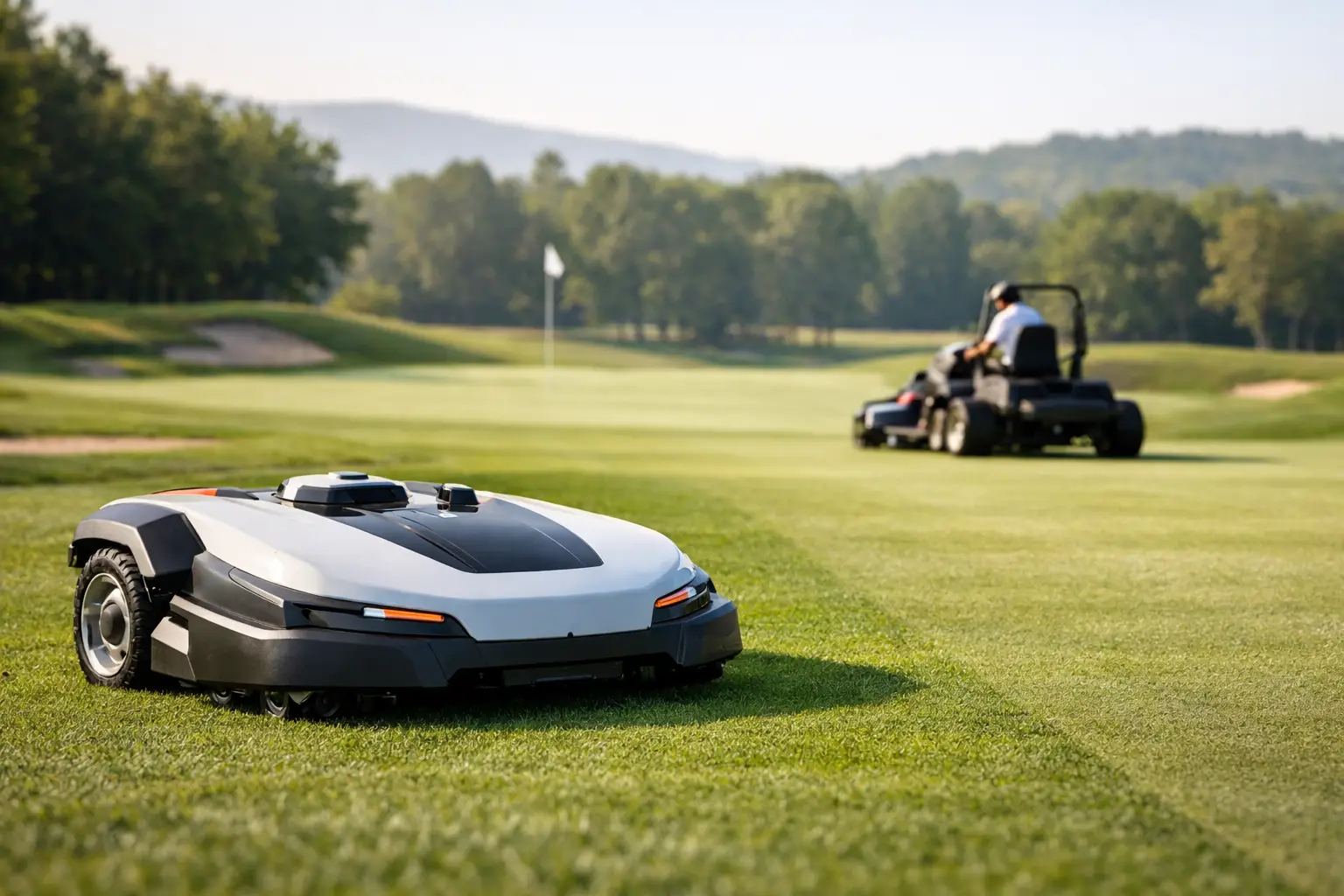
A fairway cut missed by half a day is noticeable. Not because players suddenly become agronomists, but because presentation standards on a golf course are built on consistency. That is exactly where a robotic fairway mower starts to make commercial sense – not as a gimmick, but as a dependable way to keep large areas moving to schedule with less pressure on labour.
For course managers and greenkeeping teams, the real question is rarely whether autonomous mowing works. It is whether it fits the site, the turf standard, and the operational model of the course. On some properties, the answer is straightforward. On others, it depends on layout, staffing, budget and how fairway maintenance is currently organised.
What a robotic fairway mower actually changes
The biggest shift is not simply replacing one machine with another. A robotic fairway mower changes how fairway maintenance is planned across the week. Instead of assigning labour, fuel, machine hours and transport time to repetitive cutting, the site can move to a more continuous, autonomous cycle.
That matters because fairways occupy significant acreage and consume a large share of available labour. When skilled staff are tied up on repeat mowing runs, they are not available for detail work, presentation tasks, irrigation checks, bunker refinement or recovery work after poor weather. Automation releases time where human input adds more value.
There is also a quality benefit when mowing becomes more frequent and more consistent. Traditional scheduling often depends on who is available, what else is happening on site, and whether weather has disrupted the week. Autonomous mowing reduces those gaps. The result is a more even visual finish, more stable clipping volumes and fewer peaks and troughs in presentation.
Where robotic fairway mowing delivers the strongest return
Not every hectare of maintained turf offers the same opportunity. Fairways are especially well suited because they combine scale, repetition and visible standards. They are large enough for automation to save meaningful labour, yet important enough that consistency has a direct effect on how the course presents.
The strongest return typically appears on sites facing one or more familiar pressures. Labour shortages are the obvious one. Many clubs are operating with leaner teams while still being asked to maintain or improve standards. A robotic fairway mower can absorb a substantial amount of routine mowing demand without adding another operator to the wage bill.
The second is season-long workload pressure. In peak growth periods, fairway cutting frequency can become a constant operational demand. If the same team is also managing greens, tees, rough, course set-up and broader estate work, something always competes for time. Autonomous mowing creates headroom.
The third is the need for predictable output. Contractors, multi-course operations and facilities managers often value consistency just as highly as headline quality. If a robotic platform can maintain agreed standards with reliable scheduling, the site becomes easier to manage and less exposed to staffing disruption.
The trade-offs professionals should assess
A robotic fairway mower is not a universal answer. It works best when matched to the right environment and expectations.
Site layout is a major factor. Open, well-defined fairway areas with clear working boundaries are generally easier to automate than highly fragmented holes with numerous pinch points, complex crossings or constant interaction with non-play areas. A challenging layout does not rule robotics out, but it does affect deployment planning and the likely productivity gain.
There is also a difference between replacing labour completely and reallocating it intelligently. Most professional sites will not remove all human involvement from fairway maintenance. Teams still need oversight, transport planning, quality checks and support across the wider course. The practical value lies in reducing dependence on manual mowing hours, not pretending a course can run itself.
Weather and growth conditions also require realistic expectations. Autonomous mowing can improve consistency, but it still operates within turf reality. During extreme wet periods, heavy growth flushes or renovation windows, course managers need flexibility. The best robotic strategy supports the maintenance plan rather than forcing the plan to fit the machine.
Cut quality and presentation standards
For most professional buyers, labour saving alone is not enough. If the finish is not acceptable, the business case weakens immediately.
That is why the conversation around robotic fairway mowing should start with output quality. A professional-grade machine is expected to deliver accurate navigation, repeatable cutting performance and a consistent surface appearance over time. Frequency is part of that quality equation. By mowing more regularly, the machine can maintain a neater, more uniform presentation without the visible step-change that sometimes comes with longer intervals between cuts.
This is particularly relevant on courses where visual consistency across holes contributes strongly to perceived standard. Members and visitors may not know the exact height of cut or machine specification, but they recognise clean, even fairways. Frequent autonomous cutting helps maintain that impression with less variability between days.
That said, expectations should stay aligned with the chosen technology and site conditions. Courses pursuing a very specific aesthetic or pattern-led presentation standard may still combine robotics with conventional mowing in certain areas or at particular times. Automation does not have to be all or nothing.
Labour savings are only part of the value
The most common mistake in assessing return on investment is focusing only on wages saved. Labour matters, but it is not the whole picture.
A robotic fairway mower can also reduce pressure on fleet utilisation, fuel consumption, operator scheduling and the hidden inefficiencies that come with repeated set-up and travel time. It can improve planning confidence, especially on sites where staffing cover is fragile or recruitment is difficult. In practical terms, that means fewer compromises elsewhere on the course.
There is a management benefit too. When routine fairway mowing becomes more predictable, it is easier to assign skilled staff to specialist work that protects playing quality. That shift is often where the strongest operational gain sits. The machine does not replace expertise. It gives expertise more useful work to do.
For budget-conscious operators, this is where a consultative approach matters. The right solution is not automatically the largest or most advanced machine. It is the one that matches acreage, target standard, working hours and site complexity closely enough to produce a clear operational return.
How to judge site fit before you invest
The right question is not, “Can this machine mow a fairway?” The right question is, “Will this machine improve how our site operates?”
Start with fairway acreage and current mowing frequency. If a significant share of weekly labour is being absorbed by repeat fairway cutting, the case for automation strengthens quickly. Then look at staffing resilience. If absence, recruitment pressure or seasonal peaks regularly disrupt the programme, a robotic system can offer stability as well as savings.
Next, assess the physical layout. Boundary definition, access routes, charging or docking logistics, crossing points and interaction with golfers all influence implementation. A well-planned deployment will account for these factors early rather than treating them as minor details.
Finally, be honest about objectives. Some sites need immediate labour relief. Others want to scale output without expanding headcount. Others are focused on maintaining presentation standards more consistently across a busy calendar. Those goals can all justify robotics, but they may point towards different equipment choices and deployment plans.
For professional venues, this is why specialist suppliers such as GrassRobotics focus on application-led solutions rather than generic claims. The technology has to fit the maintenance reality of the site.
Why the market is moving this way
The wider direction is clear. Professional turf maintenance is under pressure to do more with tighter labour availability, rising cost sensitivity and no tolerance for declining standards. Fairways are a logical place to introduce autonomy because they combine measurable workload with visible results.
That does not mean every course will convert overnight. Adoption will continue in stages, often starting where the labour strain is highest or where management wants proof of value before broader automation. But the idea that robotic mowing is only for novelty or experimentation has already passed. On the right site, it is now a practical operating decision.
A robotic fairway mower is worth it when it reduces labour dependence, protects presentation standards and gives your team more time for the work that actually needs skilled hands. If that sounds close to your current pressure points, the opportunity is probably closer than it first appears.