
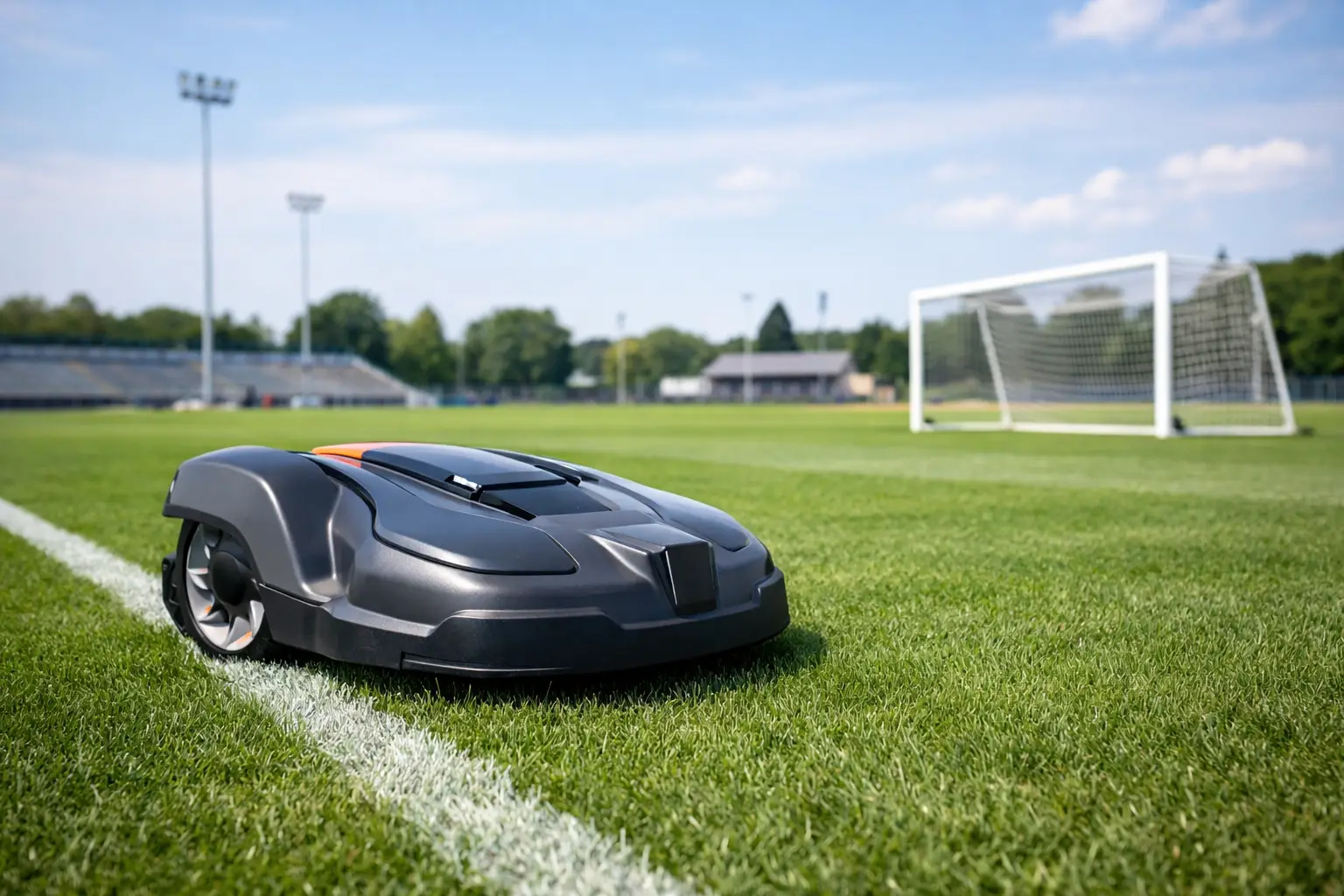
If your team is still chasing mowing windows between fixtures, training blocks and weather shifts, a robotic mower for sports pitches stops being a nice idea and starts looking like a practical operations decision. For many schools, clubs, local authorities and professional venues, the pressure is not simply to cut grass. It is to hold a reliable presentation standard, protect playability and do it with fewer available labour hours.
That is where robotic mowing earns attention. Not because it replaces every task in sports turf management, but because it can take one of the most repetitive and time-sensitive jobs and make it predictable. On a sports pitch, predictability matters. Surface consistency, clipping management, presentation and staff deployment all sit downstream from the mowing plan.
Why a robotic mower for sports pitches is gaining ground
The biggest change in the market is not the technology itself. It is the labour equation around it. Many grounds teams are operating with tighter staffing, rising cost pressure and greater expectations from users. At the same time, pitches are being asked to do more. More usage, shorter recovery windows and higher visual standards have become normal.
A robotic mower addresses those pressures by shifting routine mowing into an autonomous process. Instead of assigning staff to repeated cutting passes, the machine handles scheduled mowing while the team focuses on tasks that still require judgement – line marking, surface repairs, disease monitoring, irrigation checks and fixture preparation.
That labour shift is usually the first reason operators consider automation, but it is not the only one. Consistency is often just as valuable. Frequent cutting at a controlled height can improve presentation and help maintain a more even, managed surface. That does not mean every pitch will instantly perform better simply because the mower is robotic. Grass species, nutrition, usage levels and drainage still matter. But when mowing becomes consistent, the rest of the maintenance programme is easier to control.
What sports pitch managers actually need from autonomous mowing
Consumer robotic mowers have made the category familiar, but sports turf is a different standard. Professional operators are not buying novelty. They are buying output.
A robotic solution for pitches needs to cope with defined cutting areas, repeatable routing, dependable scheduling and a finish that supports the expectations of players, coaches and venue managers. It also needs to fit the site. A flat training grid, a school rugby pitch and a heavily used stadium support area do not present the same requirement.
This is why product selection should start with the operating environment rather than headline features. Area size matters, but so do access routes, gradients, perimeter definition, obstacle frequency and the number of separate surfaces to maintain. The right machine for a single enclosed pitch may not be the right machine for a multi-pitch facility where movement, charging logistics and daily scheduling become more complex.
Reliability is another non-negotiable. If a grounds manager is going to trust autonomous equipment on a working sports site, it must perform as a professional asset rather than a gadget. That means stable operation, accurate cutting performance and straightforward management of the mowing programme.
Cut quality, frequency and the real performance benefit
The strongest argument for robotic mowing on sports pitches is often the simplest one: little and often works. Instead of waiting for labour availability or dry enough conditions to complete a full pass with conventional kit, the robotic mower can maintain regular cutting cycles that reduce stress on the sward and help keep the surface visually consistent.
That frequent cutting approach can support denser presentation and tighter control of growth during active periods. It may also reduce the peaks and troughs that come from missed mowing windows. Anyone managing sports turf in the UK knows how quickly growth can move after rain and warmth. If the schedule slips, recovery can take time and extra effort.
There are limits, of course. A robotic mower is not a substitute for every finish requirement. If your venue requires pronounced presentation patterns for televised use or specific pre-match striping expectations, you may still rely on conventional mowing at key times. Likewise, where conditions are exceptionally wet, heavily worn or affected by renovation work, operational decisions still need human oversight.
The practical value is that the robot handles baseline mowing demand consistently, leaving the team to intervene where presentation or agronomic conditions require a different approach.
Labour savings are real, but they are not the whole case
It is easy to talk about labour reduction in broad terms, but professional buyers tend to ask a more useful question: what does that labour get reassigned to?
That is the better way to measure value. A robotic mower for sports pitches does not just remove hours from a time sheet. It gives those hours back to higher-value work. On many sites, that means more attention to line quality, in-goal wear, divoting, overseeding, goalmouth repairs and the dozens of details that shape playability.
For contractors and multi-site operators, the gain can be even clearer. If mowing becomes less dependent on crew presence at every visit, route planning and resource deployment can improve. That can support margin as much as maintenance quality.
Return on investment still depends on the site. A lightly used single pitch with low presentation demands may not justify a premium autonomous setup in the same way as a busy school estate, sports complex or professional training ground. The more consistent the mowing requirement and the more constrained the labour picture, the stronger the business case tends to be.
Where robotic mowing works best on sports sites
Not every sports surface is an identical fit, but several use cases stand out.
Training pitches are often well suited because they need dependable mowing without always justifying dedicated daily staff time. School and university sites also benefit, particularly where one team manages multiple grass areas with competing priorities. Local authority sites can see value where staffing is stretched and presentation standards still matter to community use.
Higher-end venues can also benefit, especially on secondary pitches, academy areas or support surfaces where consistency and labour efficiency are both priorities. In those settings, autonomous mowing is not necessarily replacing all conventional equipment. It is strengthening the full maintenance system.
Integration with wider pitch maintenance
One of the mistakes buyers sometimes make is treating robotics as a standalone fix. On a sports pitch, mowing quality sits inside a wider programme. Fertiliser planning, aeration, irrigation, disease pressure, renovation timing and usage control still determine long-term results.
That is why autonomous mowing works best when it is introduced as part of an operating model. You need to consider cut height strategy, clipping behaviour, fixture scheduling and how the robotic unit interacts with line marking and other machine movements. There is also a straightforward practical question: who is checking daily performance, and how quickly can the team respond if site conditions change?
For professional operators, this is not a drawback. It is simply the reality of good turf management. Better automation supports better systems. It does not remove the need for them.
Choosing the right robotic mower for sports pitches
Selection should be disciplined. Start with the surface requirement, then work backwards into the machine.
Area capacity is the obvious first filter, but not the only one. Consider the finish expected, the frequency required, the complexity of boundaries and whether the mower needs to work across one pitch or several. Think about access and charging arrangements. Assess how often the pitch is in use and how tightly mowing has to be scheduled around players.
You should also be realistic about whether you need rotary or cylinder performance for the intended standard. On some sites, a rotary robotic mower provides the right balance of productivity and quality. On others, especially where cut definition is more demanding, a robotic cylinder solution may be more appropriate.
This is where a specialist supplier adds value. The right recommendation is not the biggest machine or the cheapest one. It is the system that matches the standard of surface, the site layout and the labour objective. GrassRobotics positions robotic turf care in exactly that way – as a professional solution aligned to real operating conditions, not a one-size-fits-all product story.
Is it worth it?
For many sports facilities, yes – but only when the decision is based on workflow, not hype. If your site struggles to maintain mowing frequency, if labour is difficult to secure, or if staff time is better spent on specialist tasks, a robotic mower can make a measurable difference. The gains usually show up in consistency first, then in labour efficiency, and finally in the overall standard you can sustain with the team you have.
If, however, your surface demands highly specific presentation effects, your site layout is awkward, or your mowing requirement is too limited to justify the capital outlay, a conventional approach may still make more sense. Professional turf care is rarely about absolutes.
The more useful question is not whether robotics will replace grounds teams. It is whether autonomous mowing can give your team more control over the standard they are already expected to deliver. On the right sports pitch, that is where the value becomes hard to ignore.