
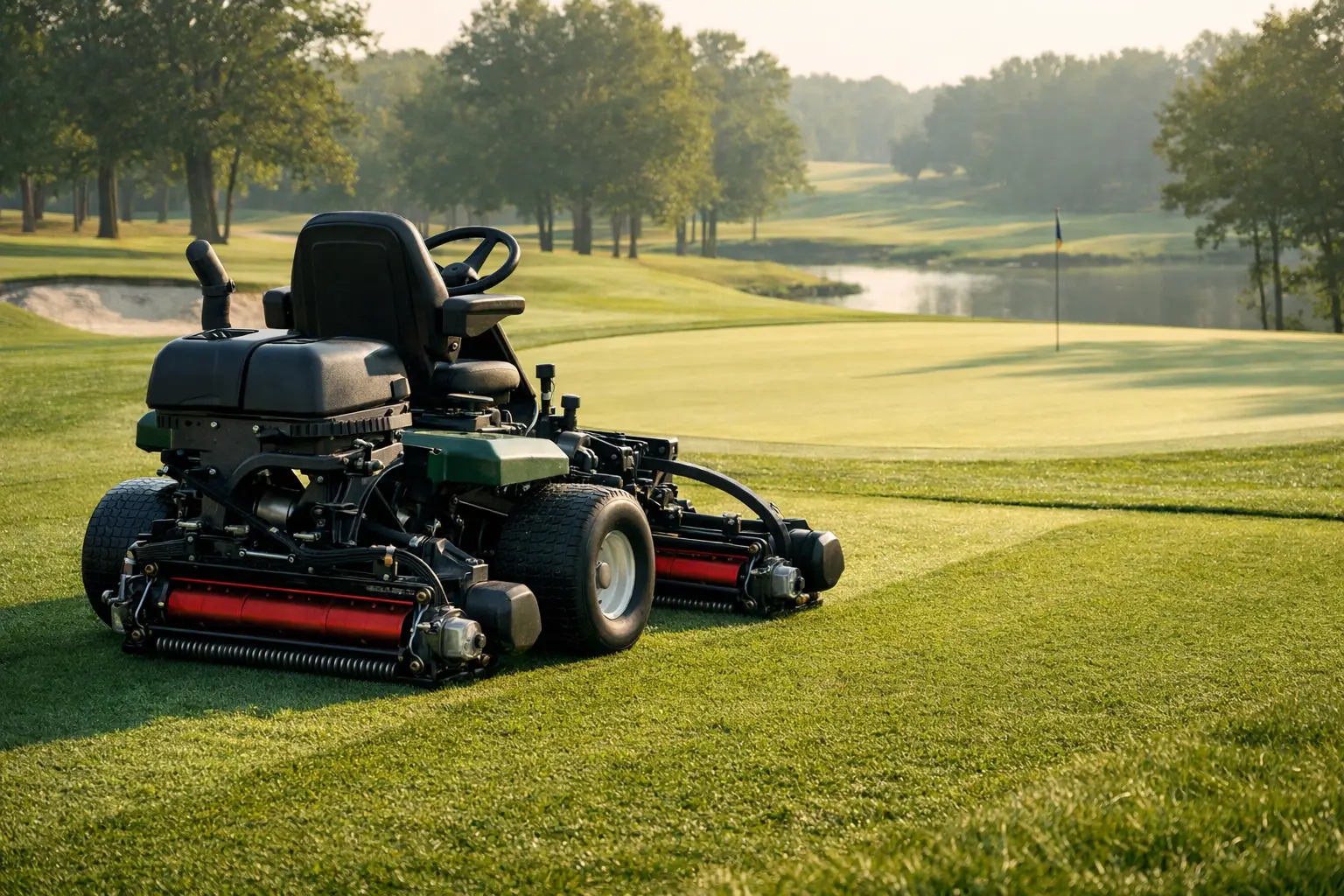
A golf green cut at 3 to 5 mm leaves very little margin for error. At that height, mowing quality is not just a presentation issue – it directly affects ball roll, plant health and the consistency players expect. That is the real answer to why do golf courses use reel mowers: they produce the clean, precise cut needed for fine turf surfaces where rotary machines would struggle to match the standard.
For professional turf managers, that decision is less about tradition and more about performance. Greens, tees and closely managed approaches demand a machine that can maintain tight heights of cut without tearing the leaf, bruising the plant or introducing unnecessary surface inconsistency. Reel mowing remains the benchmark because it is engineered around those requirements.
Why do golf courses use reel mowers on fine turf?
A reel mower cuts with a scissor-like action. The rotating reel passes against the bedknife and slices the grass cleanly. That is fundamentally different from a rotary blade, which relies more on impact and high-speed cutting.
On domestic lawns, that difference may be acceptable. On a golf course, especially on greens and tees, it is not. Fine turf species maintained at low heights need a precise cut to reduce stress, preserve leaf integrity and support a smooth, uniform surface. A cleaner cut also helps limit the whitening and frayed appearance often seen when grass is torn rather than sliced.
The result is visible and measurable. Better cut quality supports truer ball roll, improved visual striping and tighter presentation. For golfers, that shows up as consistency. For course managers, it shows up as surface quality that is easier to maintain across the week.
The cut quality advantage of reel mowing
The strongest argument for reel mowers is still the finish. When set correctly, a reel unit follows the surface closely and cuts evenly at very low heights. That makes it the preferred choice for greens, collars, approaches and often tees.
This matters because golf is played on managed turf, not just short grass. A slight inconsistency in height on a green can affect pace and line. A bruised leaf on a tee can weaken presentation and recovery. Reel mowers are used because they deliver the level of precision these surfaces demand.
There is also a turf health benefit. Cleanly cut leaf tissue generally recovers better than shredded tissue, particularly during periods of stress. In practice, that can mean a neater finish, less visible damage after mowing and a surface that holds quality more reliably through intensive maintenance cycles.
Why rotary mowing is not the default for greens
Rotary mowers have a place in turf maintenance. They are useful for rough, general amenity areas and situations where speed and broad coverage matter more than tournament finish. But they are not usually the first choice for greens because they are less effective at maintaining ultra-low heights with the same standard of cut quality.
Rotary systems can also create more airflow disturbance and a less refined finish on fine turf. That does not make them poor machines. It simply means they suit different tasks. On a golf course, equipment selection is surface-specific, and reel mowers remain the right tool where precision is critical.
Low heights of cut require a different machine
One of the clearest reasons golf courses use reel mowers is that many playing surfaces are maintained below the practical range of rotary equipment. Greens in particular operate at heights where tolerance is tight and adjustment accuracy matters.
Reel mowers are built for that environment. Their cutting units allow precise height-of-cut control, close surface following and repeatable setup. For head greenkeepers and course managers, that means less compromise. If the target is tournament-level presentation or dependable daily green speed, reel mowing gives operators far greater control.
It also supports consistency between units and across the site. That matters on facilities where the standard expected on the 1st green needs to match the 18th, and where teeing grounds, approaches and surrounds all have slightly different but equally deliberate mowing targets.
Surface consistency matters as much as appearance
The visual finish of reel mowing is obvious, but golf operations are driven by playing performance as well as looks. Smoothness, pace and uniformity all depend on consistent turf height and a dependable cut across the whole surface.
A reel mower helps achieve that consistency because it is designed to cut rather than strike. On greens, that supports trueness of roll. On tees, it improves presentation and footing. On approaches, it helps maintain the clean transition players expect around the putting surface.
This is also where disciplined mowing practice becomes operationally important. The machine alone is not enough. Setup, sharpness, clipping management and mowing frequency all affect the outcome. Reel mowers reward good maintenance standards with superior results, which is why they remain central to professional golf turf programmes.
Why do golf courses use reel mowers instead of switching entirely to rotary or flail systems?
Because the playing surfaces dictate the machinery. Golf courses are not maintained as one uniform landscape. Greens, tees, fairways, semi-rough and rough all have different performance requirements, different target heights and different productivity considerations.
That means there is no single mower type that is ideal everywhere. Reel mowers dominate fine turf because they produce the finish those surfaces require. Rotary and flail systems may still be used elsewhere where robustness, throughput or debris handling are bigger priorities.
For many operators, the more relevant question now is not whether reel mowing remains necessary, but how it can be delivered more efficiently. Labour pressure, rising operating costs and difficulty recruiting skilled staff have changed the economics of turf maintenance. The quality standard has not dropped, but the staffing model often has.
The operational challenge: reel quality has traditionally required labour
This is where the conversation has shifted. Golf courses use reel mowers because they need the cut quality. The challenge is that conventional reel mowing is labour-intensive, especially when tight mowing windows and frequent cuts are needed.
Daily or near-daily mowing on greens and regular work on tees and approaches consume skilled hours quickly. Add transport, setup, cleaning and reactive scheduling around weather, and the operational load becomes substantial. Many sites now face a simple problem: the standard still demands reel mowing, but labour availability makes that harder to sustain consistently.
That is why autonomous reel mowing has become a serious consideration rather than a novelty. For professional operators, automation is not about replacing standards with convenience. It is about protecting standards while reducing dependence on scarce labour.
Robotic reel mowing changes the delivery model
Autonomous cylinder and reel systems make sense in golf because they retain the core benefit of reel cutting while improving consistency and productivity. A robotic reel mower can maintain defined areas to a repeatable specification, support more frequent cutting and release skilled staff for higher-value tasks such as course setup, irrigation, detail work and agronomic interventions.
That is especially relevant on surfaces where frequency improves quality. Light, regular cutting often produces a better result than heavier, less frequent mowing. Robotics make that scheduling more practical.
For decision-makers, the value is straightforward. If a site can preserve reel-cut quality while reducing manual hours, improving deployment consistency and easing recruitment pressure, the equipment becomes a performance decision as much as a labour one. That is the case GrassRobotics is built around – applying autonomous precision where fine turf standards cannot be compromised.
There are trade-offs, and they matter
Reel mowers are not maintenance-free. They require accurate setup, regular grinding or backlapping, bedknife management and proper calibration. If a reel unit is poorly adjusted, cut quality deteriorates quickly. A bad reel cut can be just as problematic as using the wrong mower in the first place.
They are also not the right answer for every area in every condition. Wet weather, heavy contamination, coarse grass types and neglected surfaces can affect performance. On some fairways or secondary areas, rotary equipment may still be the more practical choice depending on the finish required and the resources available.
That is why equipment strategy should follow the surface requirement, not the other way round. The question is not whether reel mowers are universally best. It is whether the area being maintained needs the level of precision they provide. On golf greens and other closely managed playing surfaces, the answer is usually yes.
The real reason reel mowers remain standard on golf courses
Golf courses use reel mowers because fine turf performance depends on cut quality, precision and consistency. Those surfaces need a machine that can maintain low heights cleanly and repeatedly, without compromising plant health or playing standard.
That has been true for decades, but the operating model is changing. The modern opportunity is to combine reel-cut quality with autonomous delivery, giving golf facilities a practical way to maintain standards while managing labour and productivity more effectively.
For course operators planning the next stage of their maintenance strategy, the key question is no longer whether reel mowing matters. It is how to deliver that standard more efficiently, more consistently and with less pressure on the team every morning.