
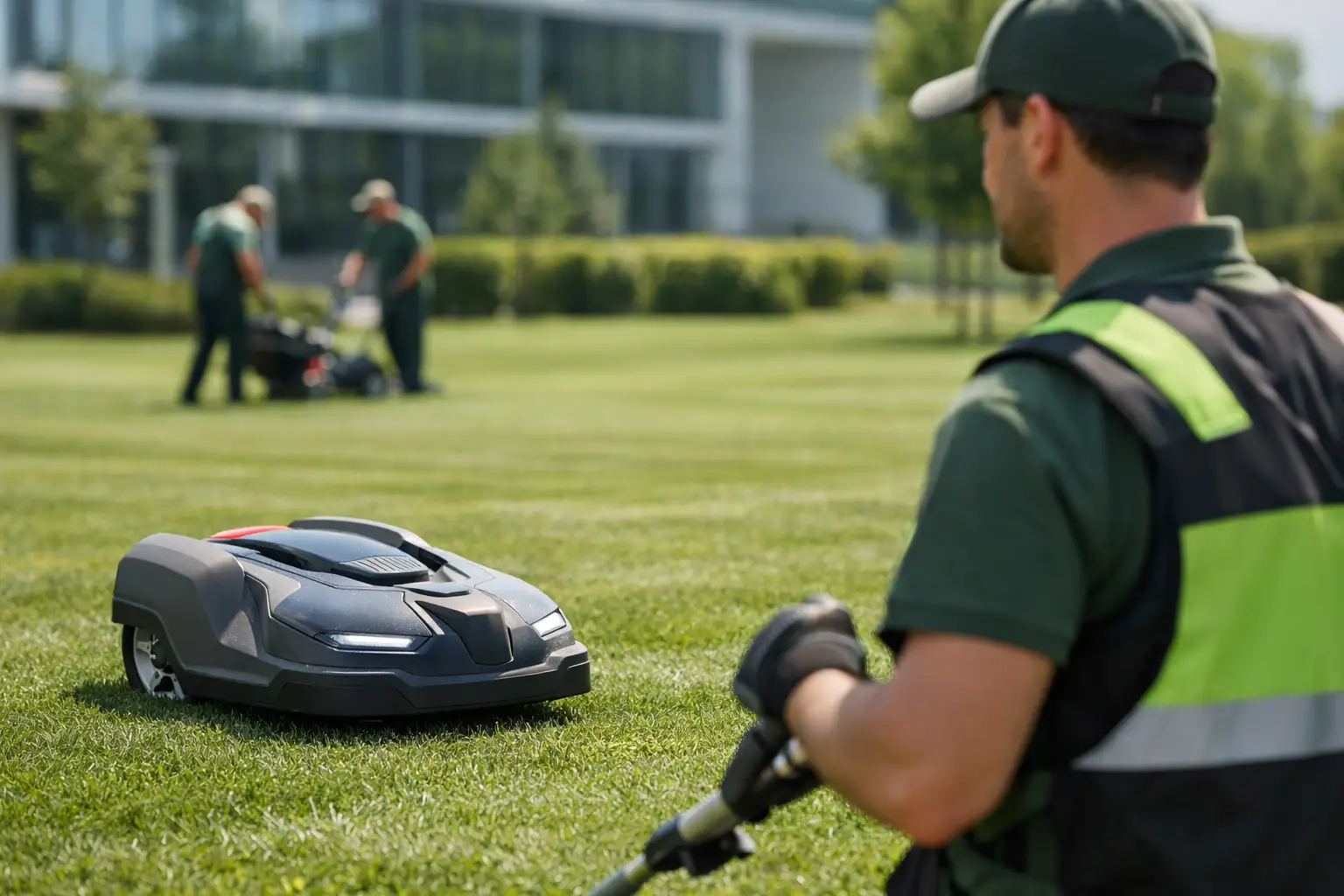
At 6am on a golf course or sports site, the labour question is rarely theoretical. It shows up as rota gaps, delayed first cuts, rising overtime and skilled staff spending hours on repetitive mowing instead of presentation, repair work and surface management. So, do autonomous mowers save labour? In professional turf environments, the short answer is yes – but not by making labour disappear. They save labour by changing where your team’s time goes, reducing repeat mowing hours and creating a more controlled, predictable maintenance operation.
Where autonomous mowing actually saves labour
The biggest labour saving comes from removing long stretches of routine mowing that have to be repeated day after day. Fairways, surrounds, rough, outfield areas and other large managed surfaces consume hours without necessarily requiring a skilled operator to sit on a machine for every pass. An autonomous mower takes on that repeatable workload and does it to a programmed standard.
For a course manager or grounds manager, that matters because labour is not simply about headcount. It is about skilled hours. If your best people are tied up cutting acreage for much of the week, they are not available for more valuable work such as bunker presentation, detail trimming, disease monitoring, divoting, line marking, irrigation checks or surface preparation ahead of play.
That is the real shift. Autonomous mowing reduces dependence on manual mowing hours and allows the same team to cover more ground without compromising standards. In many cases, it also reduces the operational pressure caused by sickness, holidays and the wider challenge of recruiting experienced turf staff.
Do autonomous mowers save labour in high-standard turf settings?
They can, provided the system is matched to the site and the mowing objective. Professional sites are not domestic lawns. Greens, tee boxes, fairways and marked pitches have clear quality expectations, and labour savings only count if the finish remains commercially acceptable.
On suitable areas, autonomous mowers save labour because they maintain frequency without requiring an operator on board. Instead of allocating staff to complete each cut manually, the mower continues to work within set boundaries and schedules. The result is a steadier maintenance rhythm. Turf is kept under control with less stop-start pressure on the team.
This is particularly valuable where daily or near-daily mowing frequency improves presentation and playing quality. Repeated light cutting often delivers a cleaner, more consistent finish than occasional heavier cuts, and automation makes that frequency easier to sustain.
That said, not every task should be handed to autonomy. Highly detailed presentation work, recovery after extreme weather, one-off renovation support and certain specialist finishes still benefit from direct operator input. The strongest labour model is usually a hybrid one, with autonomous mowing covering repeatable areas while skilled staff focus on the work that genuinely needs judgement.
Labour saving is not only about fewer hours on a mower
Many buyers initially frame the question too narrowly. They ask whether one robot replaces one operator. In practice, that is not how labour savings work in turf management.
The better question is whether autonomous mowing reduces the amount of staff time required to achieve your target standard across the whole site. In most professional settings, the answer is yes. A robot may not remove the need for people, but it can reduce machine hours, ease scheduling bottlenecks and improve labour efficiency across the week.
There is also a knock-on effect in planning. Manual mowing is vulnerable to interruptions. Staff are pulled onto other jobs, weather windows tighten, and large areas may be completed later than ideal. Autonomous mowing introduces more consistency into the programme. When cutting happens regularly and automatically, managers have greater confidence in what labour is available for the rest of the maintenance schedule.
That improved predictability can be as valuable as the direct hour saving. Teams become less reactive. Work can be organised around agronomy and presentation priorities rather than around whichever large mowing task is still outstanding.
Where the strongest savings usually appear
Large, repeatable areas tend to offer the clearest return. Fairways are an obvious example, as are sports outfields, training grounds, rough management zones and expansive formal turf around institutions or commercial estates. These areas often absorb significant labour because of their scale rather than their complexity.
On those sites, autonomous mowing can run for extended periods and maintain output without the fatigue, availability limits or scheduling conflicts that come with manual operation. That does not only save labour in direct wages. It can also reduce overtime, lower the need to redeploy experienced staff from higher-value tasks and support a leaner approach to seasonal workload peaks.
For golf and sports facilities, there is another operational benefit. Early morning mowing windows are often under pressure from fixture schedules, member expectations and play demands. Autonomous systems can help maintain cutting frequency without placing the entire burden on the earliest part of the day.
The trade-off: labour is reduced, not eliminated
There is no serious professional case for pretending autonomous mowing is labour-free. Machines still need oversight. Boundaries need to be planned correctly. Blades, batteries and wear components need attention. Site changes, seasonal growth patterns and surface conditions still require management.
However, the labour attached to an autonomous mower is different from the labour attached to a conventional mowing route. It is generally lower in volume and higher in control. Instead of assigning hours of operator time to every cut, you assign a smaller amount of time to supervision, optimisation and routine support.
That distinction matters financially. If a skilled operator spends three or four hours manually mowing a defined area, that is a fixed recurring labour cost. If an autonomous unit can maintain the same area with a fraction of that staff input, the labour profile changes materially over a season.
The more often a site repeats the same mowing task, the stronger that case usually becomes.
Why labour shortages make the answer more urgent
Across the UK, skilled grounds staff are not always easy to find or retain. This is one reason the question do autonomous mowers save labour has become more commercially relevant. For many operators, the issue is not only wage cost. It is labour availability.
If recruitment is difficult, autonomy offers a practical way to protect standards without depending on continual team expansion. Existing staff can be used more effectively, with less time spent on repetitive acreage mowing and more time dedicated to technical turf work, presentation detail and customer-facing quality outcomes.
For contractors, the value can be even sharper. Labour efficiency affects route planning, margins and contract capacity. If autonomous mowing reduces the hours needed on recurring sites, the same team may be able to service more area or protect margin against rising labour costs.
What determines whether the labour saving is worthwhile
The answer depends on five main factors: the type of surface, the size of the area, required finish quality, site complexity and current labour pressure.
A straightforward, repeatable site with regular mowing demand is usually a strong candidate. A fragmented site with constant obstacles, frequent temporary changes or very limited repeatable area may deliver a slower return. Equally, a venue with stable staffing and low mowing pressure may view the labour saving differently from one already stretched by vacancies and overtime.
Equipment selection also matters. Professional robotic systems designed for greens, fairways, sports pitches or larger managed turf environments are built around commercial performance expectations. Consumer-grade machines are not a useful benchmark for professional labour analysis.
This is where specialist providers such as GrassRobotics are positioned differently. The conversation is not about novelty or domestic convenience. It is about selecting autonomous turf-care systems that fit the operational demands of managed sports and amenity surfaces.
The stronger business case: labour plus consistency
Labour saving is often the entry point, but consistency is what makes the model stick. If an autonomous mower reduces hours while maintaining a dependable cut, the benefit compounds. Surfaces look more consistent, mowing frequency becomes easier to sustain and teams can spend more time on work that improves overall turf performance.
That combination is why professional adoption is growing. The value is not just that less labour is required to complete a mowing task. It is that the labour you still have can be used better.
For decision-makers, that is the practical answer. Yes, autonomous mowers do save labour, especially on repeatable, high-frequency mowing areas where manual cutting consumes skilled hours. The real gain is not replacing turf professionals. It is allowing them to focus on the work that actually needs their expertise.
If your site is under pressure to maintain standards with a tighter team, autonomy is no longer a future idea. It is a serious operational tool – and often a very sensible place to start is asking which mowing hours your staff should no longer need to spend.