
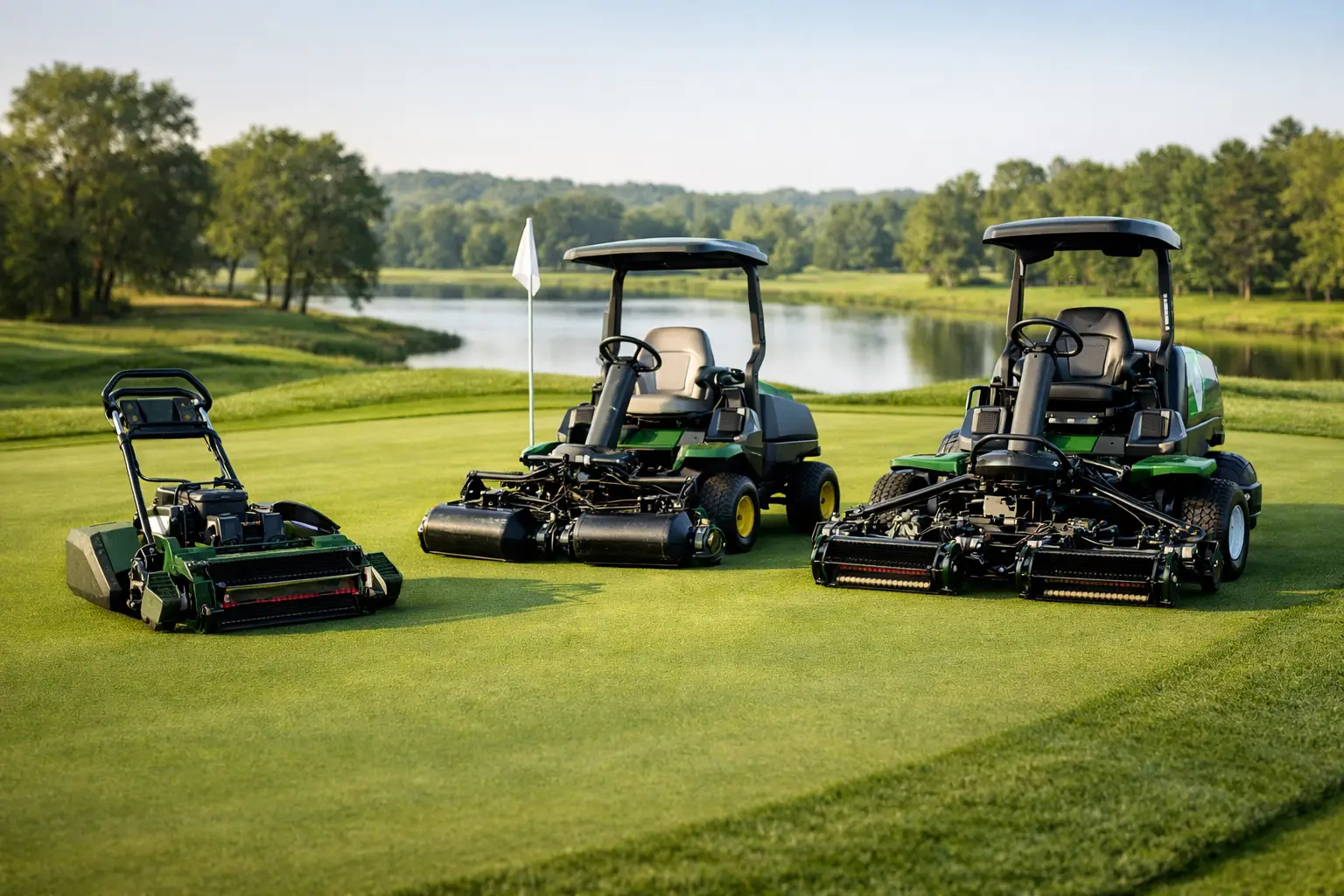
The best golf green mowing systems are no longer judged on cut quality alone. For most UK courses, the real question is whether a system can hold presentation standards while easing labour pressure, protecting playing surfaces and fitting the wider maintenance programme. That changes the buying decision. A mower that produces an excellent finish for two hours each morning may still be the wrong system if it depends on hard-to-source staff, creates avoidable set-up time or struggles to maintain consistency across the week.
For course managers and head greenkeepers, that is where mowing systems need to be assessed properly – as operational systems, not just individual machines.
What defines the best golf green mowing systems?
On greens, the margin for compromise is narrow. The surface has to be clean, consistent and predictable under play. That means the best golf green mowing systems combine three things: precision of cut, repeatability and practical fit within the maintenance operation.
Precision is obvious. The mower must follow the surface accurately, maintain a reliable height of cut and leave a uniform finish without excessive stress on the plant. Repeatability matters just as much. A high-performing system is one that delivers the same result on Tuesday as it did on Saturday, regardless of staff availability, shift timing or routine disruption.
The third factor is where many buying decisions become more complex. A green mowing system has to work around bunker work, hole changes, rolling, irrigation windows, disease pressure and tournament preparation. If the machine performs well on paper but creates friction in the daily schedule, it will not deliver full value.
Why the old comparison no longer tells the full story
Traditionally, courses compared pedestrian cylinders against ride-on units, looking at finish, speed and operator preference. That comparison still matters, but it is no longer enough. Labour constraints have become a decisive issue. Many facilities are carrying the same or higher presentation expectations with smaller teams, tighter recruitment conditions and more pressure to prove productivity.
That is why autonomous and robotic equipment is moving from interest to serious consideration. It is not replacing agronomic judgement. It is reducing dependence on repetitive manual mowing hours and allowing skilled staff to focus on tasks where human input adds the most value.
This is the key shift in the market. The best system is not always the one with the highest peak performance under ideal conditions. It is often the one that maintains standard most reliably across a full season.
Main types of golf green mowing systems
Pedestrian cylinder systems
Pedestrian cylinder mowers remain the benchmark for many clubs because they offer close control and a finish that experienced operators trust. For championship presentation, they still have a strong place. They are especially useful where green size, contour complexity or surface sensitivity demand careful handling.
The trade-off is labour. Pedestrian mowing takes time, requires trained staff and can become difficult to sustain consistently when absences or seasonal pressures hit. Output is also tied directly to operator availability, which makes resilience a problem for some sites.
Ride-on greens mowers
Ride-on systems improve productivity and can help larger operations cover more ground in a shorter window. On courses with numerous greens, large walk distances or compressed morning schedules, that gain can be significant.
The balance to consider is surface impact and presentation preference. Some teams prefer the touch and precision of pedestrian units on finer greens, particularly during sensitive periods. On the right site, ride-on mowing is highly effective. On the wrong site, it may solve one operational problem while creating a quality concern.
Robotic and autonomous mowing systems
Robotic systems are now a credible option for professional turf care, especially where labour efficiency and consistency are driving priorities. The strongest systems are designed for commercial and institutional use rather than domestic lawns, with the accuracy, reliability and build quality expected on managed sports turf.
Their value is straightforward. They can maintain routine cutting with repeatable precision, reduce manual mowing hours and support a more stable maintenance schedule. That does not remove the need for skilled greenkeeping. It changes how labour is deployed.
For greens and closely managed areas, the quality of the system matters. Professional buyers should look beyond the word “robotic” and assess whether the equipment is genuinely built for fine turf standards, not general grass reduction.
How to compare systems in practice
Start with labour, not just machinery
If labour is currently the constraint, that should shape the whole evaluation. A course with reliable staffing and established routines may decide that conventional mowing still offers the right balance. A site facing persistent shortages may find that an autonomous system delivers value faster than expected because it protects standards when staffing is under pressure.
This is where return on investment becomes more realistic. It is not only about wages saved. It is also about avoided disruption, reduced overtime pressure and the ability to maintain quality through peak demand periods.
Match the system to the surface standard
Not every green presents the same requirement. Some venues are preparing for member play with strong everyday consistency as the priority. Others are managing tournament expectations where clipping yield, speed control and visual striping may all carry more weight.
The best golf green mowing systems are the ones matched to that reality. A highly automated set-up can be an excellent fit where consistency and operational efficiency are the priority. A more manual approach may still suit clubs chasing a very specific presentation outcome under close supervision. Often, the right answer sits between the two, with automation supporting selected areas while conventional equipment remains part of the programme.
Consider the wider site, not only the greens
Buying decisions improve when greens are viewed as part of the whole course operation. If the same supplier or technology platform can support greens, tees, surrounds or fairways, the value case becomes stronger. Standardisation simplifies planning, training and service support.
This is one reason specialist providers such as GrassRobotics are gaining attention in the sector. The conversation is not centred on a single machine. It is about building an autonomous turf-care approach that works across different maintained areas while keeping professional standards intact.
Where robotic systems make the strongest case
Robotic mowing tends to make the strongest case on courses where the pressure points are already clear. That includes sites with limited labour depth, multi-course operations, contractor-led maintenance models and venues trying to improve consistency without continually increasing staffing costs.
It is also compelling where presentation windows are tight. Autonomous mowing can take routine cutting pressure out of the morning set-up, freeing staff for detail work, course set-up and reactive tasks. That shift matters because many teams are not short on expertise – they are short on hours.
There are, however, conditions to assess honestly. Site layout, access control, charging logistics, operational oversight and the quality expectation of the club all influence suitability. Robotic systems are practical tools, not magic fixes. The best results come when they are specified properly and integrated into the maintenance plan with clear intent.
Common mistakes when choosing a green mowing system
One common mistake is buying purely on unit price. Lower capital cost can look attractive until labour, downtime or inconsistent results are factored in. For professional turf managers, total operating value is the more useful measure.
Another is treating automation as an all-or-nothing change. In reality, many successful transitions happen in stages. A course might automate selected areas first, prove the workflow, then expand coverage once the operational benefit is clear.
A third mistake is focusing too heavily on brochure specifications and too lightly on use case. Width of cut, battery duration and stated output all matter, but they matter in context. Contours, green access, traffic patterns and the standard expected by members or paying visitors are what determine whether a system truly fits.
The right question to ask before you buy
Instead of asking which machine is best in absolute terms, ask which system will maintain your required standard with the least operational strain. That is usually the better commercial question. It connects mowing quality to staffing, scheduling and resilience, which is where long-term value is really created.
For some courses, that answer will still point to conventional cylinder mowing supported by skilled operators. For others, especially where labour reduction and dependable consistency are now central, autonomous equipment will be the stronger choice.
The market is moving because course operations are moving. Standards remain high, but the route to achieving them is changing. The best golf green mowing systems are the ones that bring precision and productivity together without asking your team to carry avoidable pressure. If a mowing system gives your staff more time for the work that actually improves the course, it is already doing more than cutting grass.