
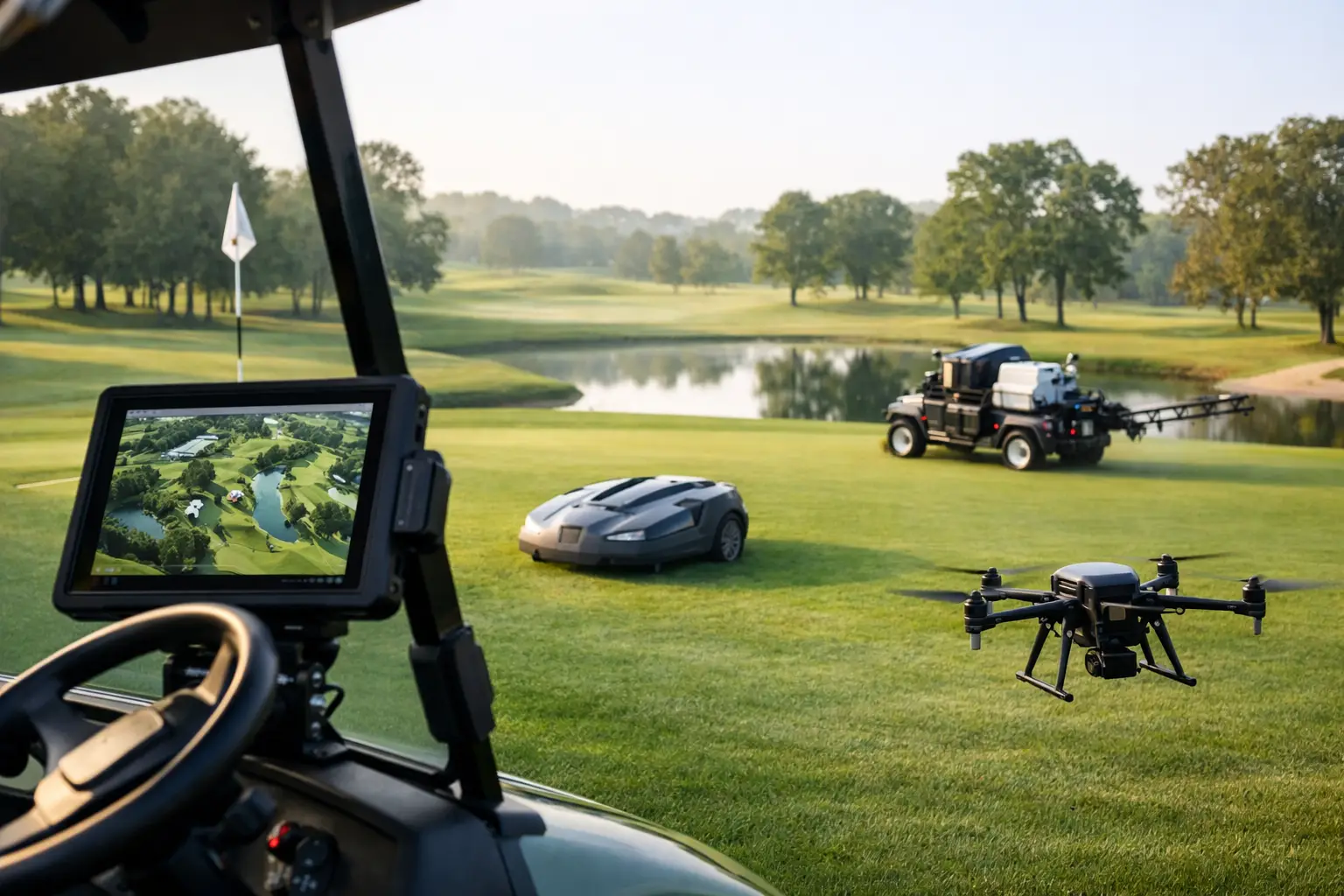
At 5.30am, before the first fourball reaches the 1st tee, the real pressure on a golf course is rarely the grass alone. It is labour allocation, machine availability, weather timing, and the daily question of whether standards can be held without stretching the team too far. That is why a golf course automation case study matters. It turns automation from a talking point into an operational decision.
For golf facilities across the UK, the case for robotic mowing is not built on novelty. It is built on repeatable cut quality, reduced labour dependency, longer productive windows, and a more predictable approach to turf presentation. The strongest results come when automation is applied with a clear understanding of where it fits, where it does not, and how it changes the working week for the greenkeeping team.
What this golf course automation case study is really measuring
The most useful way to assess automation is not to ask whether a robotic mower can replace a member of staff. In a professional golf setting, that is the wrong question. The better question is whether autonomous mowing can take over routine, repetitive cutting tasks to release skilled staff for higher-value work.
On a typical 18-hole course, labour pressure tends to collect around fairways, approaches, surrounds, tees, and rough management. Greens often remain the most tightly controlled area, particularly where presentation standards are exacting and site conditions vary across the day. That means automation should be judged by surface type, frequency requirement, and the operational cost of maintaining consistency.
In practice, a well-planned robotic deployment often delivers the clearest gains on fairways, semi-rough, tee complexes, and selected surrounds. These are the areas where repetitive mowing consumes time, yet consistent presentation has a direct effect on perceived course quality.
Starting point: the operational challenge
Consider a mid-sized UK golf club with an 18-hole course, a modest greenkeeping team, and familiar constraints. Labour is competent but stretched. Recruitment is difficult. Absence cover is limited. Peak season standards are expected to rise just as maintenance windows become tighter.
Before automation, fairway and tee mowing may absorb a substantial portion of the weekly schedule. Staff who should be focused on detail work, course set-up, irrigation checks, bunker presentation, or agronomic tasks are instead tied to routine cutting. The result is not always poor quality. More often, it is inconsistency. Some areas are cut exactly when needed, others when labour becomes available.
That inconsistency carries a cost. Presentation slips first, then productivity, then team morale. When mowing becomes reactive, the rest of the maintenance plan starts to drift with it.
The automation model
A realistic automation model does not attempt to put one machine everywhere. It allocates autonomous equipment to surfaces where frequency, precision, and labour release combine to create a measurable return.
For example, robotic rotary or cylinder solutions can be assigned to fairways, approaches, tees, or greens depending on specification and site requirement. The key point is that the mower is not simply doing the same job at the same time as a conventional machine. It is operating on a planned cycle that maintains a more constant finish.
That has two immediate effects. First, clipping volume is reduced because grass is maintained more continuously rather than being taken back in larger intervals. Second, visual consistency improves because the surface is not moving between too-long and just-cut conditions.
For golfers, that means a neater, more uniform course. For the course manager, it means fewer compromises in the daily plan.
Results from a golf course automation case study
The first measurable outcome is labour reallocation. On many sites, automation will not reduce the need for skilled greenkeepers. It changes how those hours are used. Routine mowing time can be redirected into course detail, seasonal renovation support, drainage attention, bunker edging, or presentation standards that are often delayed during busy periods.
This is one of the most commercially significant gains. Labour remains one of the hardest inputs to stabilise. If autonomous mowing can reduce dependence on repetitive machine hours, the team becomes more resilient. holidays, sickness, and recruitment gaps still matter, but they stop threatening the whole cutting schedule.
The second outcome is consistency. Human-operated mowing quality depends on available hours, operator variation, and machine scheduling. Autonomous systems are better at repetition. On the right surface, that repetition supports a more even appearance and a tighter maintenance rhythm.
The third outcome is equipment productivity. Conventional fleet pressure often falls when selected areas move to autonomous management. That can extend the useful life of other machinery, reduce bottlenecks in the morning set-up window, and lower fuel use depending on the site mix.
There is also a quieter but important benefit in noise profile and timing flexibility. Electric robotic mowing can allow work to be carried out at times that would be less practical with conventional diesel equipment. That does not solve every scheduling issue, but it creates more room around play and staff workload.
Where the numbers usually stand up
The commercial case tends to be strongest where three conditions are present. The first is a high frequency mowing requirement. The second is difficulty in covering routine labour consistently. The third is a course layout that allows defined autonomous working zones.
Where those conditions exist, cost savings do not need to come only from headcount reduction. In many cases, they come from avoided overtime, lower contractor reliance, improved staff utilisation, and fewer compromises in course presentation. That distinction matters because many golf clubs are not looking to cut teams to the bone. They are looking to maintain standards without constantly firefighting.
It is also worth being clear about timescale. Automation usually makes the best financial sense over multiple seasons, not a single month. Initial setup, route planning, charging infrastructure, site mapping, and team familiarisation all require proper implementation. The return improves when the system becomes part of the maintenance model rather than an add-on at the margins.
Where automation needs careful judgement
Automation is not a blanket answer for every course and every surface. Steep gradients, highly fragmented areas, intensive public interaction, and awkward access routes can all affect suitability. Greens, in particular, require careful evaluation. Some sites will be well suited to autonomous greens mowing. Others will prefer a more selective rollout focused on fairways, approaches, or tees first.
There is also a management trade-off. Robotic mowing reduces routine operator time, but it increases the importance of planning, monitoring, and site discipline. Boundary integrity, machine security, charging logistics, and workflow integration all need to be thought through properly.
That does not make the system complex for its own sake. It means professional deployment matters. Consumer-grade assumptions do not belong on a golf course. Equipment must be matched to turf standard, area size, cut requirement, and site layout.
What successful adoption looks like
The best implementations usually start with a specific problem, not a broad ambition to modernise. A course manager may want to release labour from tee mowing. Another site may need more reliable fairway presentation during peak season. Another may be dealing with chronic recruitment pressure and wants a more stable operating model.
From there, the rollout should be measured. Identify the surfaces with the highest repeat mowing burden, assess navigation and infrastructure requirements, and define what success looks like in operational terms. That might be saved labour hours, tighter visual consistency, improved morning readiness, or reduced use of a conventional unit.
This is where a specialist supplier adds value. The right recommendation is not the biggest machine or the most ambitious automation footprint. It is the solution that fits the course, the team, and the standard expected by members and visitors.
For UK operators, the strongest case studies are the ones grounded in daily reality. Can the system handle the workload? Does it improve the finish? Does it give the team time back where it matters? If the answer is yes, automation stops being a future project and becomes part of present-day course management.
GrassRobotics focuses on that practical end of the market – autonomous turf care that is specified for professional performance, not showroom effect.
Why this matters now
Golf facilities are being asked to do more with tighter labour availability and little tolerance for visible decline in standards. That pressure is not going away. Automation is one of the few changes that can improve consistency and productivity at the same time, provided it is deployed with discipline.
A good golf course automation case study does not promise that robotics will solve every maintenance challenge. It shows something more useful. It shows where autonomy can take pressure out of the system, protect presentation, and give experienced turf professionals more control over how their time is spent.
That is the real value. Not replacing judgement, but giving it more room to work.