
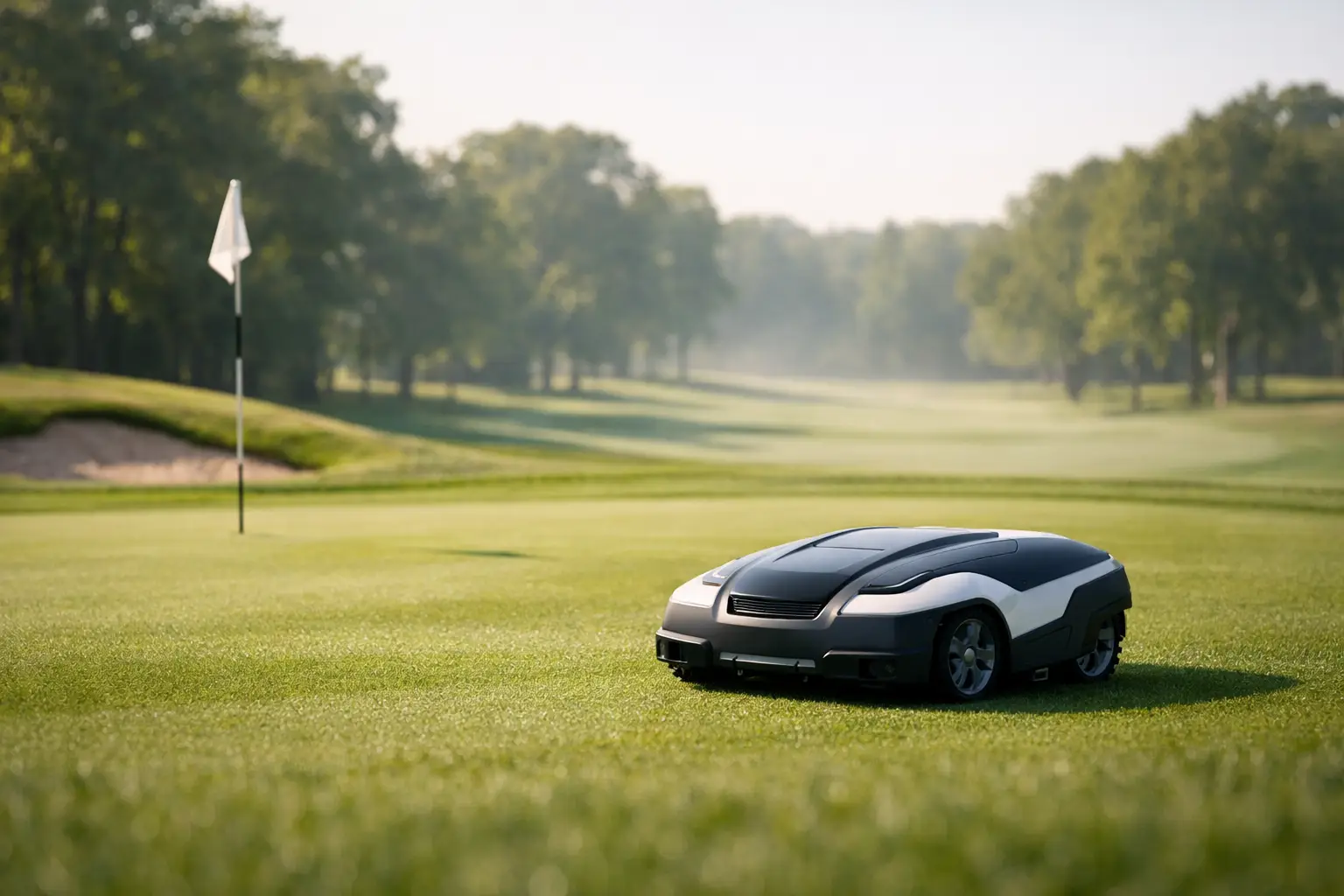
A missed cut on greens shows immediately. When labour is tight, weather windows are short and presentation standards stay high, the question is no longer whether automation belongs on a golf course. It is whether a robot mower for golf greens can meet the standard your team, your members and your surfaces demand.
The short answer is yes, but only in the right setting and with the right expectations. Greens are the most exacting turf area on the course. They expose any weakness in cut quality, consistency, tracking or machine setup far faster than fairways or rough. That is why robotic mowing for greens needs to be assessed as a professional turf-care system, not as a simple labour-saving gadget.
What a robot mower for golf greens needs to do well
A greens mower is judged on outcome, not novelty. If a robotic unit is going to earn its place in the maintenance plan, it has to deliver a clean, consistent finish at the target height of cut while fitting around existing course operations.
That means three things matter most. First, cut quality has to be reliable across repeated passes and changing conditions. Second, navigation has to be precise enough to manage defined green shapes without leaving untidy margins or excessive overlap. Third, the machine has to support the wider programme rather than disrupt it, whether that programme includes hand mowing, rolling, verticutting, topdressing or renovation work.
On greens, consistency often carries more value than outright speed. A robotic system that cuts little and often can help maintain presentation and reduce peaks and troughs in growth management. That is one of the strongest cases for autonomy. Instead of relying on a shrinking labour pool to hit every green at exactly the right time, the course can maintain a more stable cutting routine.
Where robotic mowing adds value on greens
The operational case is usually stronger than the novelty case. Most golf facilities are managing some combination of labour shortages, rising input costs and pressure to maintain standards with less room for error. In that environment, robotic mowing starts to look less like experimentation and more like capacity.
A robot mower for golf greens can reduce dependence on early-morning staffing for repetitive mowing cycles. It can free experienced greenkeeping staff for more skilled tasks such as setup, agronomy, presentation detail and reactive maintenance. That matters because high-value labour should not be tied up solely in repeat cutting when automation can handle part of that workload.
There is also a consistency benefit that is easy to overlook. Human-operated mowing is only as consistent as staffing levels, shift patterns, fatigue and time available. Robotic mowing does not eliminate the need for skilled operators, but it can reduce variation in frequency and routine. On greens, that steadiness can support presentation and playing performance, especially in periods of strong growth.
Noise and timing can also work in robotics’ favour, depending on the machine and site constraints. Some courses can use autonomous mowing windows that are harder to cover with conventional equipment, helping teams spread workload without extending pressure on staff.
The limits of a robot mower for golf greens
There is no value in pretending every green is an ideal robotic application. Some are. Some are not.
Complex green surrounds, narrow access points, steep undulations, intense member traffic and highly variable surface conditions can all affect suitability. If a course expects one robotic unit to replace every aspect of greens mowing in every condition, disappointment is likely. The better approach is to assess where autonomous mowing can deliver measurable gains and where conventional methods still have the edge.
Cut quality remains the critical test. For greens, the machine must be judged against the standard your course is trying to achieve, not against a lower benchmark borrowed from general amenity mowing. If the objective is tournament-level presentation every day, system choice and deployment need to reflect that. If the objective is to protect quality while reducing labour strain across a busy schedule, robotics may prove particularly effective.
There is also the question of workflow discipline. Robotic mowing works best when the site is prepared for it. That includes clear operating plans, sensible access arrangements, reliable charging or docking logic and a team that understands how autonomy fits into the maintenance operation. A poorly integrated machine can create friction. A well-integrated one can remove it.
How to assess if your greens are suitable
The first step is not product comparison. It is site assessment.
Look at green size, shape and repeatability. Uniform greens with predictable access and manageable boundaries are generally easier to automate. That does not mean irregular greens are excluded, but they demand more from the system and from the deployment plan.
Next, consider surface expectations across the season. If green speeds, clipping volumes and daily presentation targets shift significantly through the year, the robotic mowing strategy needs enough flexibility to respond. Some courses may use autonomous mowing as a primary method in stable periods and a supporting method during peak stress or event preparation.
Then review labour structure. If your team is losing time every morning to repetitive mowing that prevents attention elsewhere, that is often where the return appears first. The best result is not simply fewer labour hours on paper. It is more productive use of skilled staff on the tasks that genuinely require judgement.
Finally, think about integration rather than replacement. Robotic mowing can sit alongside existing equipment and practices. For many professional sites, that is the practical model. Greens are too important for all-or-nothing thinking.
Why professional-grade equipment matters
This is where many assumptions go wrong. A consumer robot and a professional autonomous mower may both be called robotic mowers, but the comparison ends quickly once you look at turf expectations, operating demands and output standards.
Golf greens require equipment built for managed turf, repeat use and precision performance. Navigation accuracy, machine stability, cut system design and operational reliability all matter far more here than they would in a domestic setting. A machine designed for ornamental lawn care is not a credible answer for golf performance surfaces.
Professional buyers should also look beyond the mower itself. Support, commissioning, setup advice and sector understanding are part of the decision. Courses are not buying novelty hardware. They are investing in a turf-care process. That is why specialist suppliers such as GrassRobotics position robotics as a professional maintenance solution tied to outcomes like consistency, productivity and reduced labour reliance.
What success looks like in practice
Success is not simply seeing a machine move across a green. It is seeing better control of the mowing programme with less operational strain.
On the right site, that can mean more frequent cutting without increasing labour pressure. It can mean fewer compromises when staff are pulled onto bunker work, irrigation issues or tournament preparation. Also it can mean maintaining standards through staffing gaps that would otherwise force difficult decisions.
It may also mean a more scalable approach across the wider course. Once a facility proves autonomous performance in a high-standard area, the discussion often expands to tee boxes, approaches, fairways or surrounding managed turf. That broader value matters because golf operations rarely have only one pressure point.
At the same time, success depends on realistic deployment. Some courses will use robotics daily. Others will use them selectively, supporting conventional greens mowing rather than replacing it outright. The right answer depends on the site, the standard and the operating model.
The real question is not whether it works
Robotic mowing on golf greens is already credible. The more useful question is whether it works for your surfaces, your labour structure and your maintenance objectives.
If your course needs to protect presentation while reducing reliance on increasingly hard-to-source labour, a robot mower for golf greens deserves serious attention. If your greens demand absolute flexibility in every weather shift and every tournament window, the role may be more targeted. Either way, the decision should be made on performance, not assumption.
For professional golf operations, automation is most valuable when it is treated as a practical upgrade to turf maintenance. When the equipment is right and the deployment is disciplined, robotics can add precision, release labour capacity and help maintain the standard players expect. That is the point worth focusing on as the pressure on course maintenance teams continues to rise.