
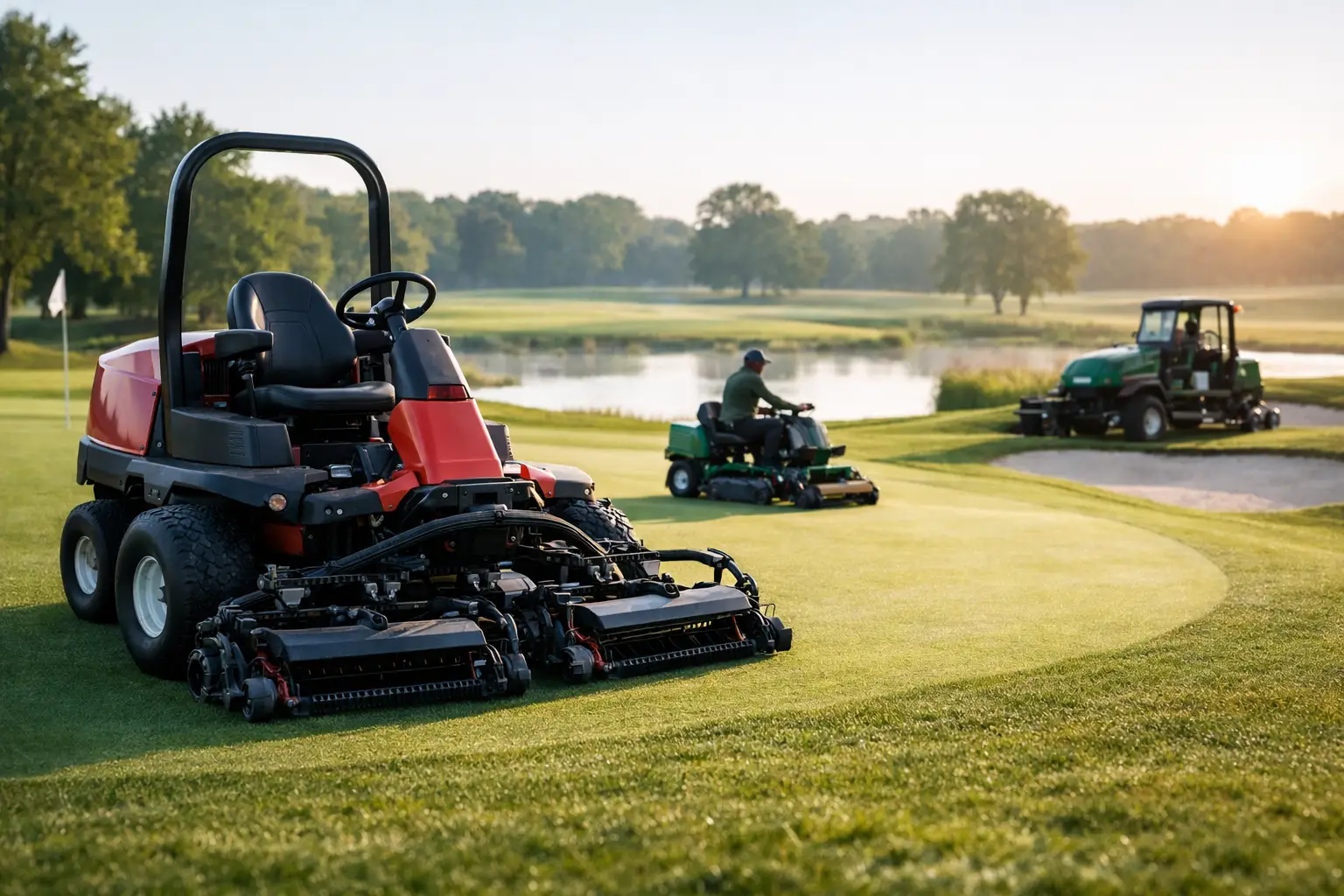
Walk behind a greenkeeping team at first light and the answer to what mowers do golf courses use becomes obvious quite quickly – not one mower, but a fleet. A golf course is a mix of very different surfaces, each with its own height of cut, presentation standard, clipping volume and tolerance for traffic. Greens demand a different machine from fairways, tees, collars or rough. That is why serious golf maintenance has always relied on specialist equipment rather than a one-size-fits-all approach.
For course managers and head greenkeepers, the more useful question is not simply what machine is used, but why that machine is chosen for that surface, that programme and that labour model. The mower has to match turf expectations, site scale, operator availability and the standard the club is selling every day.
What mowers do golf courses use on each area?
On greens, golf courses typically use pedestrian or ride-on cylinder mowers. These machines are built to deliver a very precise, clean cut at low heights, which is essential for ball roll, pace and surface uniformity. A cylinder cutting unit shears the grass cleanly, making it the standard choice where finish matters most. On high-performance greens, that precision is non-negotiable.
Tees and approaches are also commonly maintained with cylinder mowers, although the machine format may vary depending on site size and labour resource. Some courses use dedicated ride-on units to cover more ground efficiently, while others favour pedestrian machines where tighter control or surface sensitivity is a priority. The principle is the same – accuracy, consistency and a refined finish.
Fairways are usually cut with larger ride-on reel or cylinder mowers designed for productivity across wider areas. These machines often carry multiple cutting heads to maintain striping quality while covering substantial acreage within a practical working window. Fairway mowing is where presentation and output meet, so unit width, follow-ground performance and transport efficiency all matter.
Semi-rough and rough are more likely to be managed with rotary mowers or heavy-duty flail and rough-cut systems, depending on the finish required. Rotary machines are typically used where clipping volume is higher and the visual standard is less exacting than on closely mown areas. They offer throughput and resilience, particularly in strong growth periods or where the terrain is less forgiving.
That mix of machinery is the traditional answer. Increasingly, though, there is another layer to it: robotic and autonomous mowing systems deployed alongside or instead of conventional equipment on selected golf surfaces.
Why golf courses do not use one mower for everything
Every part of a course is maintained to a different purpose. Greens are about trueness and pace. Fairways need definition, consistency and efficient area coverage. Rough needs control, not tournament-level finish. The machine specification follows that reality.
Height of cut is one reason. A mower set up for greens cannot simply be redeployed to rough, and a rough mower will never produce the finish required on a green or tee. Ground-following ability is another. Golf surfaces are contoured, and inconsistent contact creates scalping, washboarding or missed grass. Then there is clipping management, operator comfort, turning behaviour, weight distribution and daily output.
This is why the question what mowers do golf courses use is really about system design. Most courses operate a mowing strategy, not just a set of machines. The best results come from matching equipment to playing surface, labour availability and maintenance goals rather than chasing a single machine that promises to do too much.
Cylinder vs rotary – the key difference
For professional buyers, the main distinction is straightforward. Cylinder mowers are used where cut quality is the priority. Rotary mowers are used where productivity, versatility and tolerance of variable conditions are more important.
Cylinder cutting is preferred on greens, tees and many fairways because it delivers a sharp, scissor-like action and a superior finish at lower heights. It is the established standard for fine turf. The trade-off is that cylinder units demand proper setup, regular grinding and closer attention to adjustment if they are to perform consistently.
Rotary mowing is more forgiving in heavier growth and less formal areas. It handles volume well and is often simpler in broader utility roles. The trade-off is finish. Even a very good rotary machine is not the first choice where the surface has to present to a high golfing standard.
For many courses, both technologies remain necessary. The decision is less about which is better in absolute terms and more about where each fits in the maintenance plan.
Where robotic mowing now fits
Autonomous mowing is no longer a fringe idea on golf sites. It is becoming a practical response to a familiar operational problem: maintaining consistent standards when labour is expensive, scarce or stretched across too many tasks.
Robotic mowing works particularly well where repeatability matters. Fairways, surrounds, approaches, tees and selected rough areas can all benefit from consistent, frequent cutting with minimal manual input. Instead of sending a machine out for an occasional heavier cut, robotic systems maintain the surface continuously at the target range. That changes turf behaviour. Clipping volumes are lower, presentation is more even, and the course avoids the peaks and troughs that come with missed mowing windows.
This matters in the UK climate, where weather disruption is routine and labour planning is rarely straightforward. A robotic mower does not solve every maintenance challenge, but it can take a large, repetitive workload out of the daily schedule. That allows trained staff to focus on set-up, irrigation, course detail, bunker work and agronomic tasks that need judgement rather than repetition.
For decision-makers, that is the real value. Autonomy is not about replacing standards with convenience. It is about protecting standards when the pressure on labour and time keeps increasing.
What mowers do golf courses use now compared with five years ago?
Five years ago, the answer would have been almost entirely conventional: pedestrian cylinders for greens, triplex or ride-on cylinders for tees and fairways, and rotary units for rough. That setup still exists, and on many courses it will remain the backbone of maintenance for some time.
What has changed is the willingness to integrate autonomous equipment into professional turf operations. Courses are now evaluating mowers not only by cut quality and purchase price, but by labour displacement, run hours, consistency of presentation and ability to maintain surfaces outside staffed working hours.
That shift is especially relevant on larger sites, labour-constrained operations and venues where appearance has to stay high even when staffing is under pressure. Robotic systems are also being considered more seriously because they are now designed for professional use cases rather than domestic lawns. That distinction matters. Commercial golf environments need reliable navigation, repeatable performance and machine design suited to managed turf, not consumer-grade autonomy dressed up as innovation.
How courses choose the right mower mix
No two golf sites are identical, so the right answer depends on scale, layout, surface expectations and staffing structure. A members’ course with modest acreage and a stable team may prioritise dependable conventional machinery with targeted automation. A larger resort or high-output venue may gain more from autonomous fairway or tee mowing where the time savings are significant.
Terrain also matters. Narrow corridors, complex bunkering, tree cover and fragmented mowing zones can influence whether a machine is practical on a given area. So can presentation expectations. If a club wants strong striping and a highly formal finish on key playing surfaces, the machine choice needs to support that outcome rather than just reduce labour hours.
Then there is service planning. Conventional fleets require trained operators and routine workshop attention. Robotic fleets reduce operator dependency but introduce a different operating model based on mapping, charging, scheduling and site integration. Neither approach is automatically right in every case. The best result usually comes from combining the two where each has the strongest operational fit.
That is why solution-led specification matters more than ever. Professional buyers are not just purchasing a mower. They are choosing how the course will be maintained across the season, under real staffing conditions, with real pressure on budgets and standards.
The future of golf mowing is mixed, not one-directional
The short answer to what mowers do golf courses use is still this: golf courses use cylinder mowers for fine turf, rotary machines for longer grass, and increasingly robotic mowers where autonomy can improve consistency and reduce labour pressure. The longer answer is that the most effective courses are building a mixed fleet around surface requirements, not habit.
That opens up a more practical conversation. The question is no longer whether autonomous mowing belongs on a golf course. It is where it delivers the strongest return, where conventional equipment still leads, and how both can work together to raise standards while reducing operational strain. For many UK courses, that is already moving from theory into day-to-day practice.
If you are reviewing machinery plans for the next few seasons, it is worth looking beyond the headline machine type and focusing on the workload behind it. The mower that makes the most difference is often the one that gives your team more time to protect playing quality where it matters most.